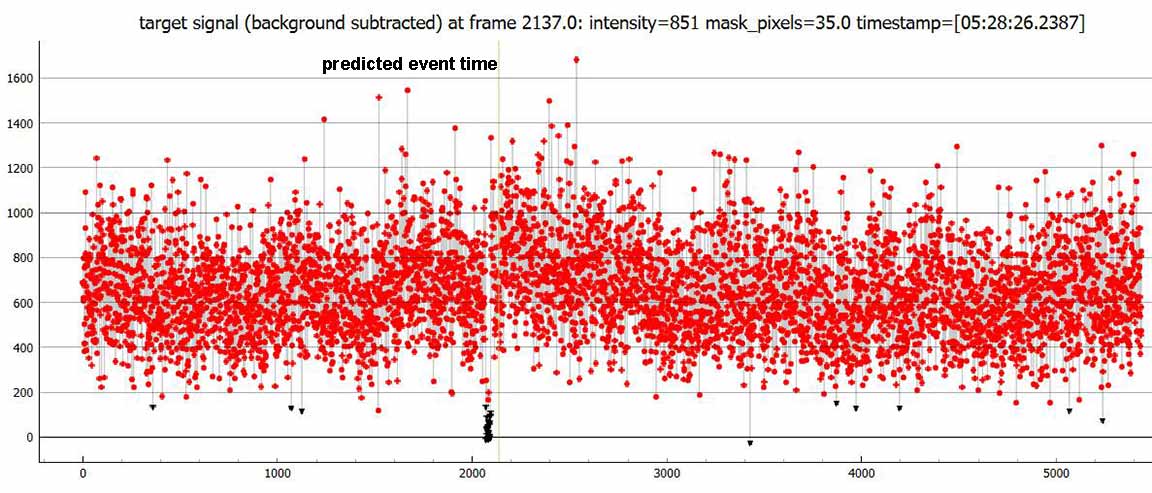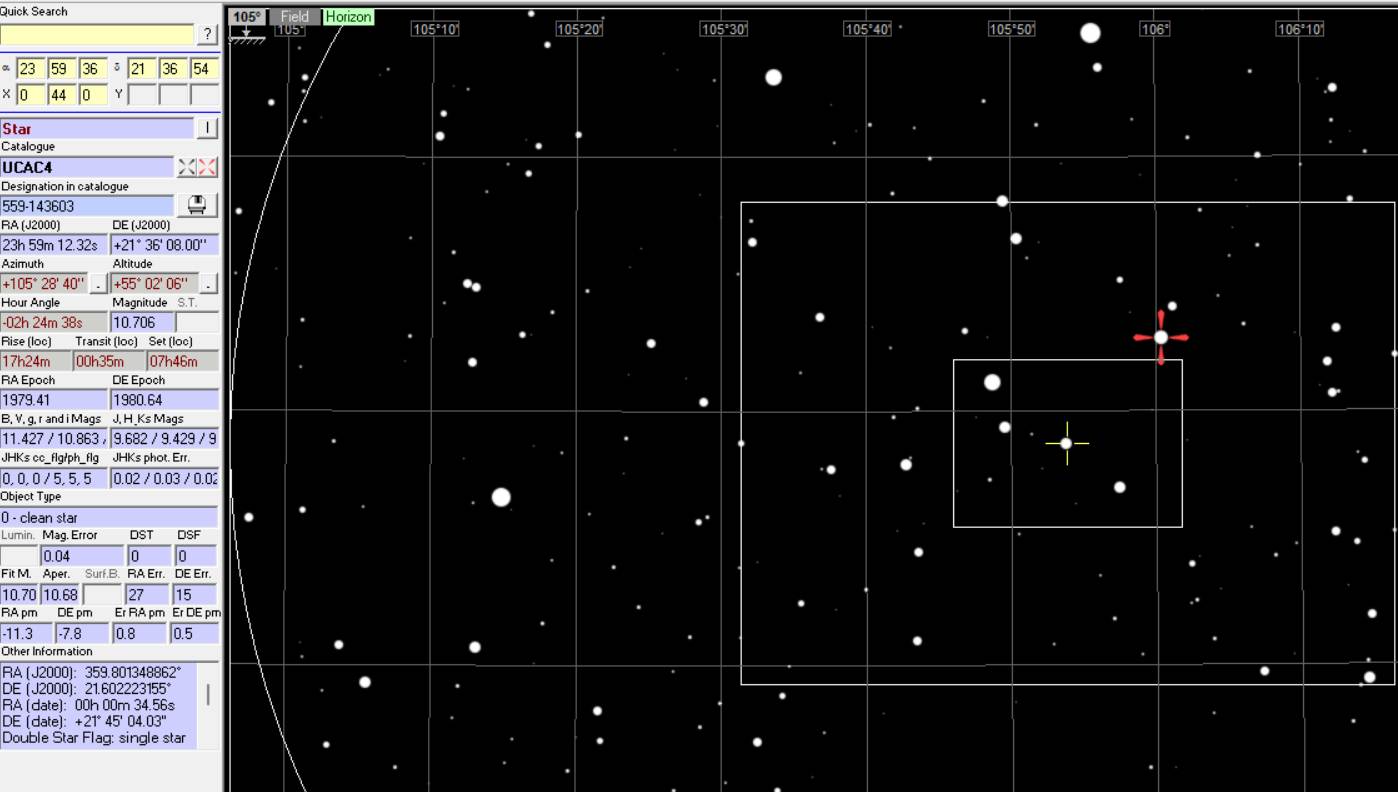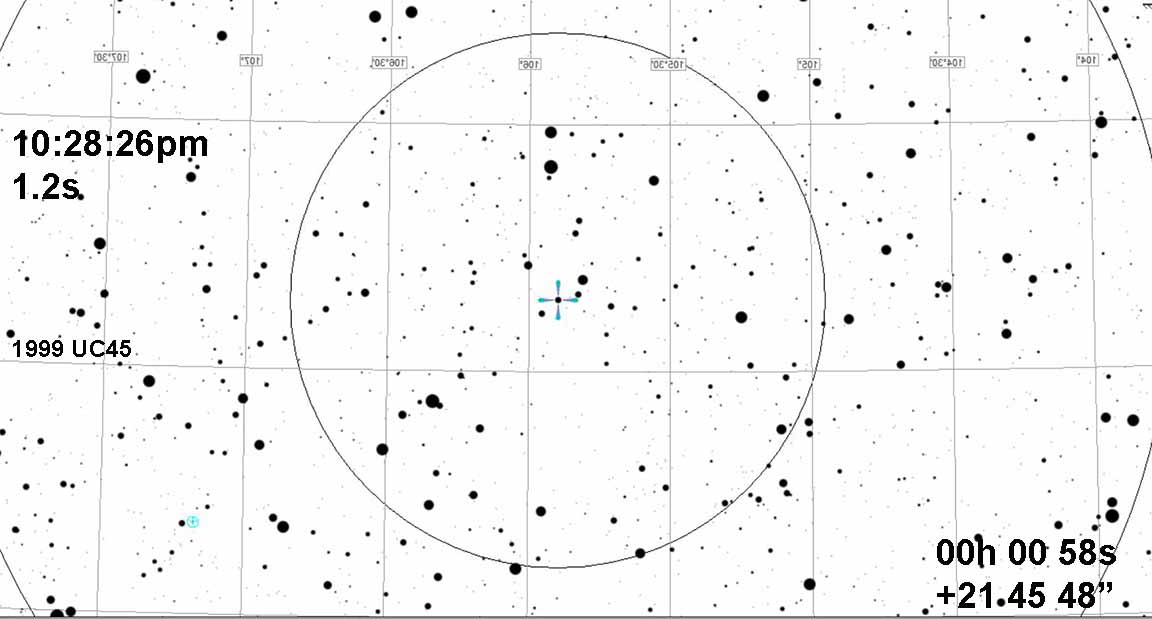
Bright event. But RUWE =1.65 which is not great for the star position, so path not as high rank as it looks on OWc. Karl's well positioned. I'm closing up at Cabrillo Observatory or maybe I'll turn people loose early so I can get above the fog??
Alt=59, Az=110 in Pegasus, 45 deg from the gibbous moon
|
|
We had clear skies and were getting great photos from our new modern cameras, so no leaving early. I stayed late, and decided I'd guard the southern limit while Karl guarded the north, and Kirk wasn't far north of me. It was better spacing for better science. And, I got lucky and the path did shift south so I had a solid event.
I got two recordings, both from the same Watec 910hx PAL I normally use. One output went to the ZR45mc camcorder, and the other to the Startech and Lenovo computer. The goal was to see how the S/N's compared for these two different methods. I observed at 2x from outside the dome building at Cabrillo Observatory, under clear skies with some moonlight but not near the target. I got a positive, 2 seconds early. Was this due to the high RUWE of the target star? I applied median filtering in horizontal and vertical directions.
First reduction is for the Startech / Lenovo recording...
start: 5:27:01 UT
End: 5:30:38 UT
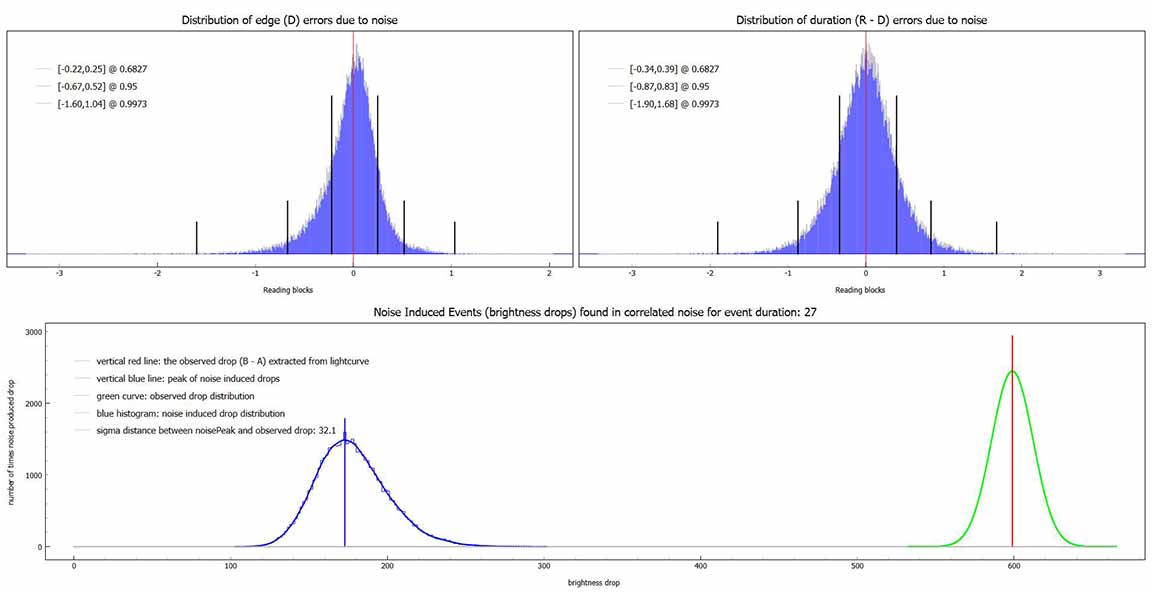
NIE test; 32.1 sigma
magDrop report: percentDrop: 91.5 magDrop: 2.679 +/- 0.518 (0.95 ci)
DNR: 2.97
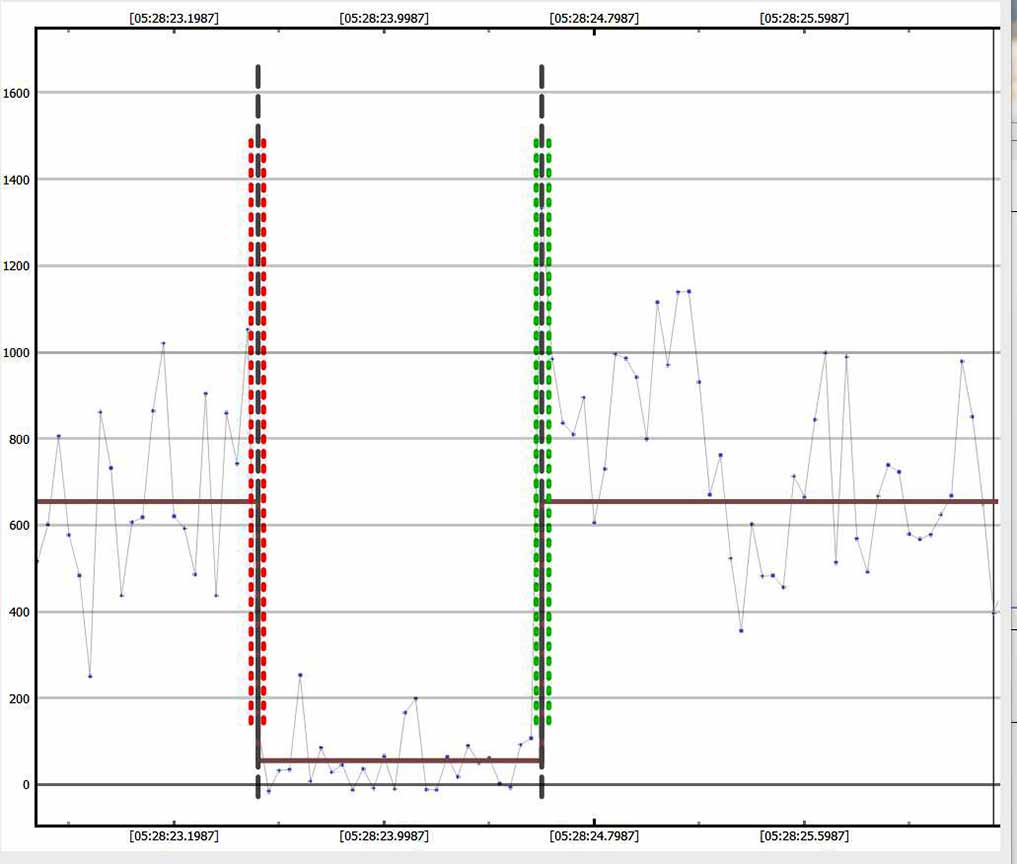
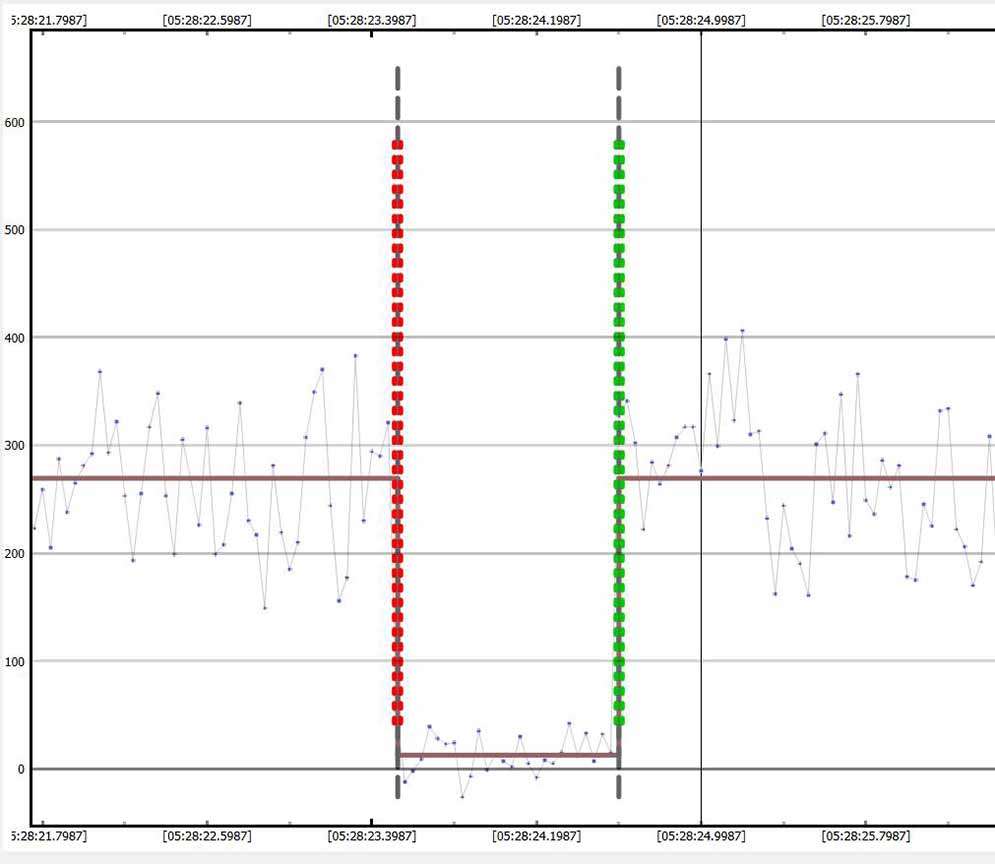
D time: [05:28:23.5187]
D: 0.6800 containment intervals: {+/- 0.0100} seconds
D: 0.9500 containment intervals: {+/- 0.0268} seconds
D: 0.9973 containment intervals: {+/- 0.0640} seconds
R time: [05:28:24.5987]
R: 0.6800 containment intervals: {+/- 0.0100} seconds
R: 0.9500 containment intervals: {+/- 0.0268} seconds
R: 0.9973 containment intervals: {+/- 0.0640} seconds
Duration (R - D): 1.0800 seconds
Duration: 0.6800 containment intervals: {+/- 0.0146} seconds
Duration: 0.9500 containment intervals: {+/- 0.0341} seconds
Duration: 0.9973 containment intervals: {+/- 0.0715} seconds
 |
Clear occultation 2s early for the target. |
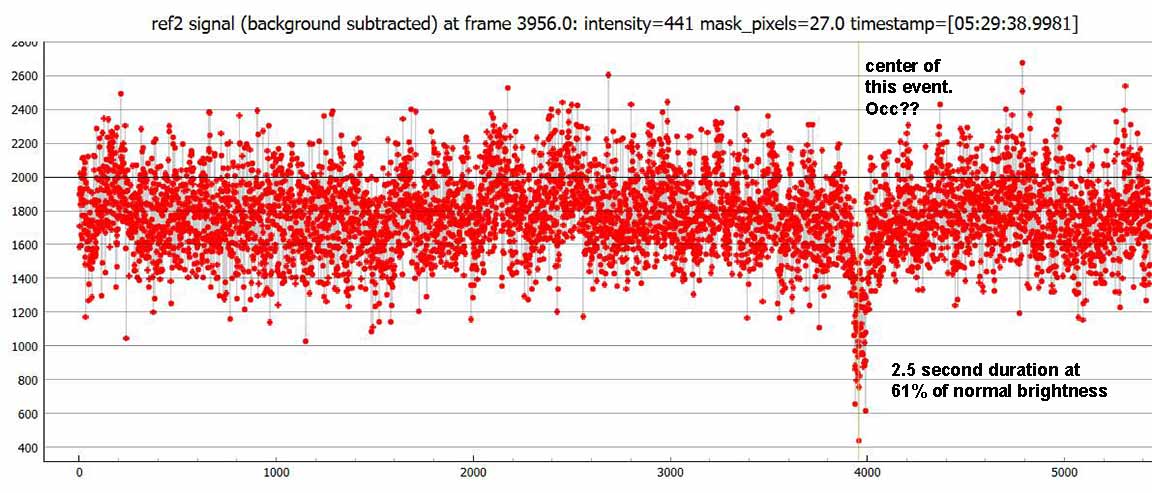
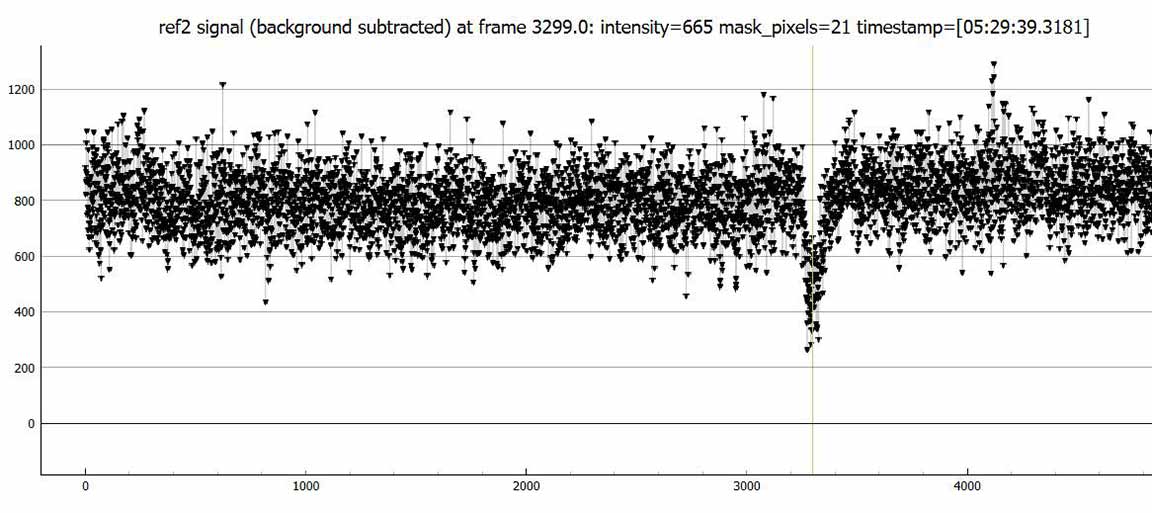
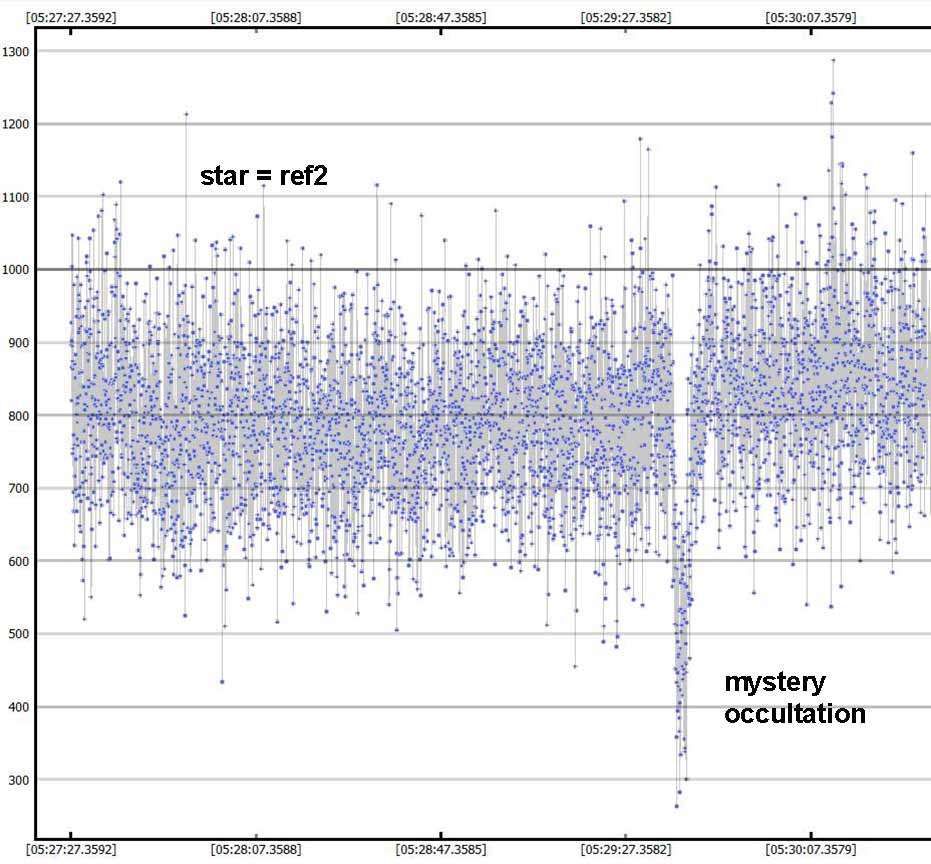
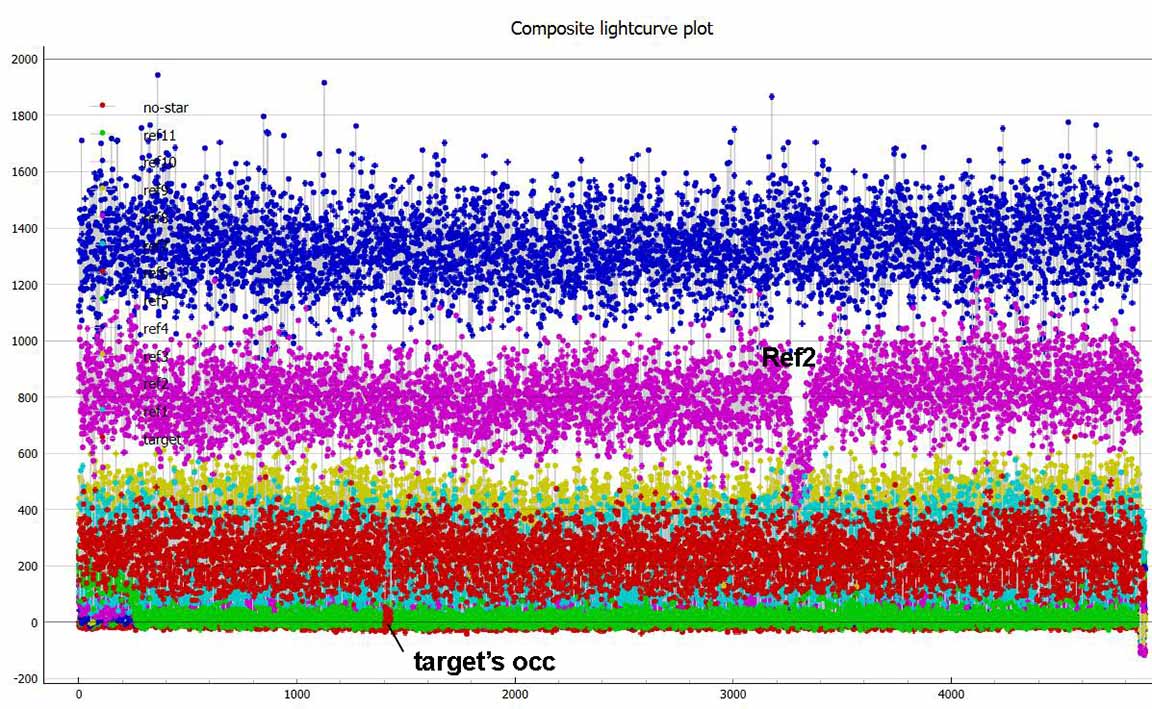
Ref2 had a surprising drop to only ~65% of normal brightness for 2.5 seconds, about a minute after the target occultation. |
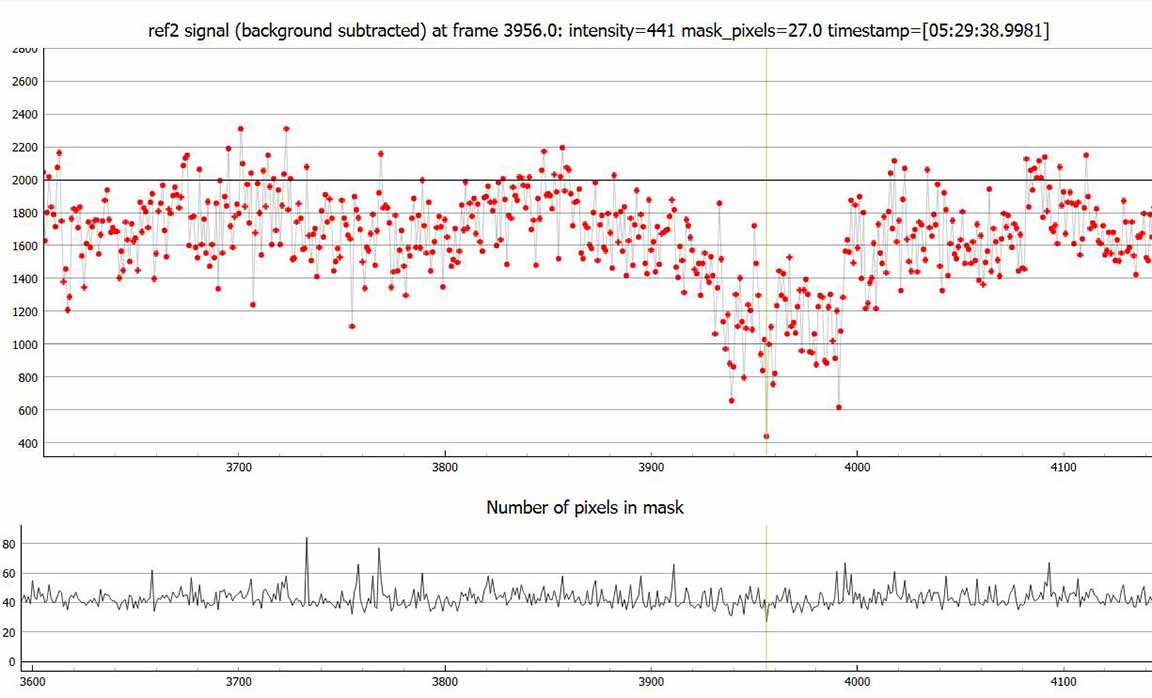
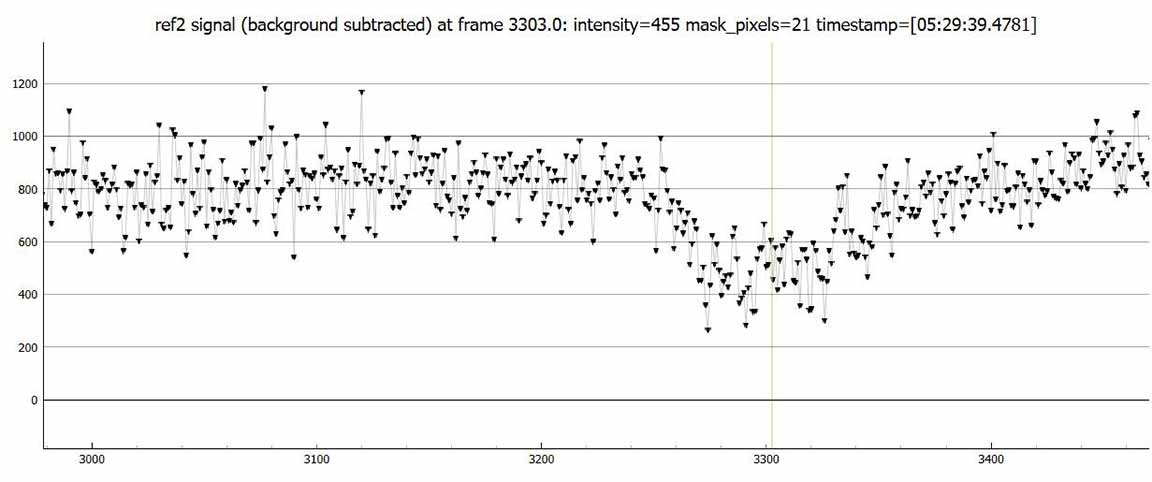
Here it is close up. What caused this?? |
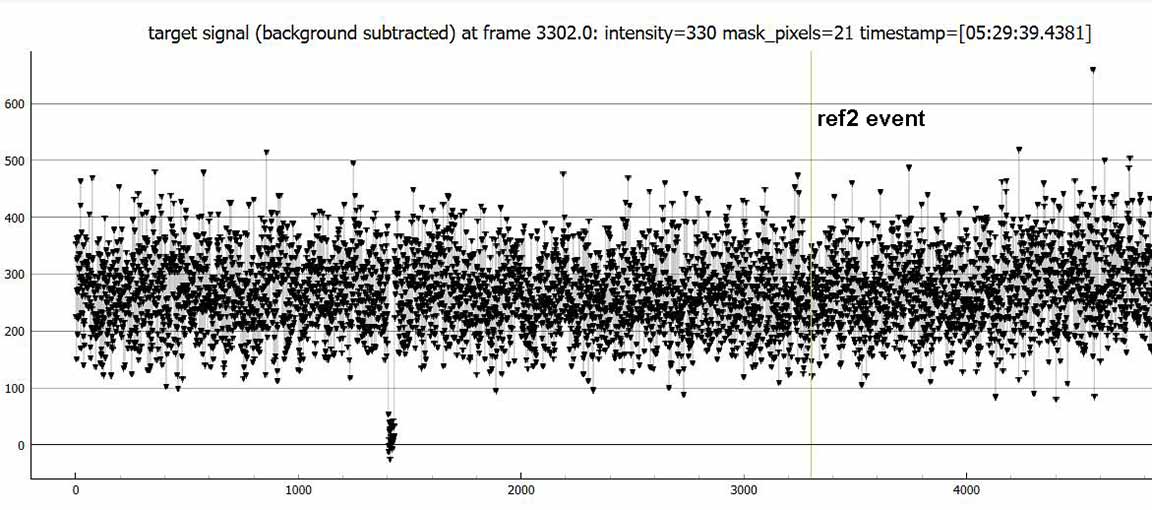
Back to the planned occultation: In PyOTE, solution was sharp and high confidence |
Zoomed in. Occasional pixels on the target were red and near or past saturation at 2x. |
NIE test; 32.1 sigma |
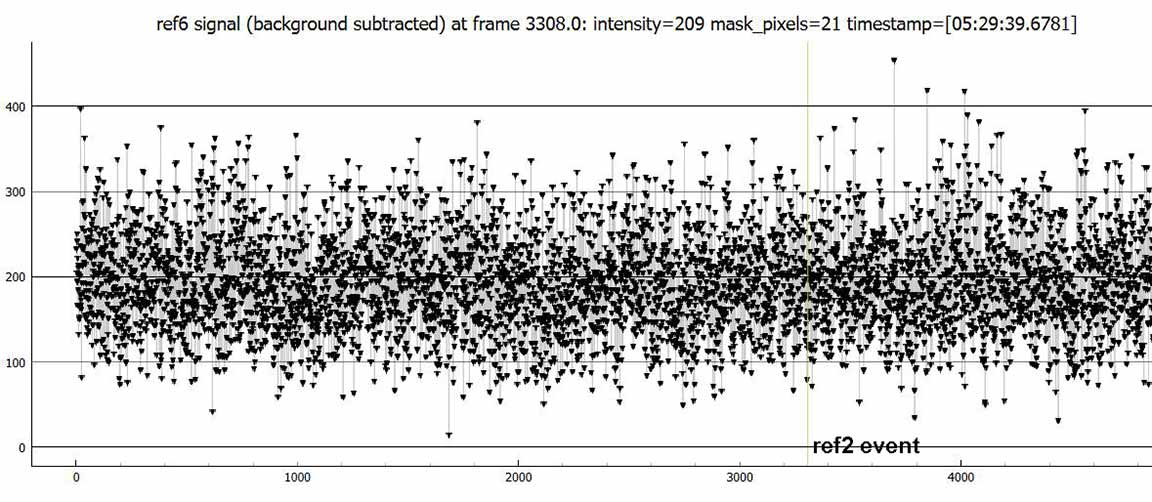
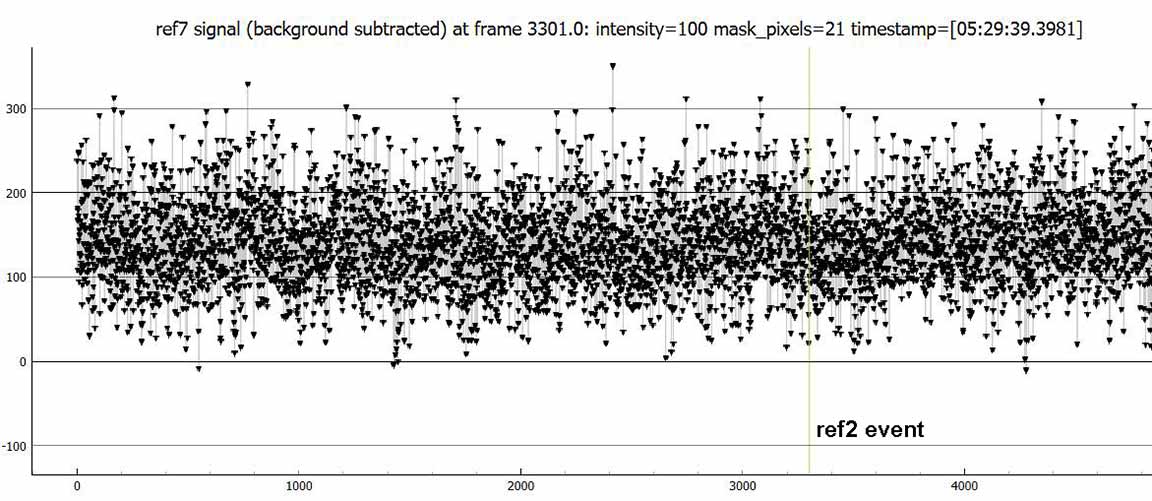
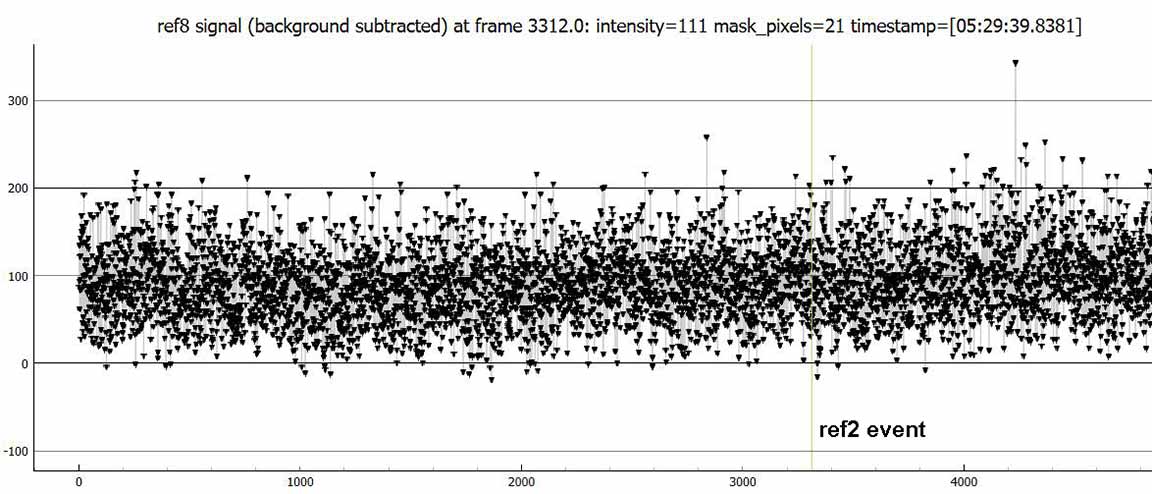
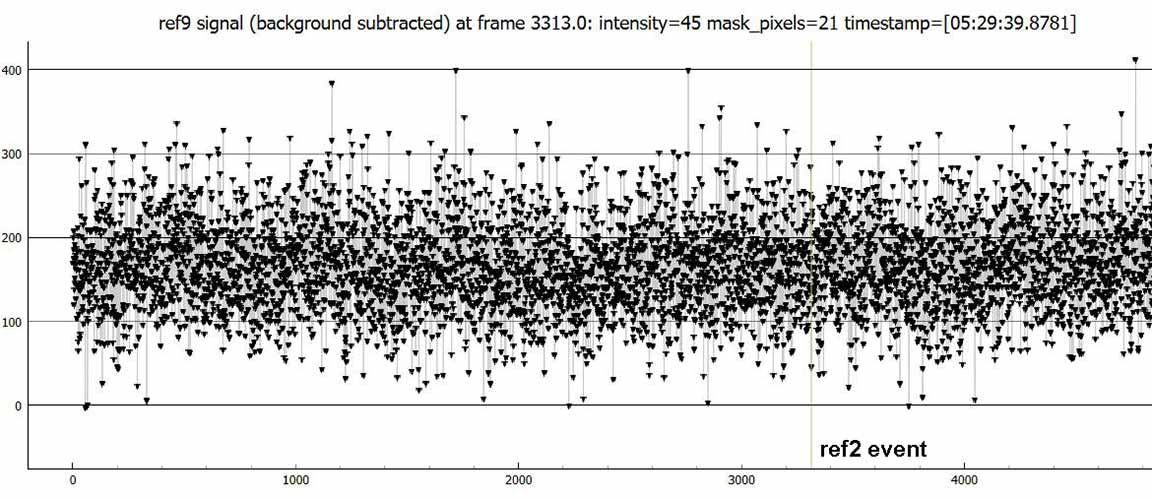
The puzzle is what caused the drop in brightness of the ref2 star? It lasted a full 3.5 seconds and dropped to 61% of normal brightness. There were no clouds, and ref1 and the target did not show a drop at this time. A flying bat? An owl? But for 3.5s that is not plausible - these animals do not hover, they are fast movers, and would occult a star for less than 0.1seconds, and would also show on other stars. I recorded this event also on my ZR45mc camcorder and the light curves at first glance are as good or better than the Lenovo / Startech IOTA VC 2.4 recording. I do not see any other star on the field which did anything unusual at or near the event of the ref2 star...
2nd Reduction, using the output into the ZR45mc camcorder
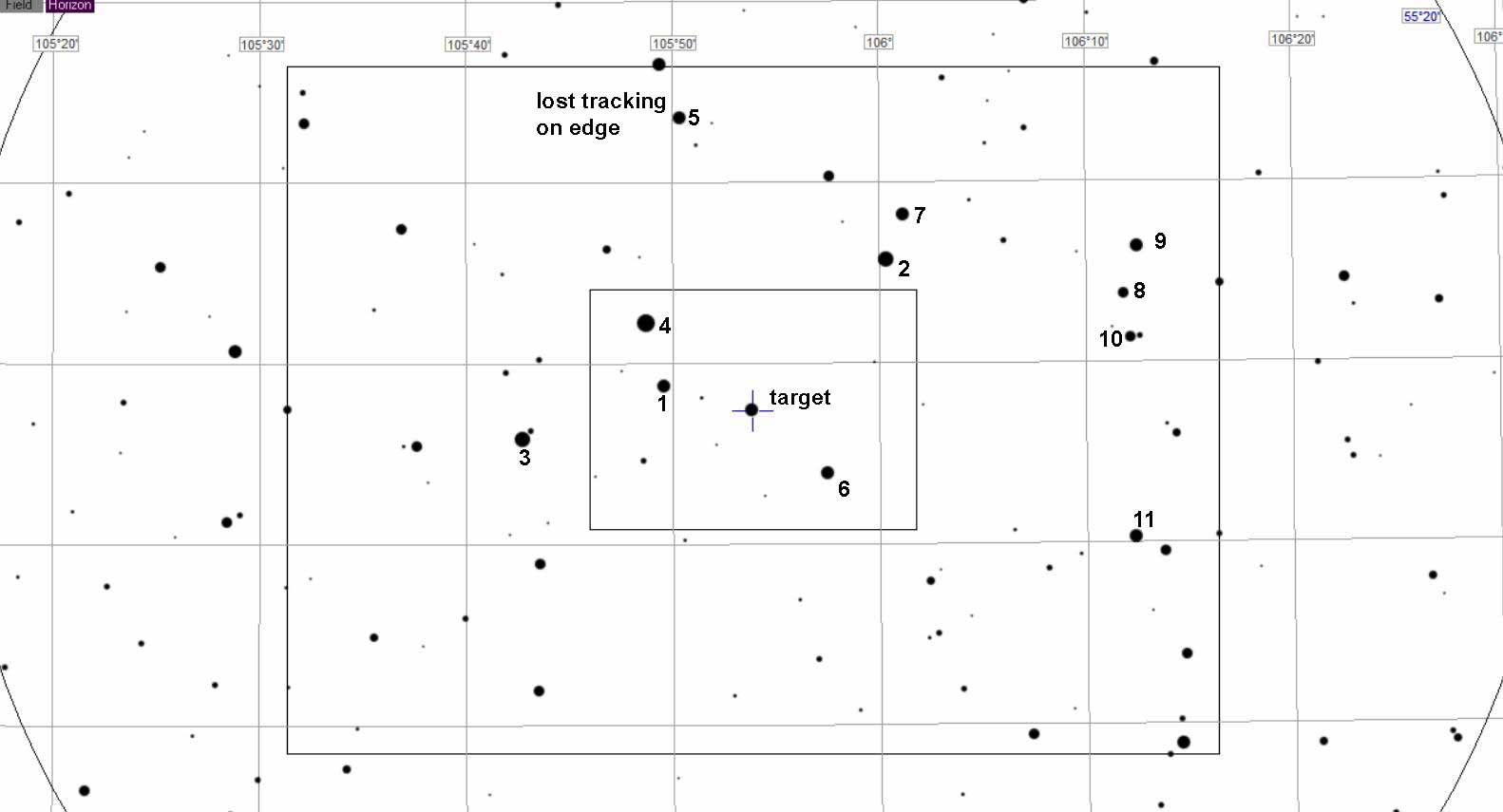
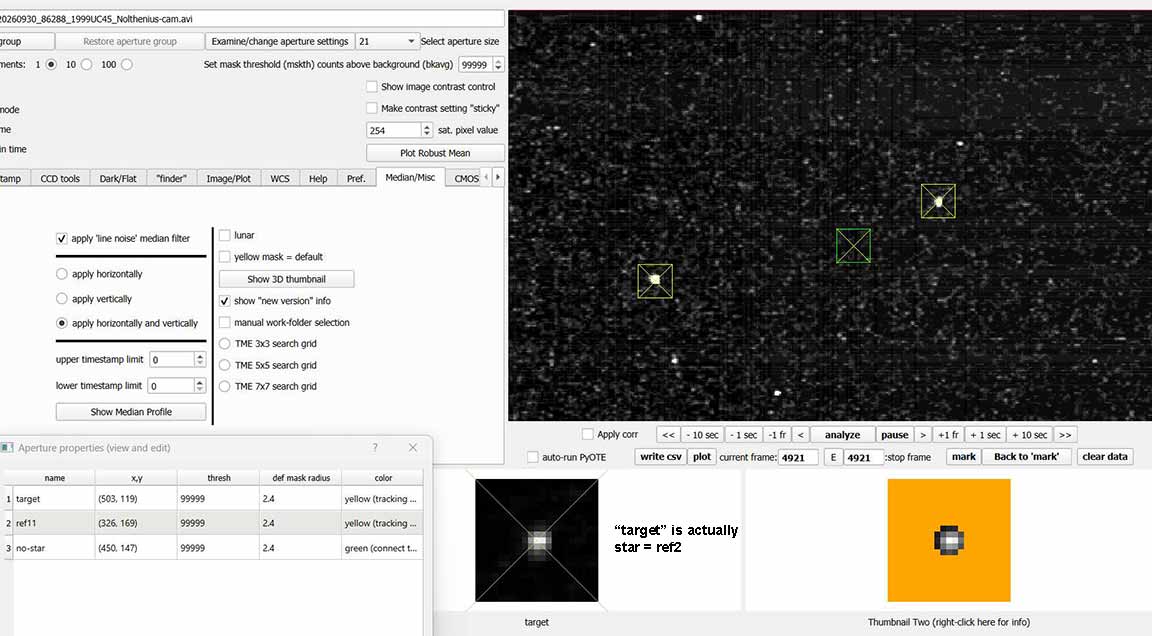
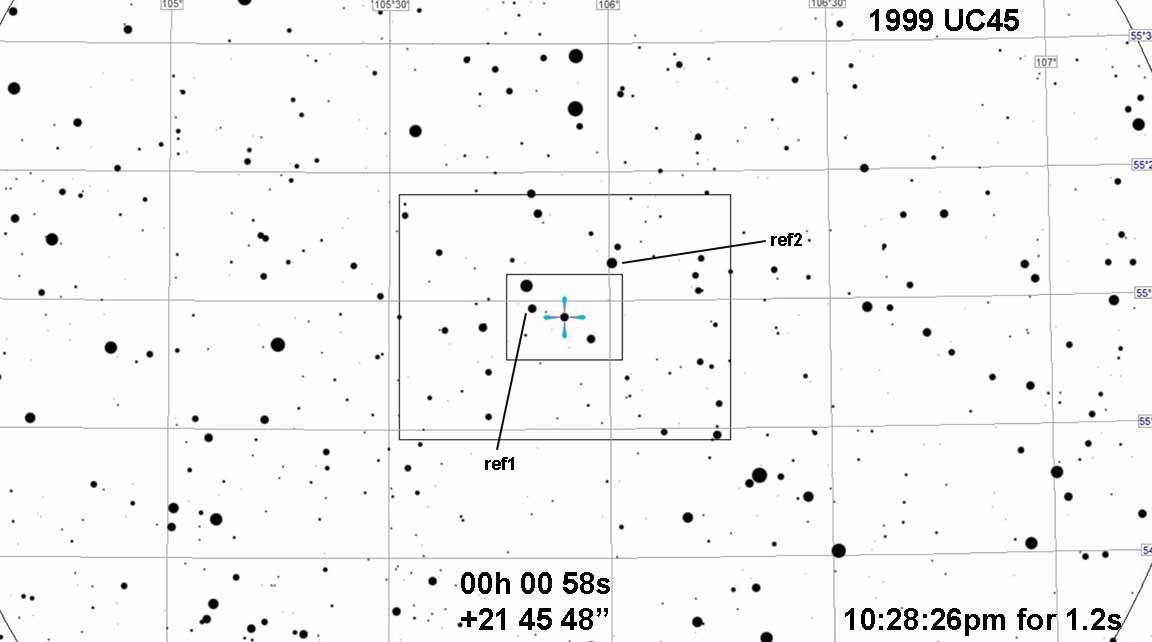
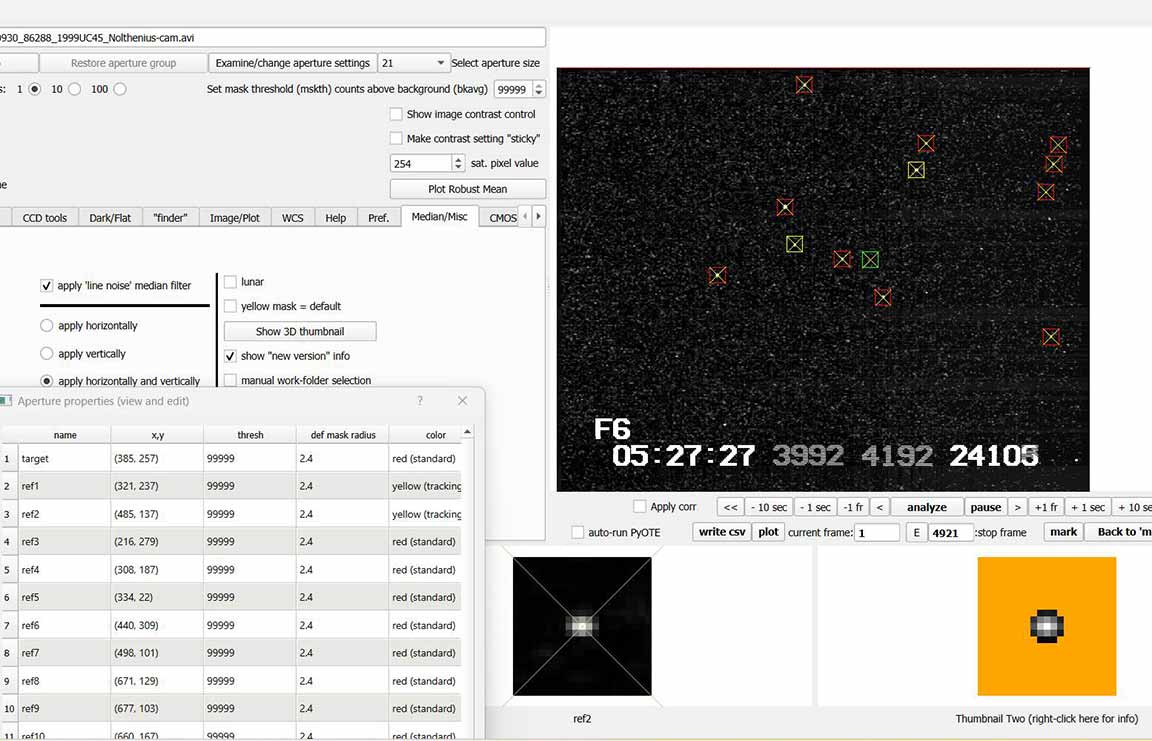
Reference star numbers used for the camcorder recording reductions |
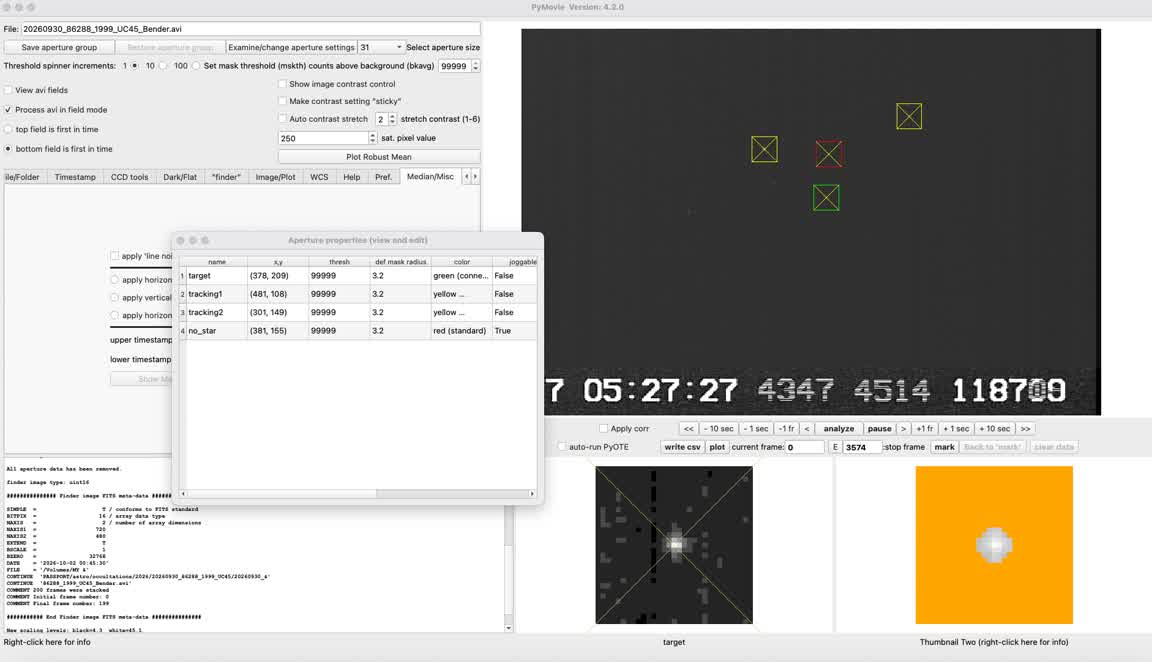
Screen capture on PyMovie. I used 2.4px fixed circular masks on all stars. |
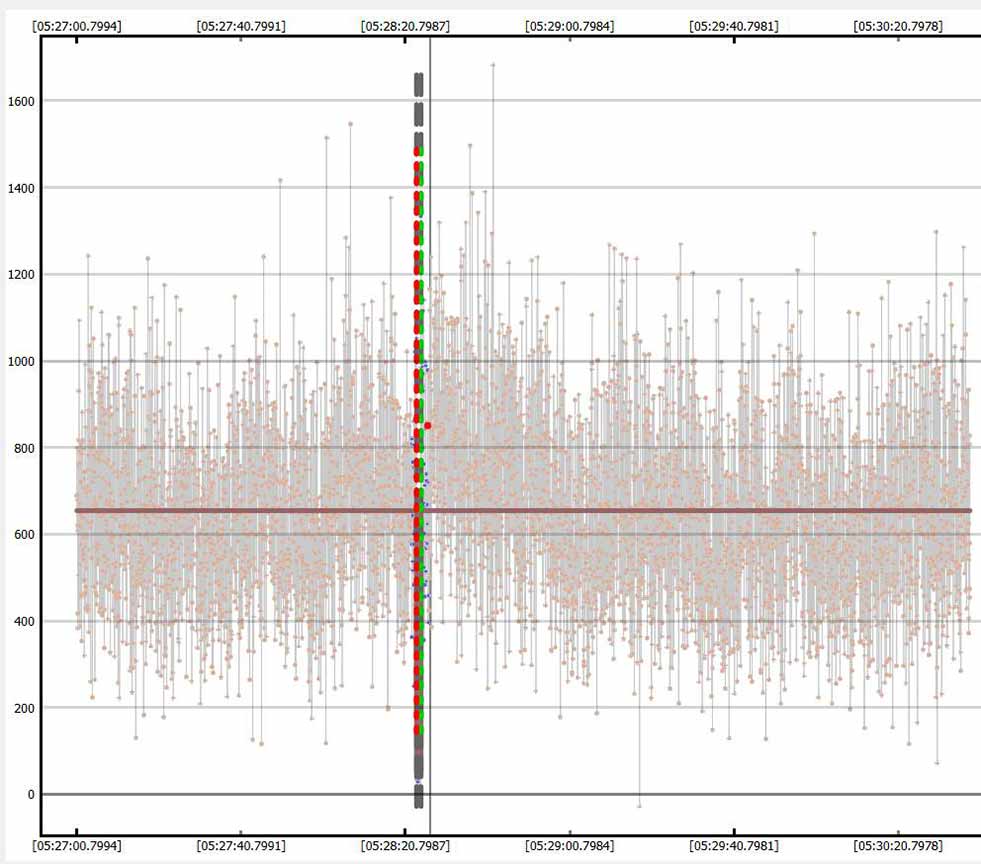
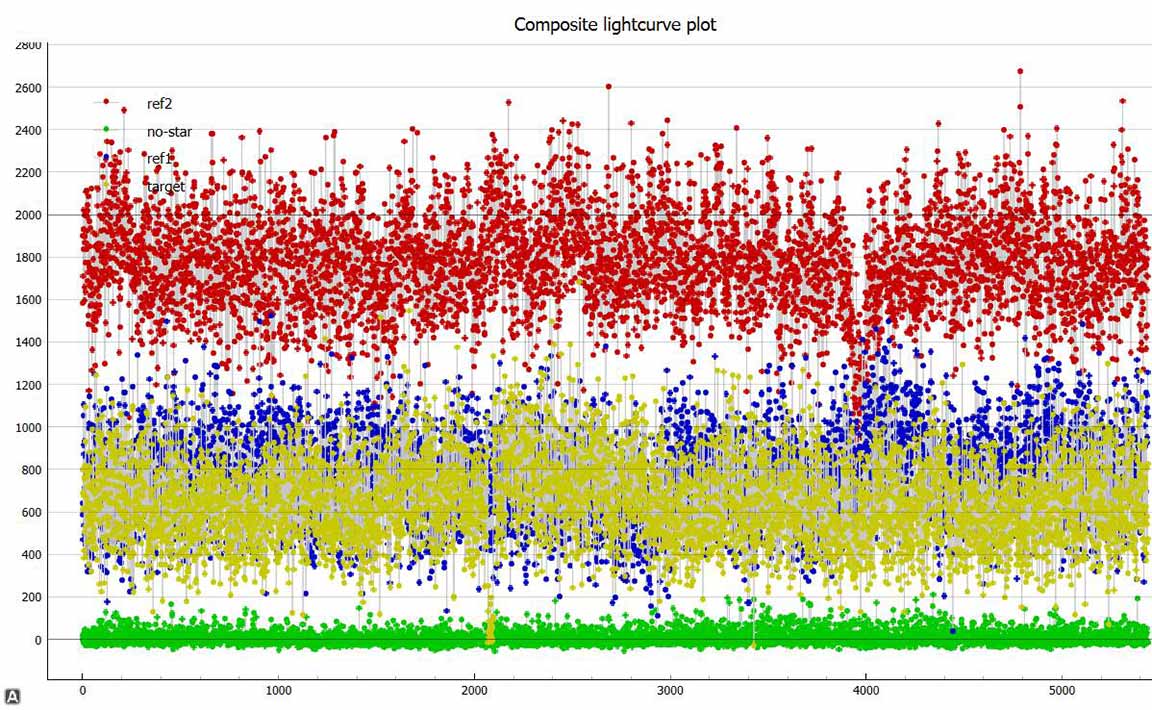
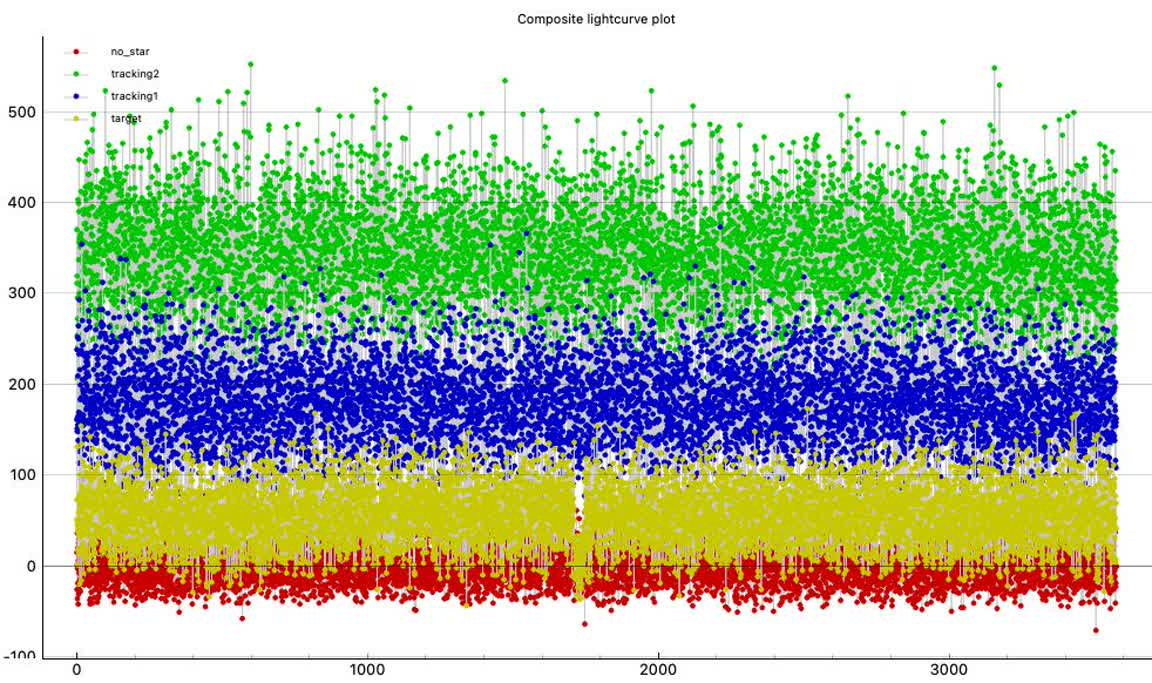
Composite of all light curves. |
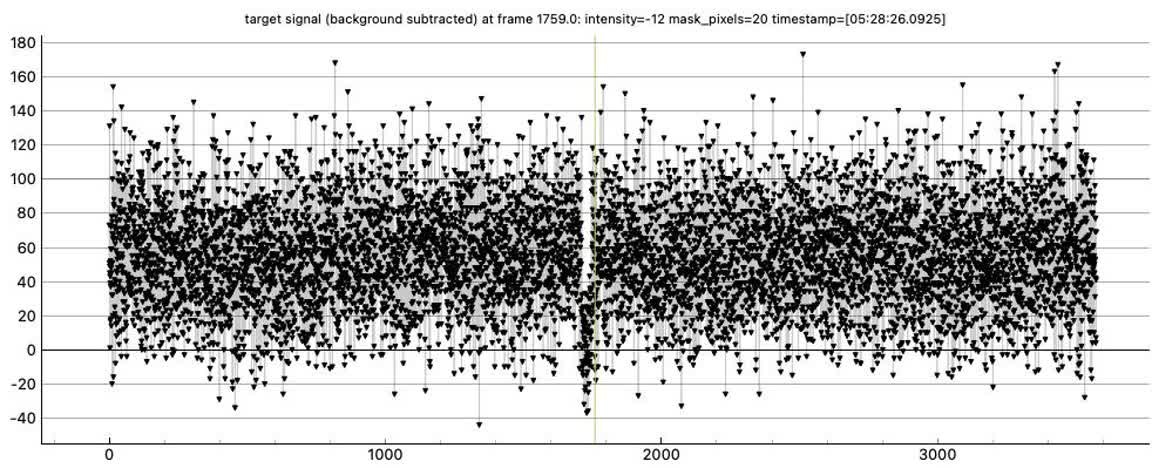
Target star, with a clear occultation at the proper time. |
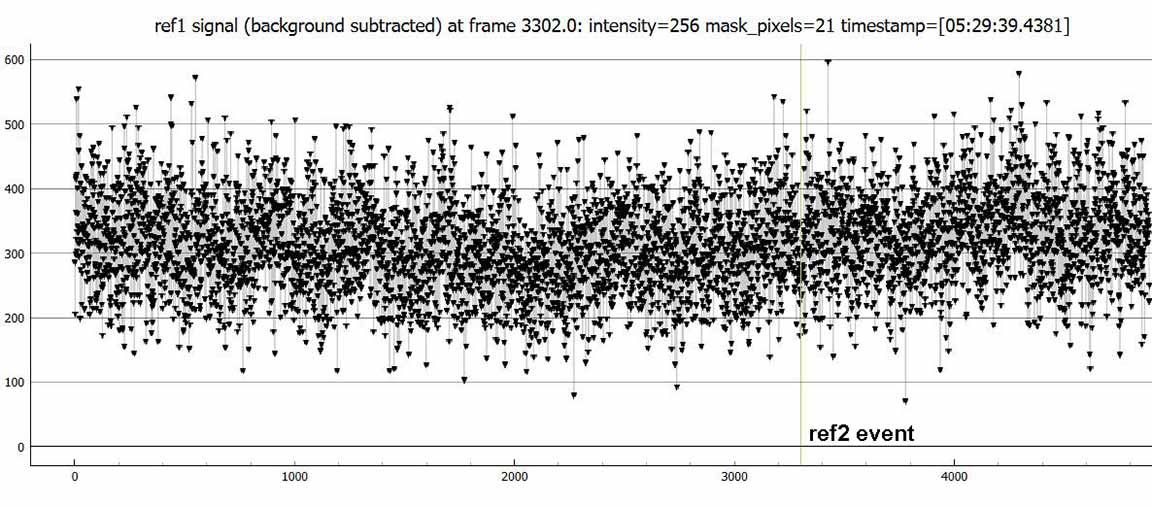
Ref1, shows no unusual behavior at the time of the ref2 star's apparent occultation. |
Ref2 and the clear event |
zoomed in, the event looks more like a gradual fade, levelling off, then rising gradually |
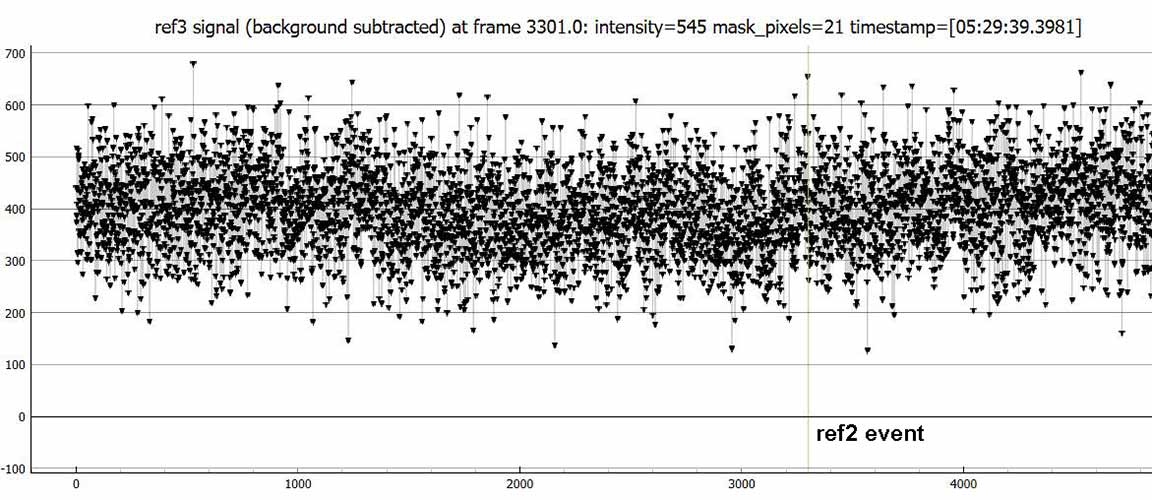
Ref3, shows no unusual behavior |
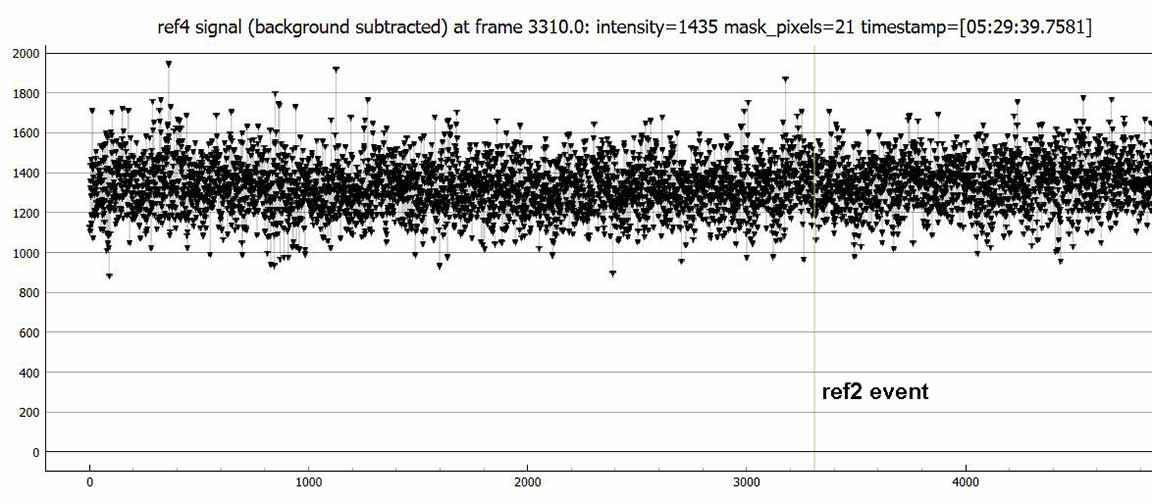
Ref4, shows no unusual behavior |
Ref6, shows no unusual behavior |
Ref7, shows no unusual behavior. This is the star closest to ref2, and is the best evidence against a local occulting object like a bird or plane. |
Ref8, shows no unusual behavior |
Ref9, shows no unusual behavior |
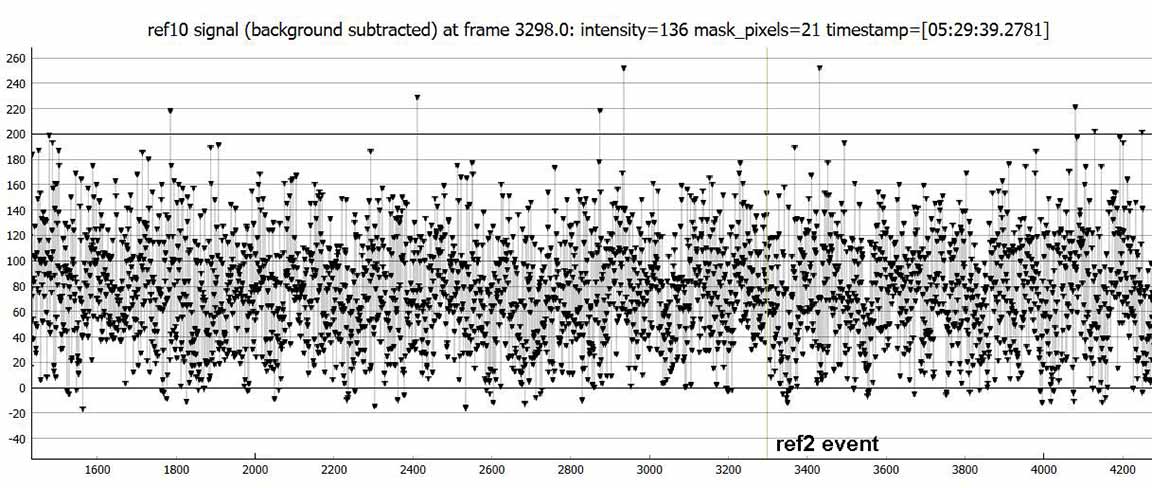
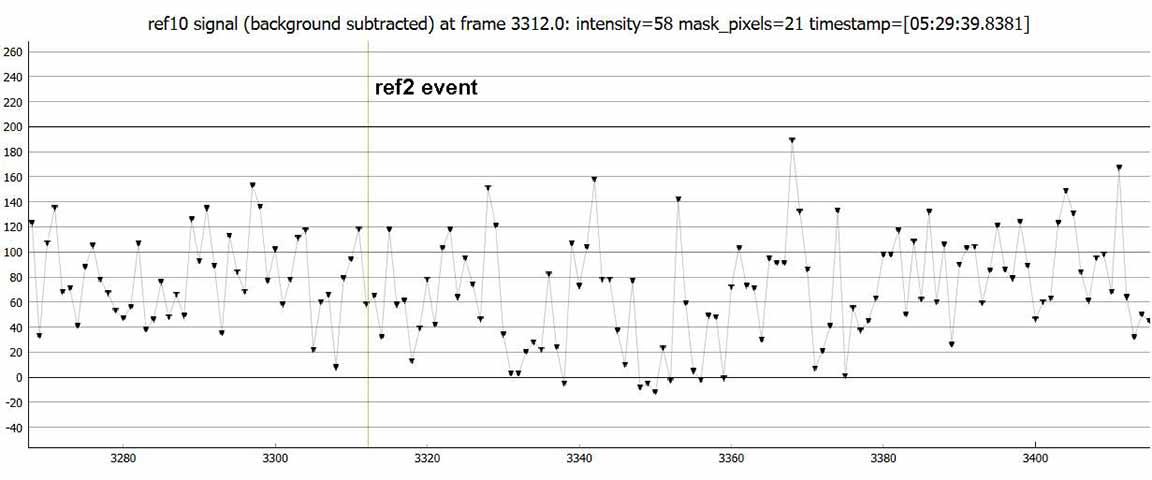
Ref10, shows no unusual behavior, although it is very faint and shows many drops to zero. It also has a close fainter neighbor which would complicate interpretting the light curve. Not a good test. |
Ref10, zoomed in. The noisy lower values are hard to judge, later than the ref2 clear event. |
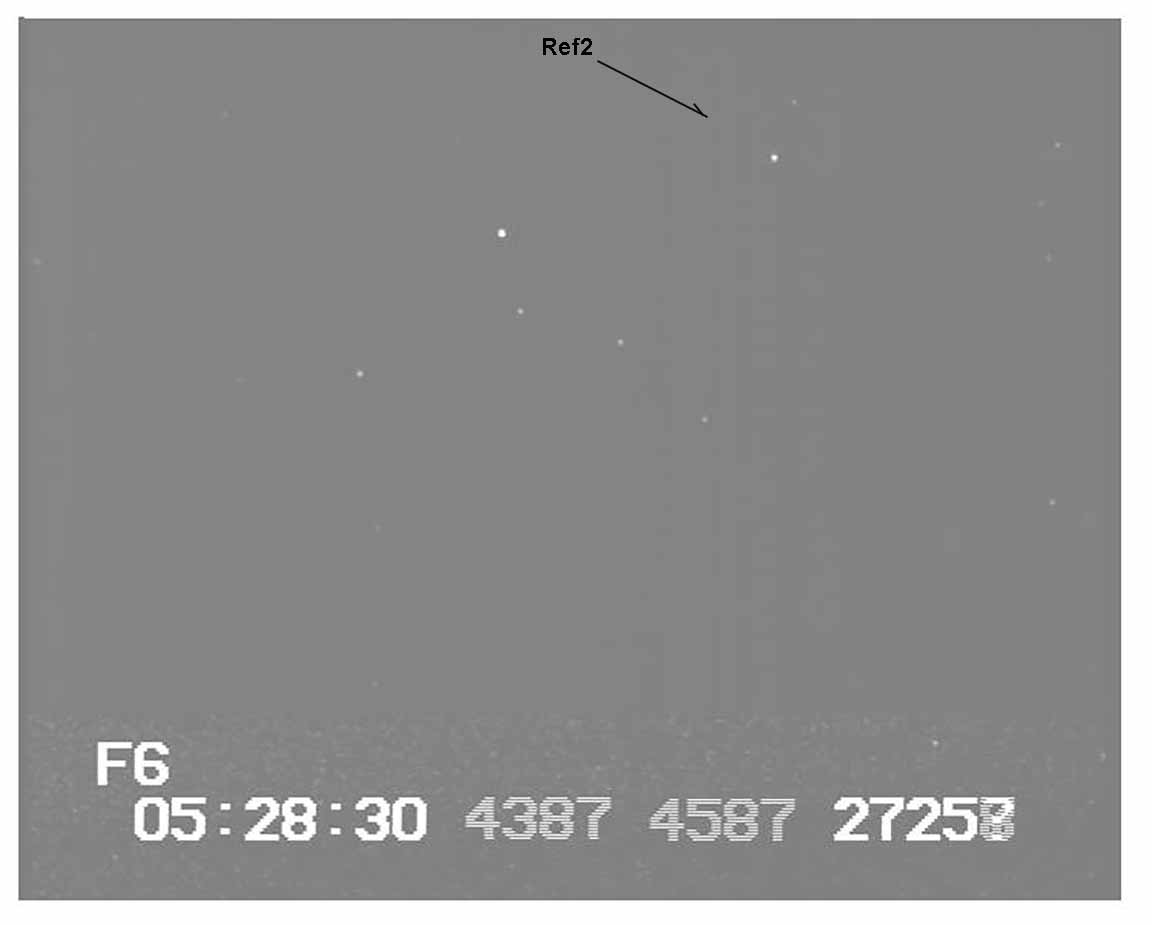
A 222 frame "finder" and stretched to show the background sky. No dust on the detector or unusual features beyond a flat sky. This seems to rule out dust on the chip window. |
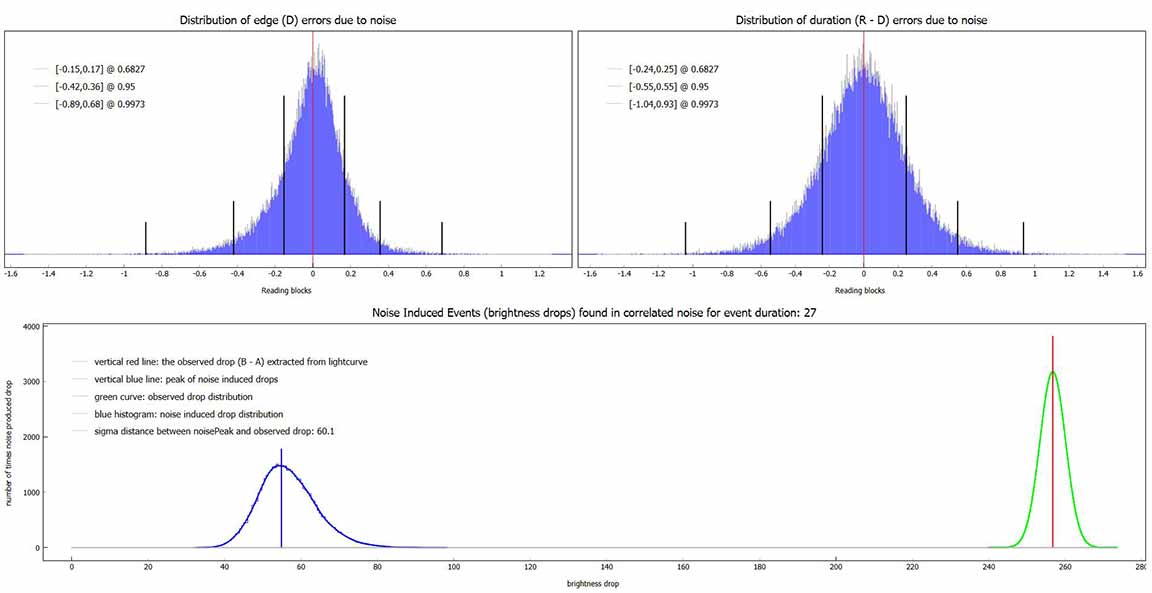
PyOTE reductions of the actual target. Do we see less noise in this, the camcorder version? Yes!
The mag drop is deeper which is more proper, and the D and R timings are tighter, and the NIE test better. I needed no reference star. Like Kirk's often experience - the smoothing needed was so long the smoothed curve reference star was flat. I.e., not needed at all. Skies were good! For both outputs, I used median filtering horiz/vert and 2.4 px circular aperture here. I used dynamic masks in the Startec version because IOTA VC 2.4 assumes an aspect ratio of 640x480 as the NTSC Watec's output, not the 768/512 the PAL version does, so my stars always look elongated vertically. But for the camcorder version, for some reason, the stars looked circular anyway and that was fine.
NIE test: 60 sigma (vs. 32 sigma for the version sent through the Startech cable)
magDrop report: percentDrop: 95.3 magDrop: 3.324 +/- 0.566 (0.95 ci) (drop should have been 5.4 mag, here is't 3.3 mag but that is better than the 2.67 mag on the Startec version)
DNR: 3.87
D time: [05:28:23.5248]
D: 0.6800 containment intervals: {+/- 0.0067} seconds
D: 0.9500 containment intervals: {+/- 0.0168} seconds
D: 0.9973 containment intervals: {+/- 0.0354} seconds
R time: [05:28:24.5987]
R: 0.6800 containment intervals: {+/- 0.0067} seconds
R: 0.9500 containment intervals: {+/- 0.0168} seconds
R: 0.9973 containment intervals: {+/- 0.0354} seconds
Duration (R - D): 1.0739 seconds
Duration: 0.6800 containment intervals: {+/- 0.0098} seconds
Duration: 0.9500 containment intervals: {+/- 0.0219} seconds
Duration: 0.9973 containment intervals: {+/- 0.0395} seconds
Despite the already sharp D and R, the timing 2-sigma is 10% better with the camcorder version here than the earlier Startech version.
 |
 |
 |
|
 |
 |
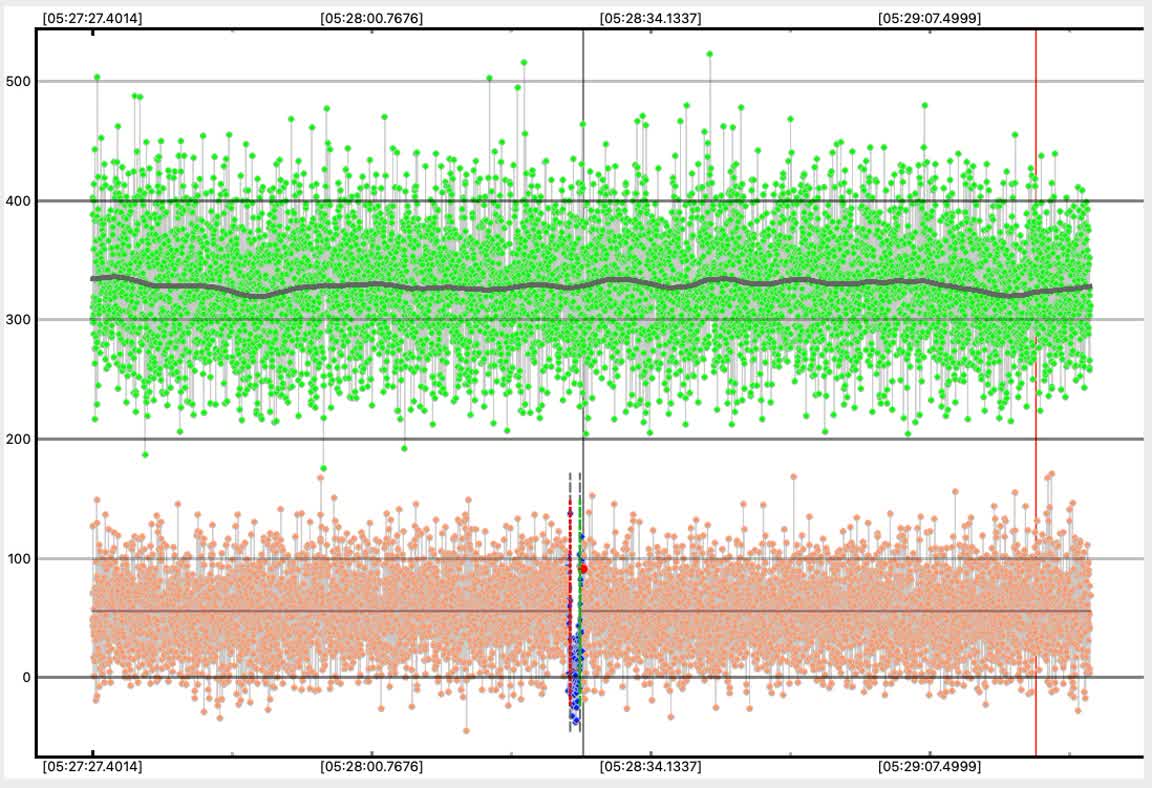
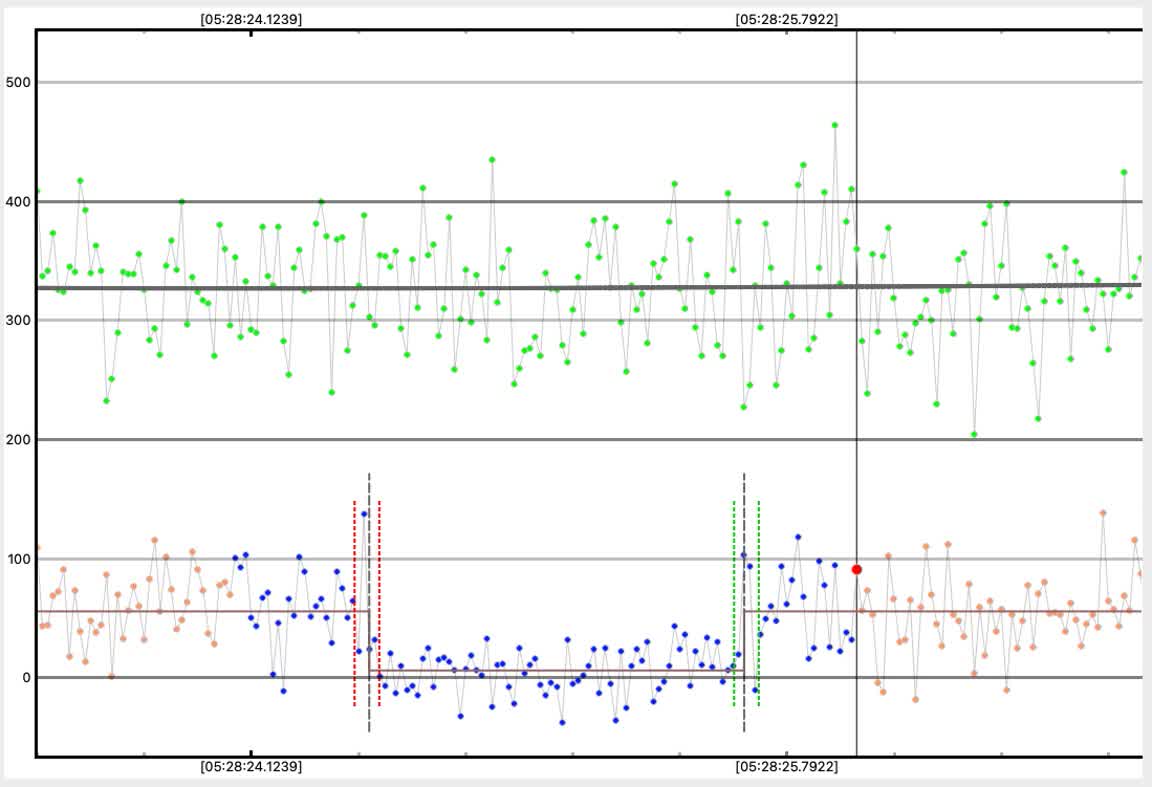
I got an obvious 1.1678s event for 1998 UC45, 1x from home on Sep. 29, time and duration as predicted.
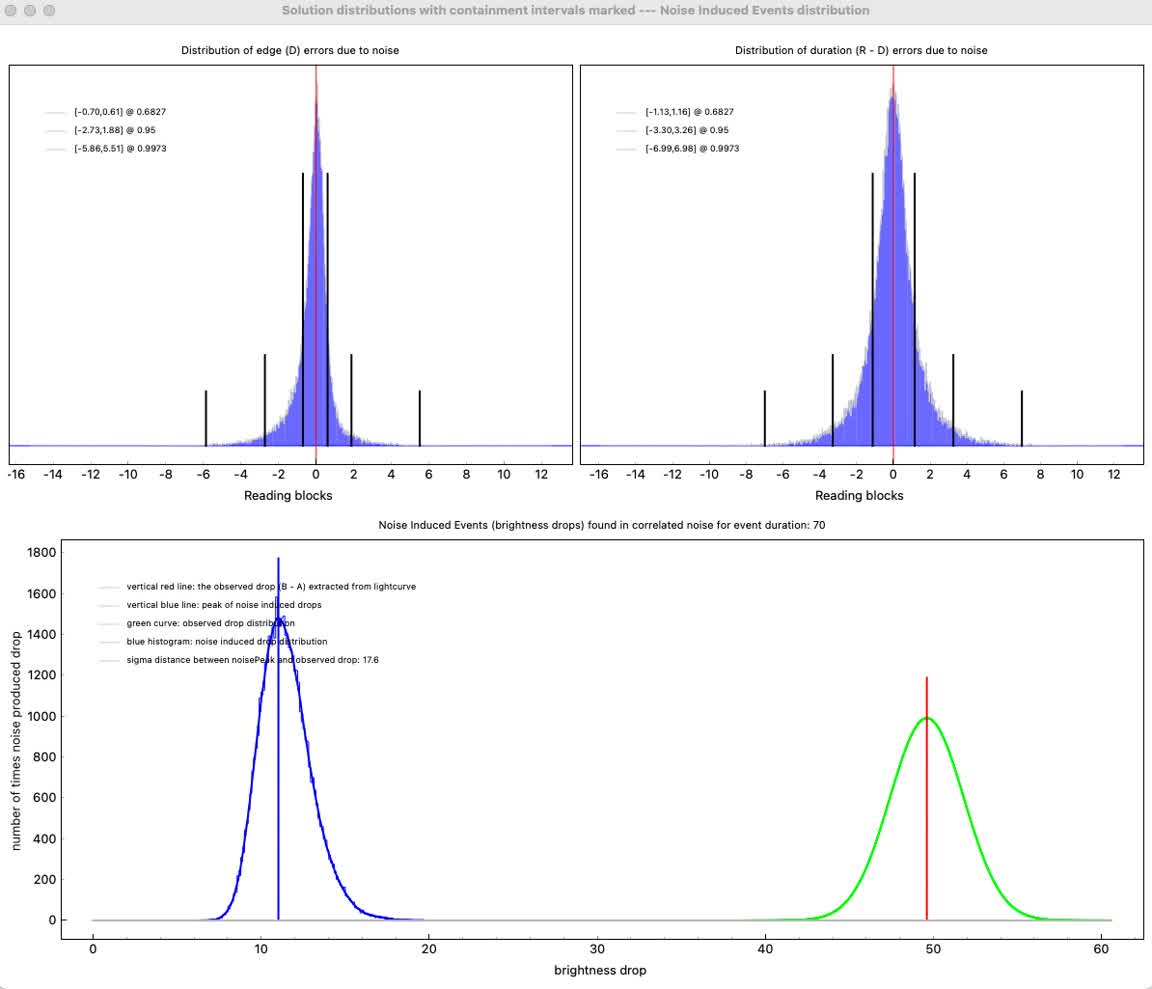
PyOTE NIE sigma distance = 17.6
magDrop report: percentDrop: 89.0 magDrop: 2.392 +/- 0.770 (0.95 ci)
DNR: 1.66
D time: [05:28:24.4909]
D: 0.6800 containment intervals: {+/- 0.0118} seconds
D: 0.9500 containment intervals: {+/- 0.0455} seconds
D: 0.9973 containment intervals: {+/- 0.0978} seconds
R time: [05:28:25.6587]
R: 0.6800 containment intervals: {+/- 0.0118} seconds
R: 0.9500 containment intervals: {+/- 0.0455} seconds
R: 0.9973 containment intervals: {+/- 0.0978} seconds
Duration (R - D): 1.1678 seconds
Duration: 0.6800 containment intervals: {+/- 0.0190} seconds
Duration: 0.9500 containment intervals: {+/- 0.0547} seconds
Duration: 0.9973 containment intervals: {+/- 0.1165} seconds
 |
 |
 |
 |
 |
 |
(Was median filtering applied?)
DNR: 3.11
D: 0.9973 containment intervals: {+/- 0.0679} seconds
R: 0.9973 containment intervals: {+/- 0.0679} seconds
 |
 |
 |
 |
 |
 |
Info on Ref2 = UCAC4 555-143603 from C2A. The B-V = +0.7 suggests an ordinary G type main sequence star. Drops of 33% for 3s in a normal star are just not possible. The light travel time alone across the star is about 3 seconds. "Hot Jupiter" transit? Not for just 3 seconds! And at that time scale, you'd see more transits during the 3 minutes of the recording, 60x the transit time. Just not plausible.
Kirk and Karl both ended their recordings before this event, so can't shed light on it. Kent's chord was very close to Karl's, on the north side and not close to my chord. Kent's timing of the main target is in good agreement with Karl's. Both got a 1/4s event.
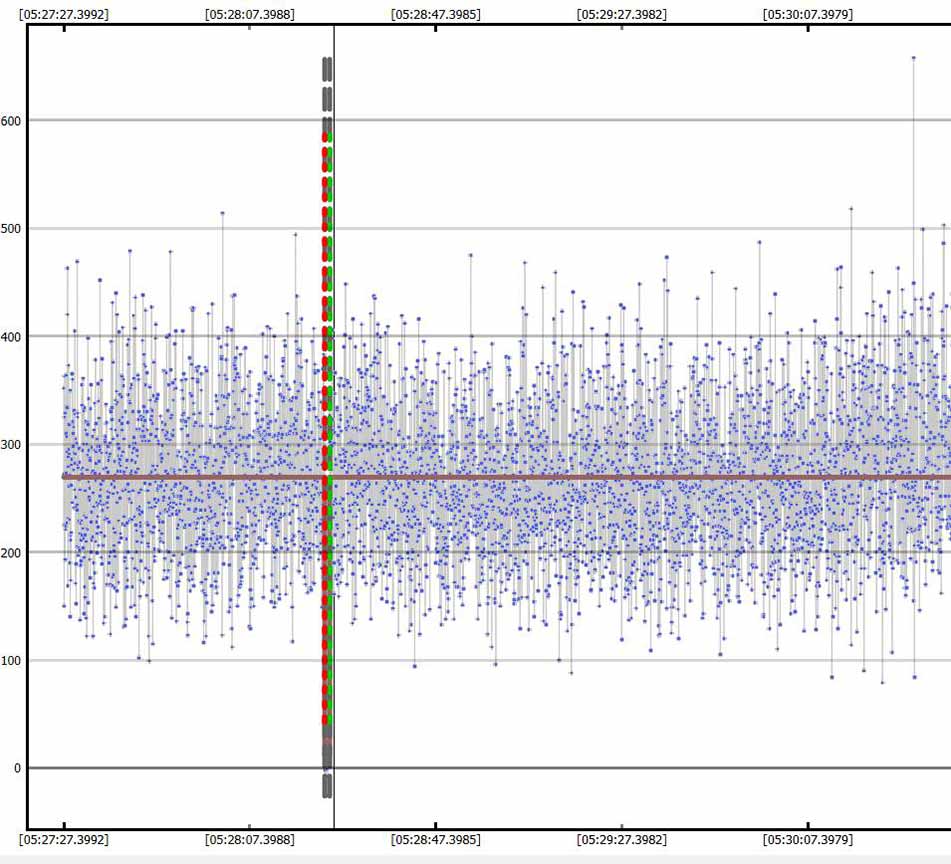
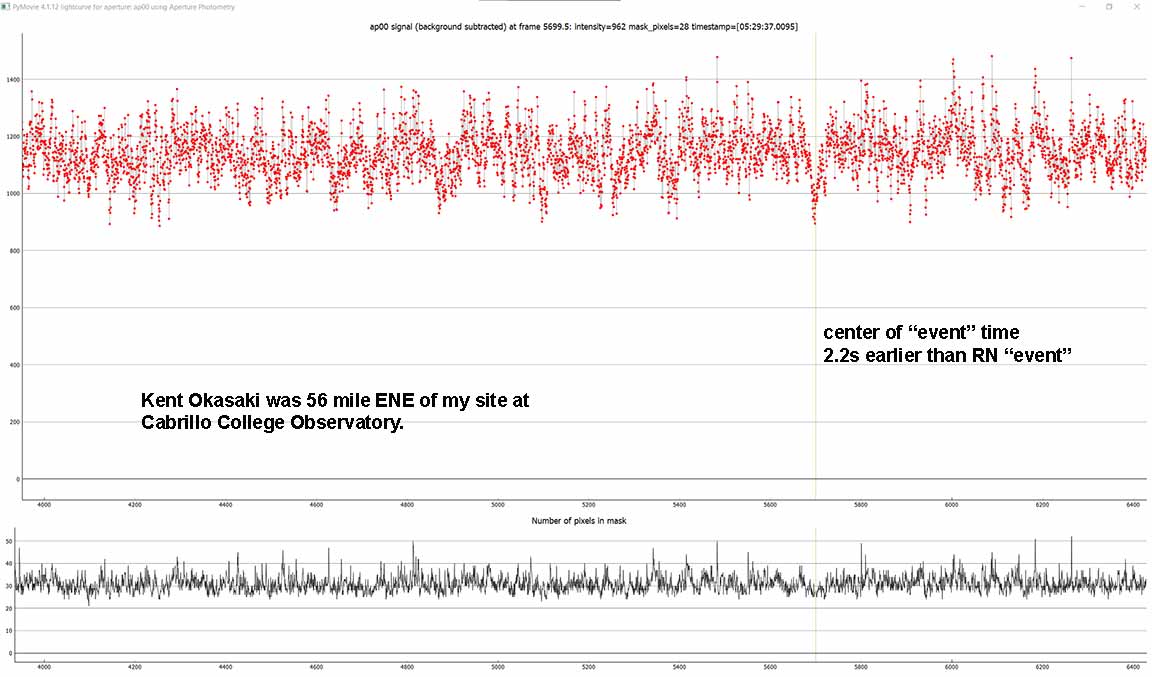
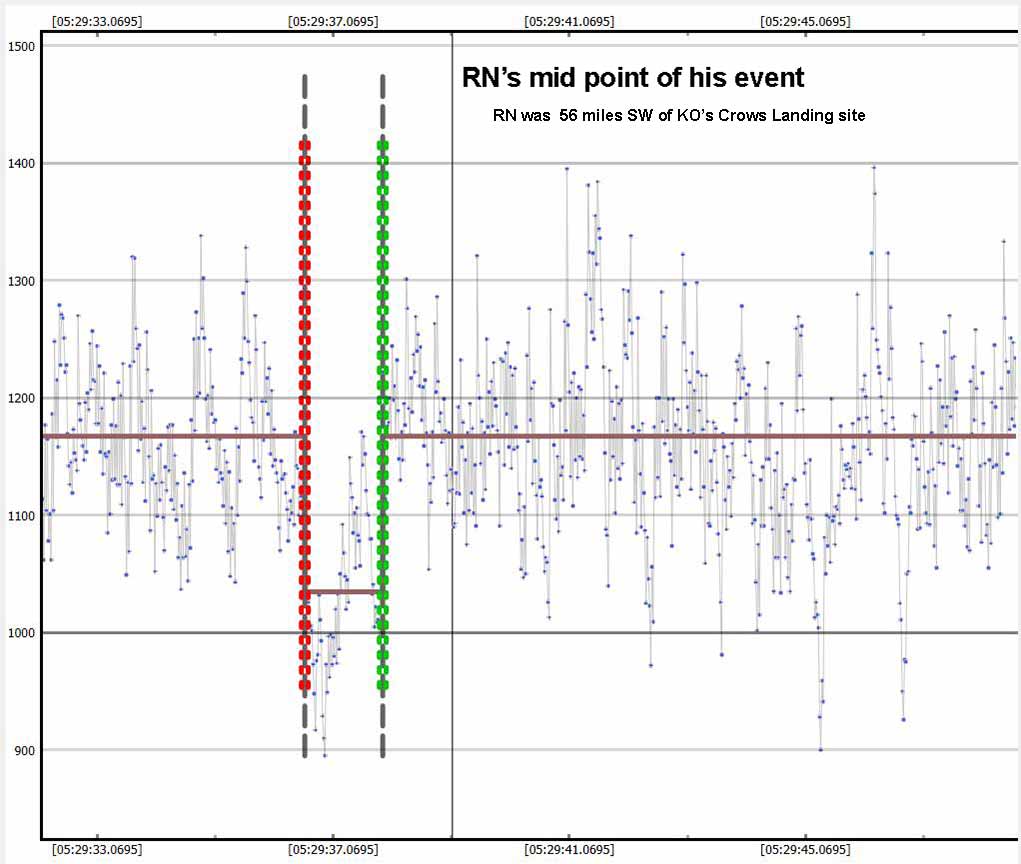
Kent Okasaki's Data, from Crows Landing 56 mile ENE from Cabrillo Observatory: He did record long enough to get a good clear light curve for star=ref2. Shown below. There are "wiggles of a couple of seconds of about 10% change in brightness, but which when looked at up close have many intertwined data points at normal brightness. They don't look like real "events", but noise. There is one exception, and it happens at 5:29:37 UT, which is 1 second before my event begins, interestingly. That is at 14% depth at its deepest few points and does not have alternating interior data points that rise back to normal brightness. It has more the profile of a real event, except it does not look like a square wave but rather a "V". My own has some hint of a gradual drop and gradual rise, with flat bottom between. Could this be caused by diffraction? Could diffraction also cause the only partial loss of light by a small or slow object such as a KBO?
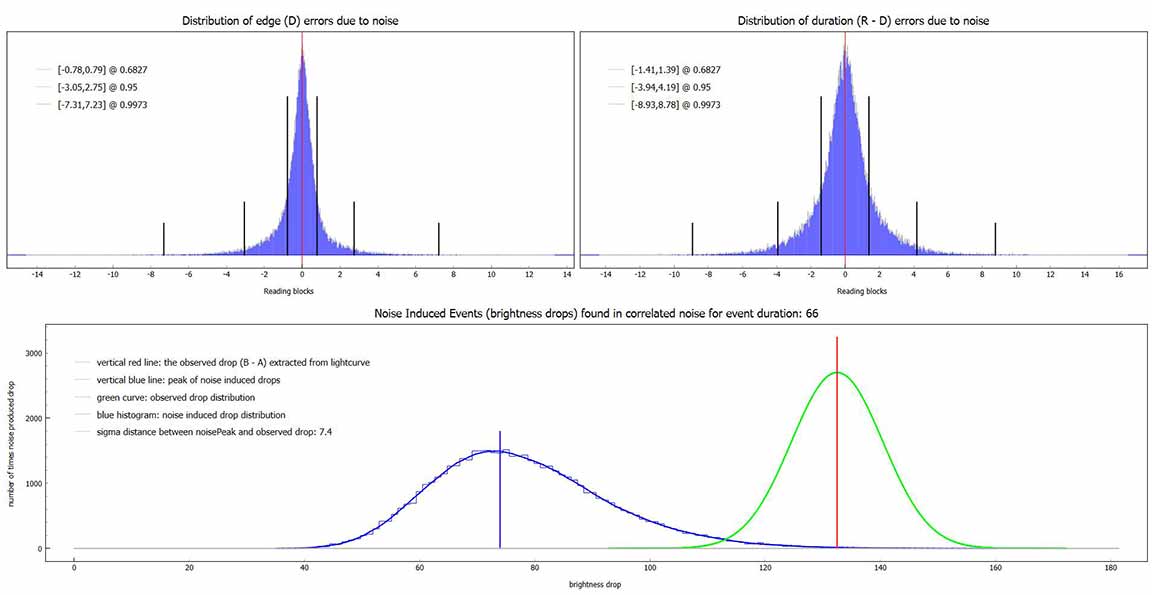
Kent supplied me with his .csv PyMovie file. In the interests of seeing what PyOTE would find if we confined it to searching in the area of my event, I trimmed it and asked it to look for events between 12 and 66 points in duration, which were selected based on the drop in his data near my event time. It found an event with NIE test of 7.4 sigma, 11% drop in brightness, but 14% if the shorter deeper early dip in this "double dip" looking drop were only considered. The NIE test would no doubt be worse if I'd left it open to considering the other wiggles in the light curve. However, the cleanest drop was the one most suspiciously in time with my own, and so I narrowed to this area. Duration 1.32 seconds
magDrop report: percentDrop: 11.4 magDrop: 0.131 +/- 0.017 (0.95 ci)
DNR: 1.74
D time: [05:29:36.5895]
D: 0.6800 containment intervals: {+/- 0.0156} seconds
D: 0.9500 containment intervals: {+/- 0.0580} seconds
D: 0.9973 containment intervals: {+/- 0.1454} seconds
R time: [05:29:37.9095]
R: 0.6800 containment intervals: {+/- 0.0156} seconds
R: 0.9500 containment intervals: {+/- 0.0580} seconds
R: 0.9973 containment intervals: {+/- 0.1454} seconds
Duration (R - D): 1.3200 seconds
Duration: 0.6800 containment intervals: {+/- 0.0279} seconds
Duration: 0.9500 containment intervals: {+/- 0.0813} seconds
Duration: 0.9973 containment intervals: {+/- 0.1771} seconds
This is Kent's plot of my "ref2" star in PyMovie. He supplied me with his resulting csv file which I then ran through my own PyOTE, getting the results at right... |
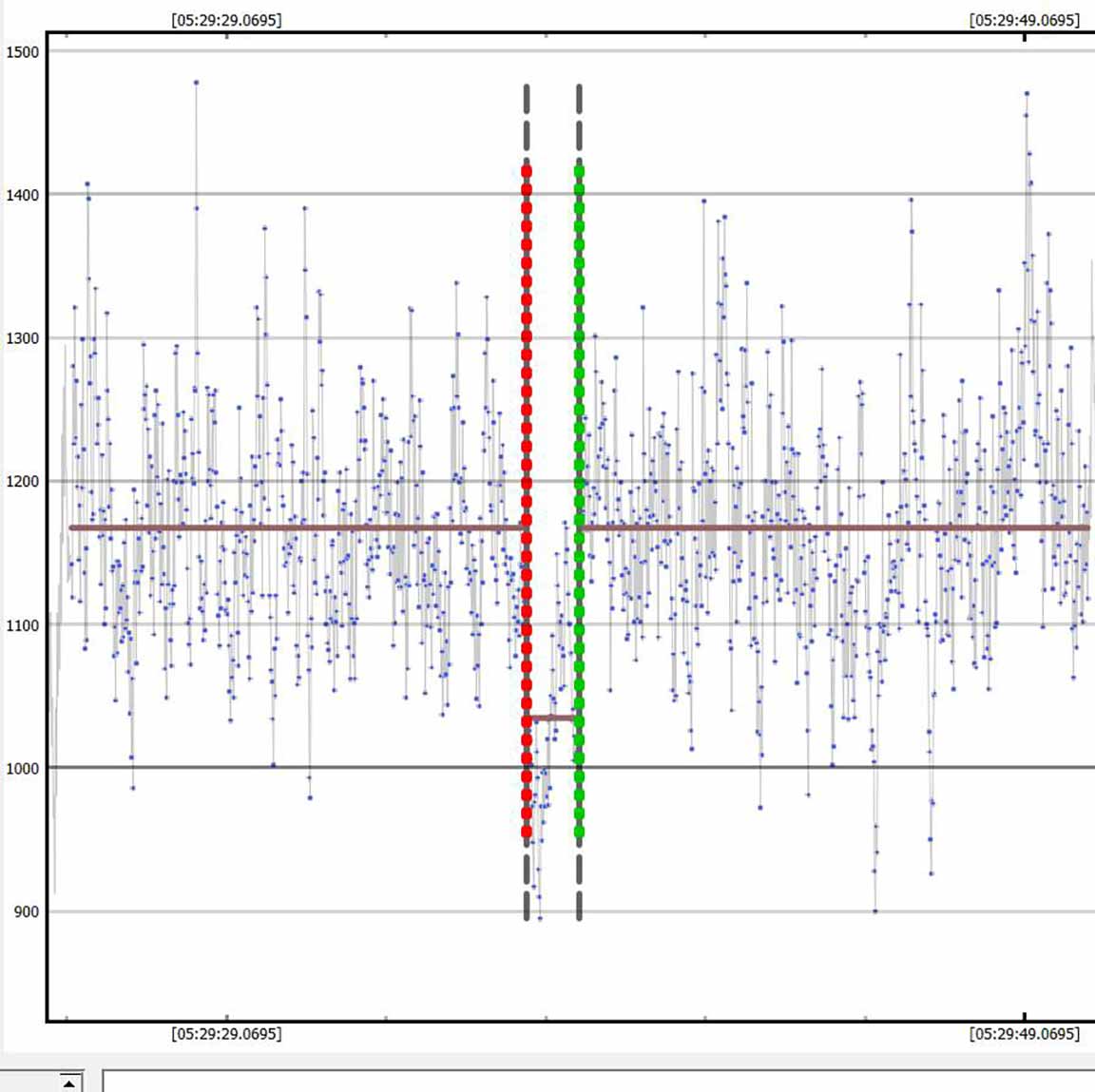 |
1.32s event of ~11% drop was found. Significant? Hard to say, but given its proximity to RN's event, I'm recording the PyOTE finding here. |
NIE test run on the trimmed data and detection of this event. |
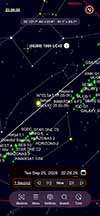 Known Geosynch satellites were not in place to cause this event, even if the duration they could occult were high enough to qualify. Known Geosynch satellites were not in place to cause this event, even if the duration they could occult were high enough to qualify. |
Causes we can rule out:
1. A power glitch - no other stars showed strange behavior around the ref2 event time
2. An overhead power line? No, there are no overhead power lines at the Observatory. All data and power lines are underground. No tree limbs in the way, either.
3. A bat or owl? No - while their wing span is capable, they move far too fast to hang over the telescope for 3.5 seconds. They don't fly like hummingbirds. Also, owl's make a noticable whoosh sound as they fly. It was very quiet. I heard nothing. Students had left a half hour earlier.
4. A bump of the tripod or wires? No - no other stars show unusual events at that time
5. An orbiting satellite? - No, NEO satellites move vastly too fast to cause a 3.5s occultation. 3600 arc sec per 4 minutes 15 arcsec per second. that's a geosynch satellite that would need to be 50 arcseconds across - a full arc minute! The size of Jupiter! Nope. And, a Geosynchronous satellite would likely be sunlit at that place in the sky. I've seen Geosynch satellites move; far too fast. Also, the declination of the object was far north of the equator. From California, Geosync satellites are usually at around Dec=-5, not Dec=+21.
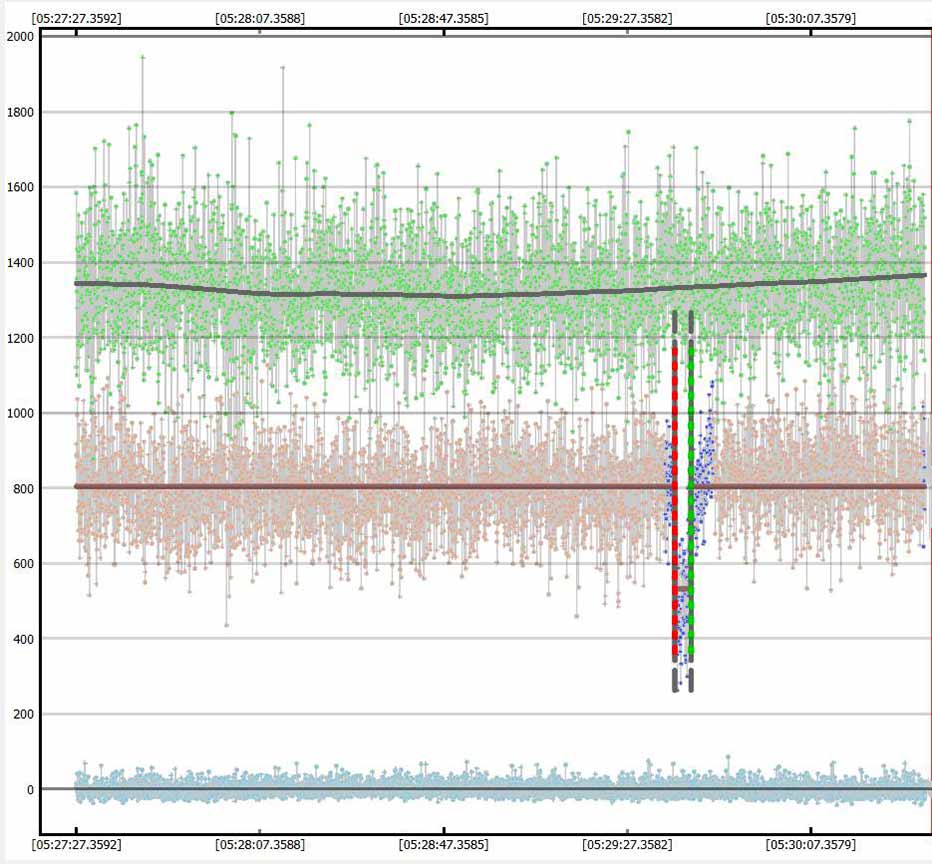
6. A cloud? No - there were no clouds on this dry calm high-pressure dominated day. None seen by any of this team around the sky. The very flat optimal smoothing of the reference star testifies to the lack of obscuring aerosols. Still, a thin microdot cloud in principle could be there, but how would it avoid all the other stars nearby?
7.
Some sort of venting emission by an airplane? But airplanes have lights and would have been seen on the video. If a military aircraft maybe no lights, but it would not take 3.5 sec to cross one star and no others. The video when played at normal speed shows the star fading and then re-brightening with no other lights or visible traces on the video. No reflections from gound lights off a bird or drone.
8. A tracking error? No. Ref2 was used as the #1 tracking star, and the ref1 star as the other tracking star. Both stars stayed rock solid in the middle of the aperture, and the 2.4px mask looked optimal; tightly fitting around the starlit pixels w/o losing significant star light nor admitting stray sky light. I watched it carefully many times during these reductions and there was not jerking or loss of tracking even for a moment. Certainly not 3.5 seconds.
Not yet ruled out entirely:
* a weather balloon? It would have to be very tiny, well less than an arc minute across and thread between the other stars, most importantly ref7, which was less than 1 arcmin from ref2. A weather balloon 30 ft across would have to be 30 miles high to subtend 30" and stay motionless for 3.5s. If rising, it would have to be rather larger and also not occult ref7 which was right vertically above the ref2 star. Still, I will try to find out if any weather balloon's were launched.
* A drone? A typical ~1 ft across consumer drone would perhaps occult enough light to work, but to avoid all other stars, the drone would have to be less than 30" angular diameter. That corresponds to a distance from the telescope of 1.3 miles and at the altitude of the target of 59 degrees, corresponds to about 5,200 ft above the ground. Why would a consumer drone be that high? And how could it stay absolutely motionless for 3.5s despite higher wind speeds at that altitude?
* an occultation by an unpredicted large'ish asteroid not on my OW feed. Highly unusual, as the target star is bright 11th magnitude and such a large required asteroid would also have a good orbit already (or could it be a much fainter more distant Centaur or KBO???)
* Space junk in a strange orbit? Small pieces could create the partial occultations w/o needing grazing incidence. But for 3.5s? That would seem to require a almost perfect line of sight velocity vector relative to our changing position on the Earth as it rotates.
I watched the .avi directly too, and the Ref2 Star does fade detectably during the 3 sec interval in question, and without jerking side to side.
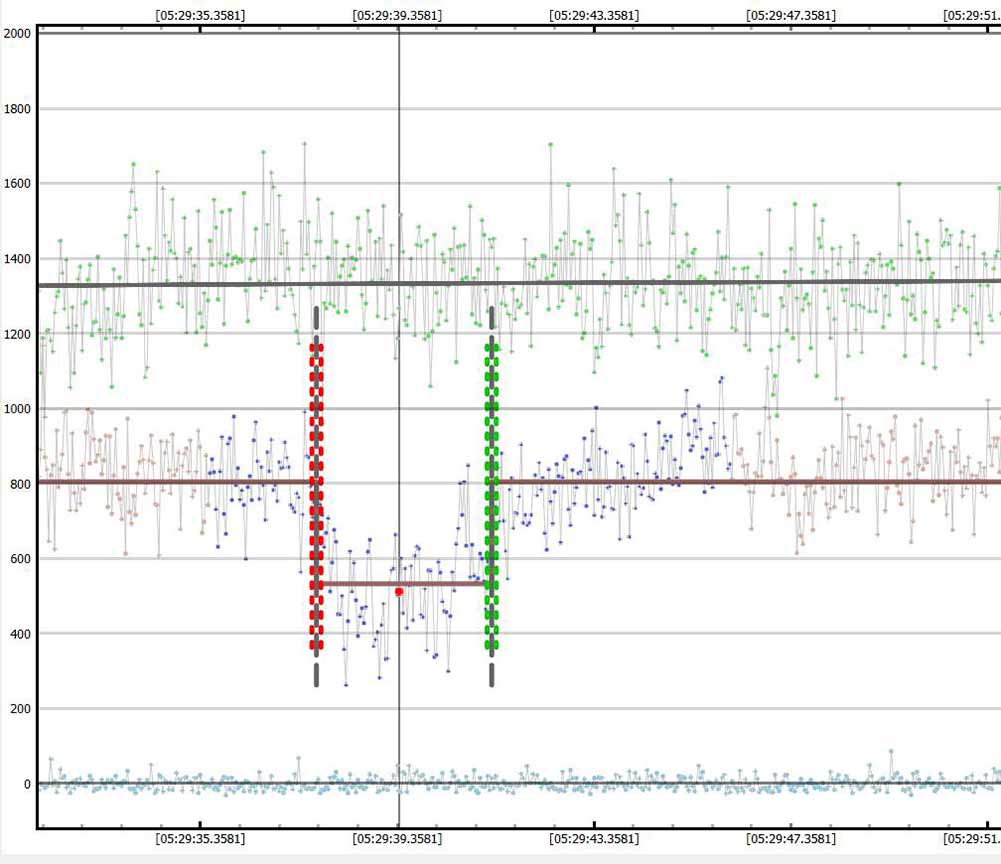
As An Occultation: Here is what PyOTE finds from my data...
magDrop report: percentDrop: 33.8 magDrop: 0.448 +/- 0.052 (0.95 ci)
DNR: 2.64
D time: [05:29:37.7181]
D: 0.6800 containment intervals: {+/- 0.0221} seconds
D: 0.9500 containment intervals: {+/- 0.0916} seconds
D: 0.9973 containment intervals: {+/- 0.2610} seconds
R time: [05:29:41.2781]
R: 0.6800 containment intervals: {+/- 0.0221} seconds
R: 0.9500 containment intervals: {+/- 0.0916} seconds
R: 0.9973 containment intervals: {+/- 0.2610} seconds
Duration (R - D): 3.5600 seconds
Duration: 0.6800 containment intervals: {+/- 0.0385} seconds
Duration: 0.9500 containment intervals: {+/- 0.1304} seconds
Duration: 0.9973 containment intervals: {+/- 0.3380} seconds
I used horiz/ver median filtering once again, 2.4px static circular masks. This at begin of recording. |
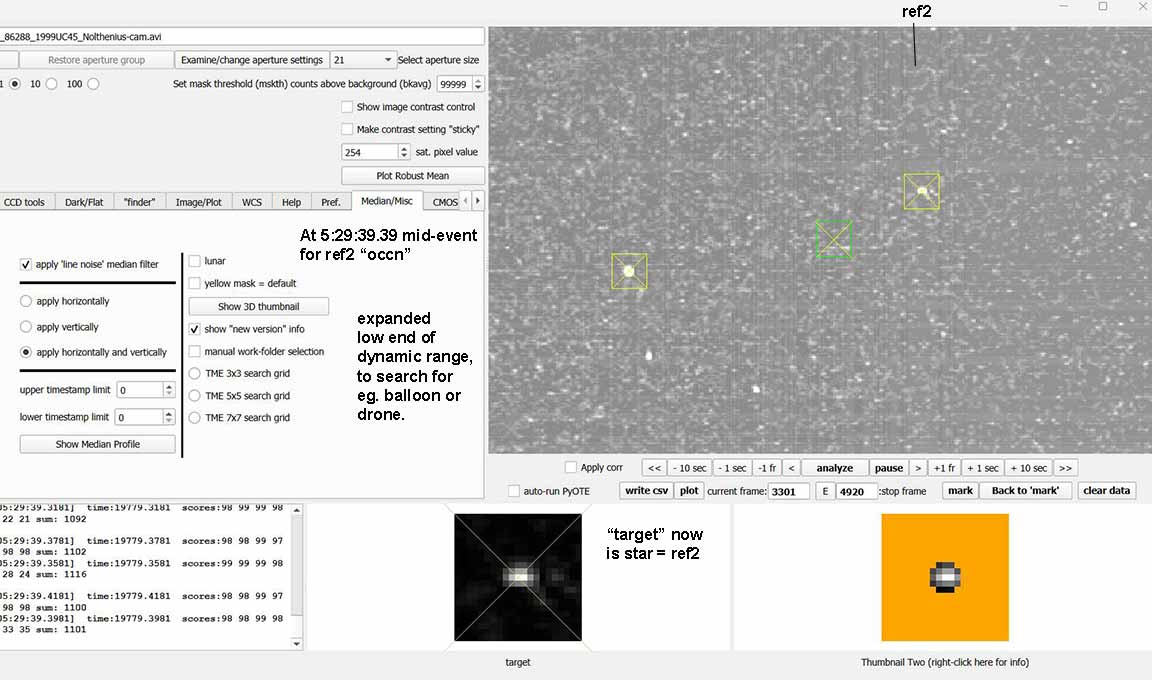
This image at mid-event for star=ref2, now to be analyzed as the "target" for PyMovie / PyOTE purposes. I expanded the low end of the dynamic range to bring out any faint nearby possible occulting objects. None are seen. |
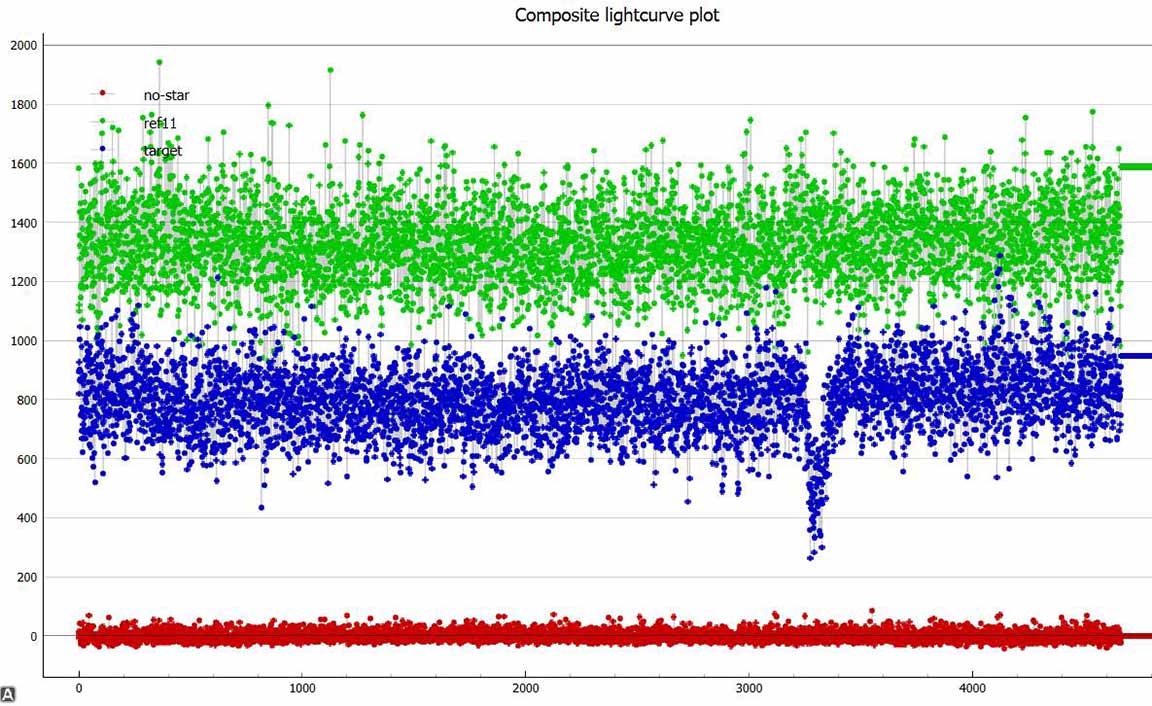 The two brightest stars on the chip. Neither showed saturation effects (top end clipping). One was Ref2, the brighter one was below/left in the images and was used as the reference star to analyze this apparent occultation. The two brightest stars on the chip. Neither showed saturation effects (top end clipping). One was Ref2, the brighter one was below/left in the images and was used as the reference star to analyze this apparent occultation. |
Light curve in Pyote. |
At best metric optimization, the reference star light curve is quite flat, arguing against variable obscuring aerosols or condensate. The night was dry, clear, and calm with no wind. |
PyOTE's occultation solution. 3.56 seconds long and tight D and R tolerances. |
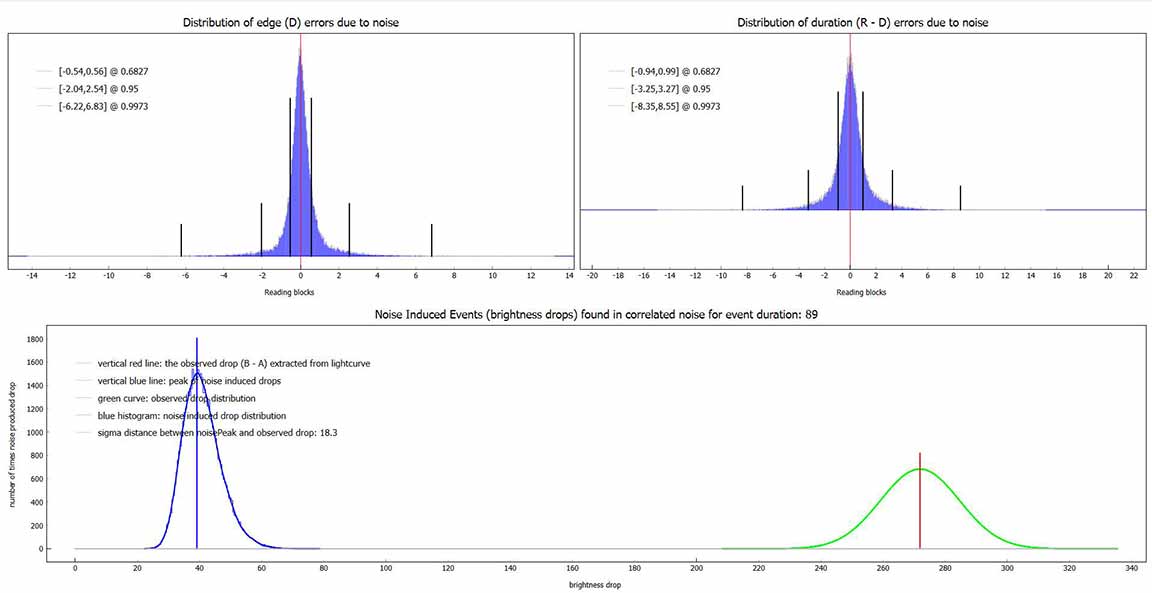 NIE test passes at 18.1 standard deviations |
Any ideas from the viewers that are not covered here?...?