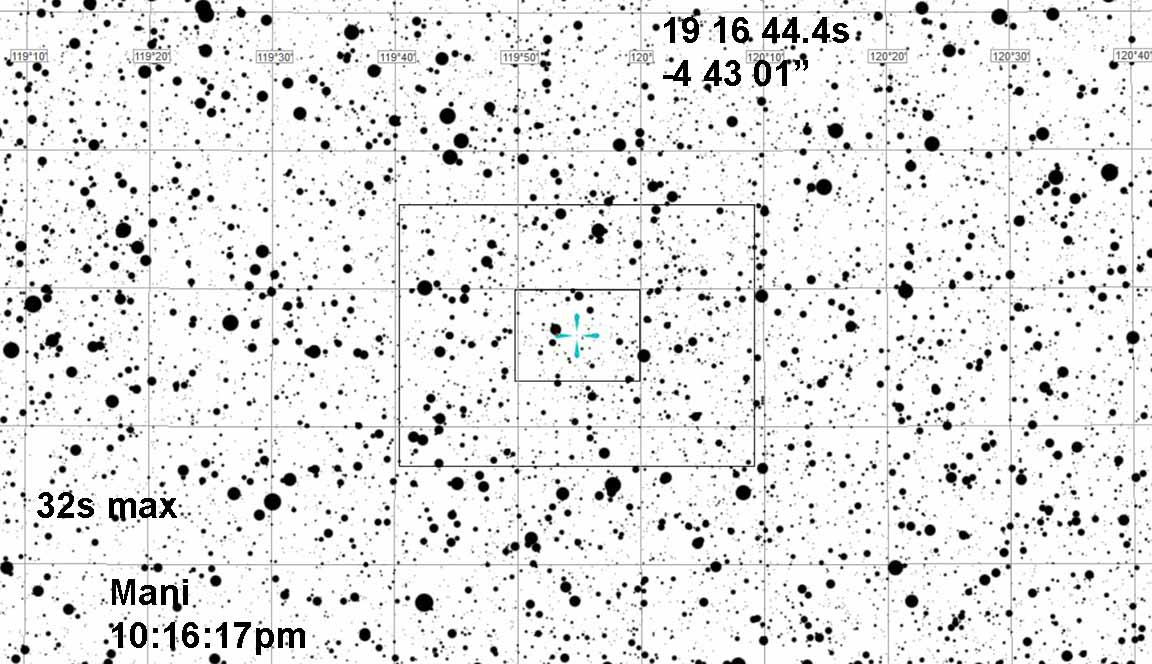
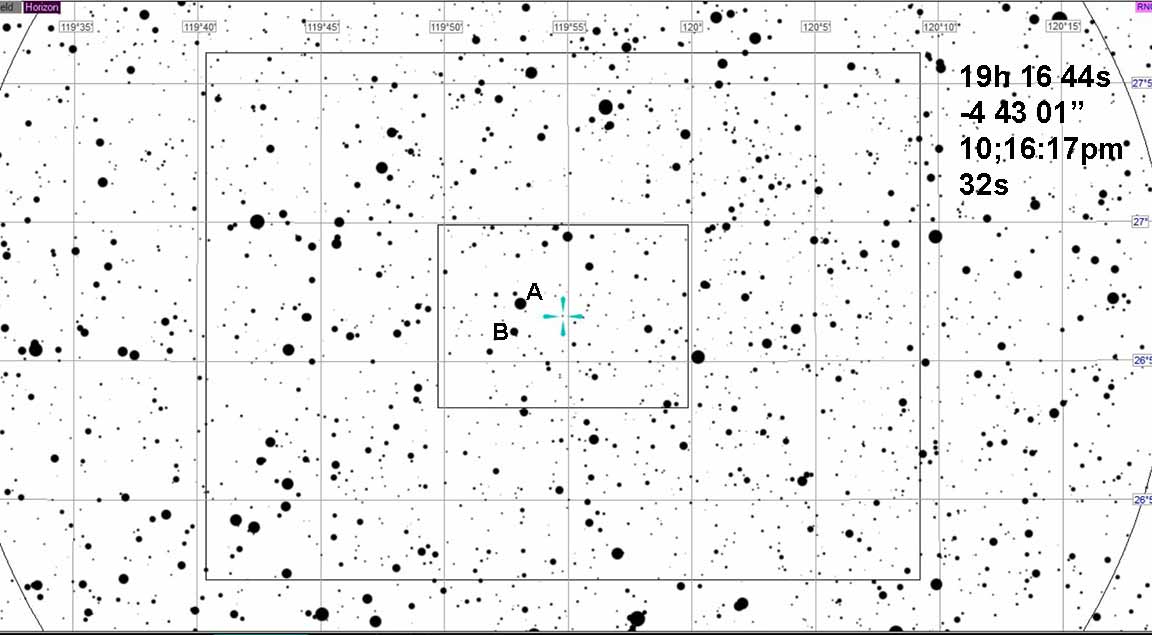
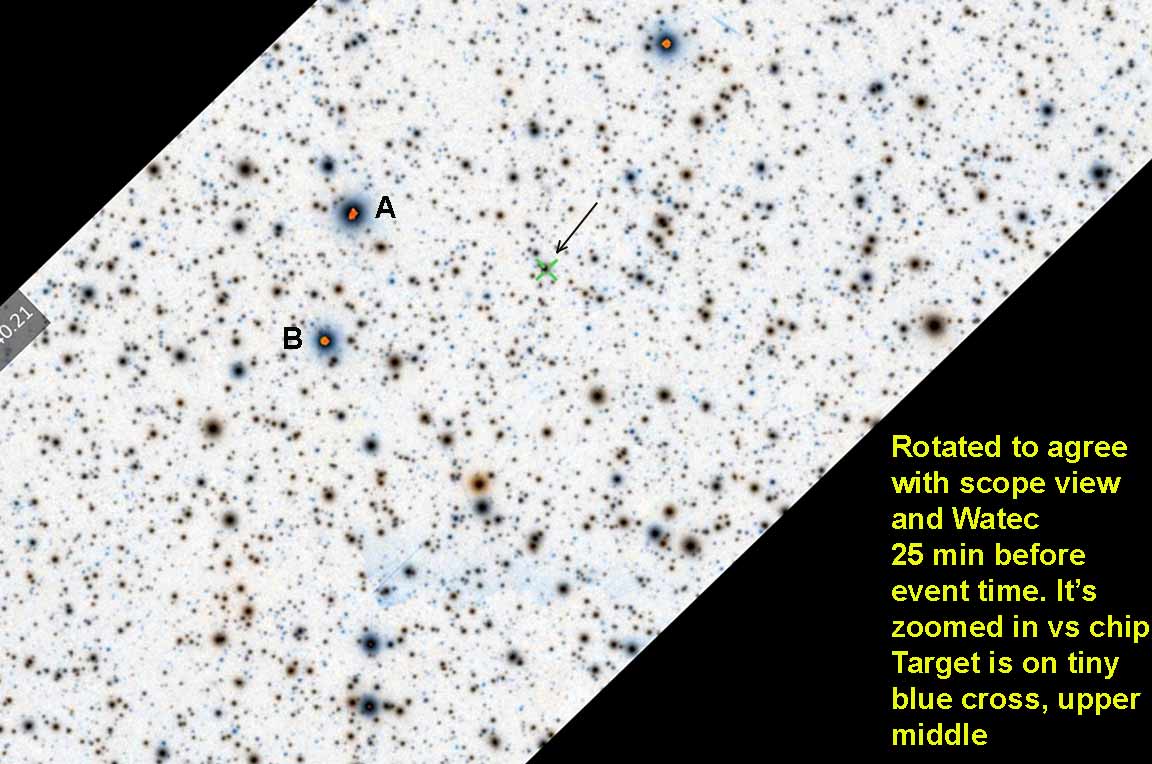
This is a very difficult event in that the target star is 15th magnitude. However, we should have very dark skies above the fog in BD and no moon. If necessary go to integration setting = 256x to get the star. That's 5 seconds per PAL integration. The star nominally should disappear for about 15s for us, we're inside the northern limit but the rank is such that we could get anything from 32s to 0 seconds for a duration. At 30 min before the event, the Az=119. At event time it will be Az=126 degrees.
There are two prediction paths. One is from OWc and has us well on the north side but inside the path decently. We're about 70% of the way from centerline to the northern limit in Marin County. The other (better?) prediction is from Lucky Star and has Santa Cruz pretty much on the centerline. Odds look pretty good for a positive from our entire county. I hope we can get observers including Karl and Bernard from his home, as the fog is perhaps likely to be less troublesome tonight. The "heat dome" high pressure is coming in.
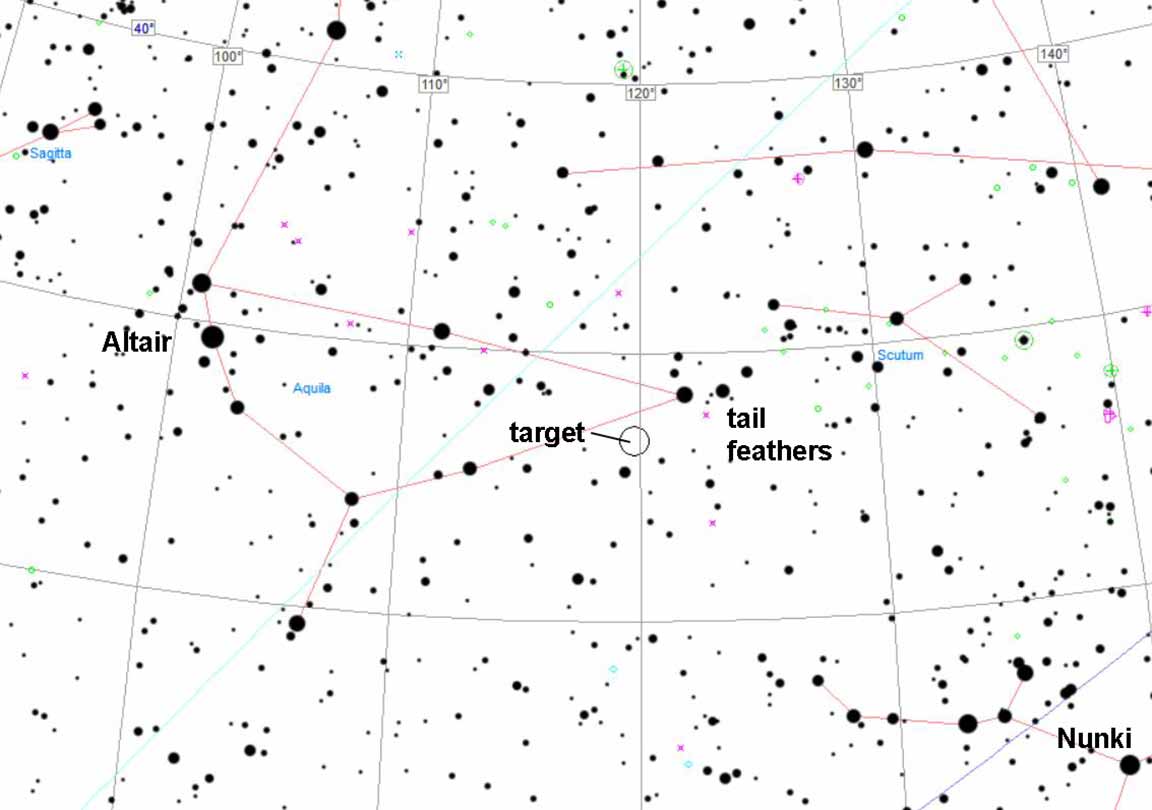
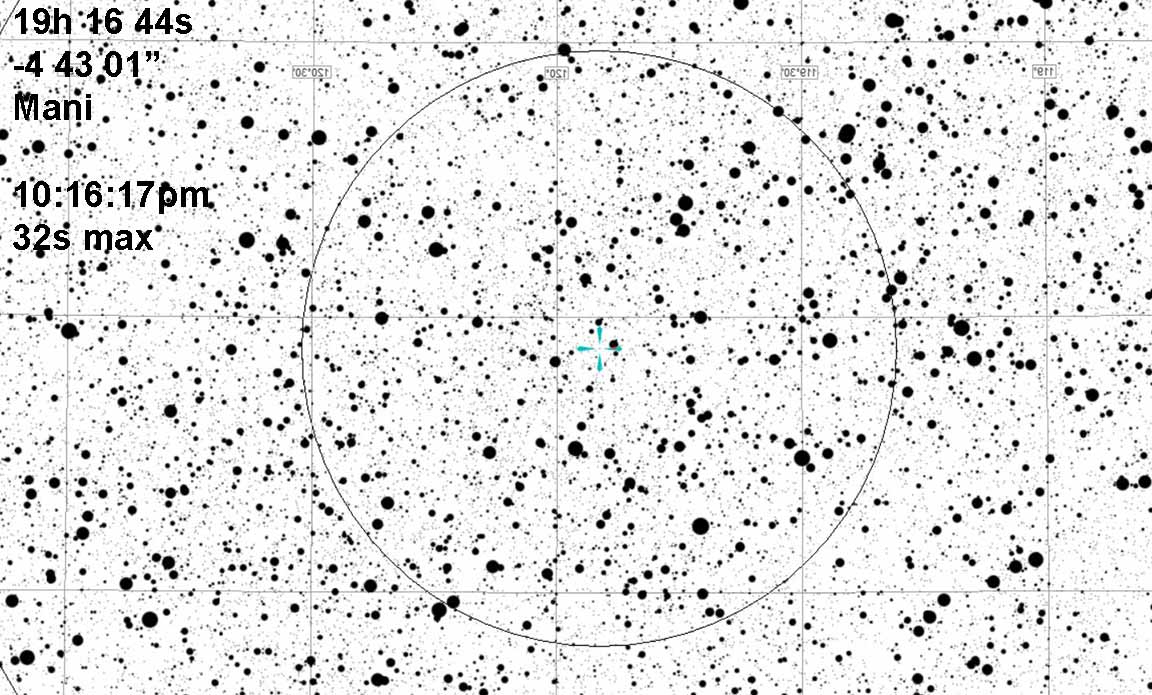
Alt=32, Az= 126, in Aquila just left of the "tail feathers" border with Scutum. See wide skymap below.
RUWE=1.00 which is good and safe. Gaia GR3 data name: GDR3 4212215134632514304 and this seems to align with UCAC4 427-101189 with W=15.8 magnitude
J2000 Coords:
RA = 19 15 20.06
Dec = -4 45 54"
On Date coords (use these for setting the 8SE on target)
RA= 19h 16 44.4s
Dec = -4 43 01"
This is a LuckyStar event, being a KBO. That means they will want a flat field video and a dark video too. Refer to my instructions on taking Dark video and Flat video for our Watec and 8SE cameras. These two additional videos may be essential to LS to get maximum signal to noise and verify the event vs. w/o using them (as we usually do).
Flat and Dark video instructions
|
|
|
|
|
We had very good skies, no moon, and at least at PineRidge cul-de-sac, good seeing and dry conditions. The star was over the SE, which is over Santa Cruz so the sky wasn't as dark as would be ideal, but dark enough that at 128x setting the sky was decently dark. At 256x however the sky was too bright and not usable. Estimated temperature = 62F
I set up at Pine Ridge Rd cul-de-sac. No disturbances by cars or people. No wind. Excellent conditions. I got on-target by ID'ing the llittle bright triangle which was above the target. The star field was dense and the predicted W magnitude was an extremely dim 15.8. This caused me to hesitate on what setting to use. There were two stars about in the right place, one very faint and another reasonably bright and do-able I felt at 64x. But 128x was brighter and the very faint star next to it may be do-able at 128x but not 64x. 256x was too bright a sky and not suitable nor easier to see stars. 128x was the choice. As it turned out, it was also the choice of Kirk and Karl. I spent time getting the focus as perfect as possible, not easy to do when the setting was 2.56s per integration.
The recording was going fine, starting 5 min before the event at 5:12 UT. But after just a minute, the screen froze and was not updating. Then a message on screen said my HDD was very close to full and I needed to delete files to make more space! I assumed the two happenings were related, so I halted recording and frantically looked for files to erase. I got rid of 2GB of files and then re-started the recording. It was 5:14:32 UT now, and I was able to keep recording until 5:20:58 UT when it froze again, and I stopped recording.
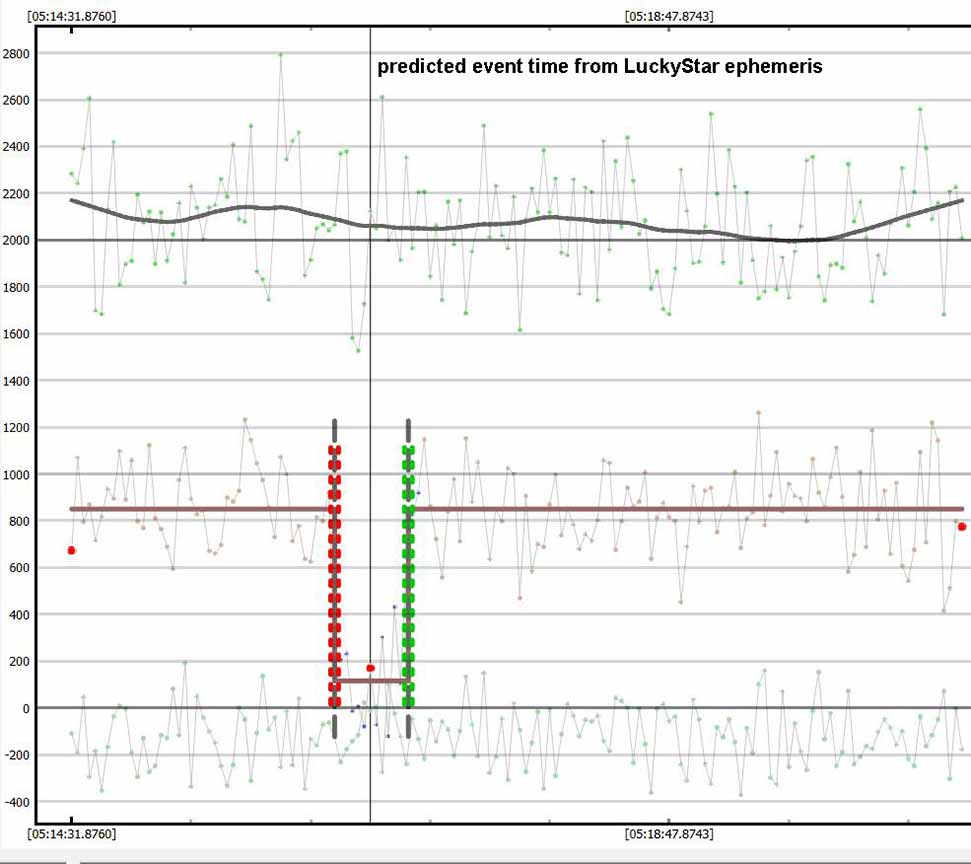
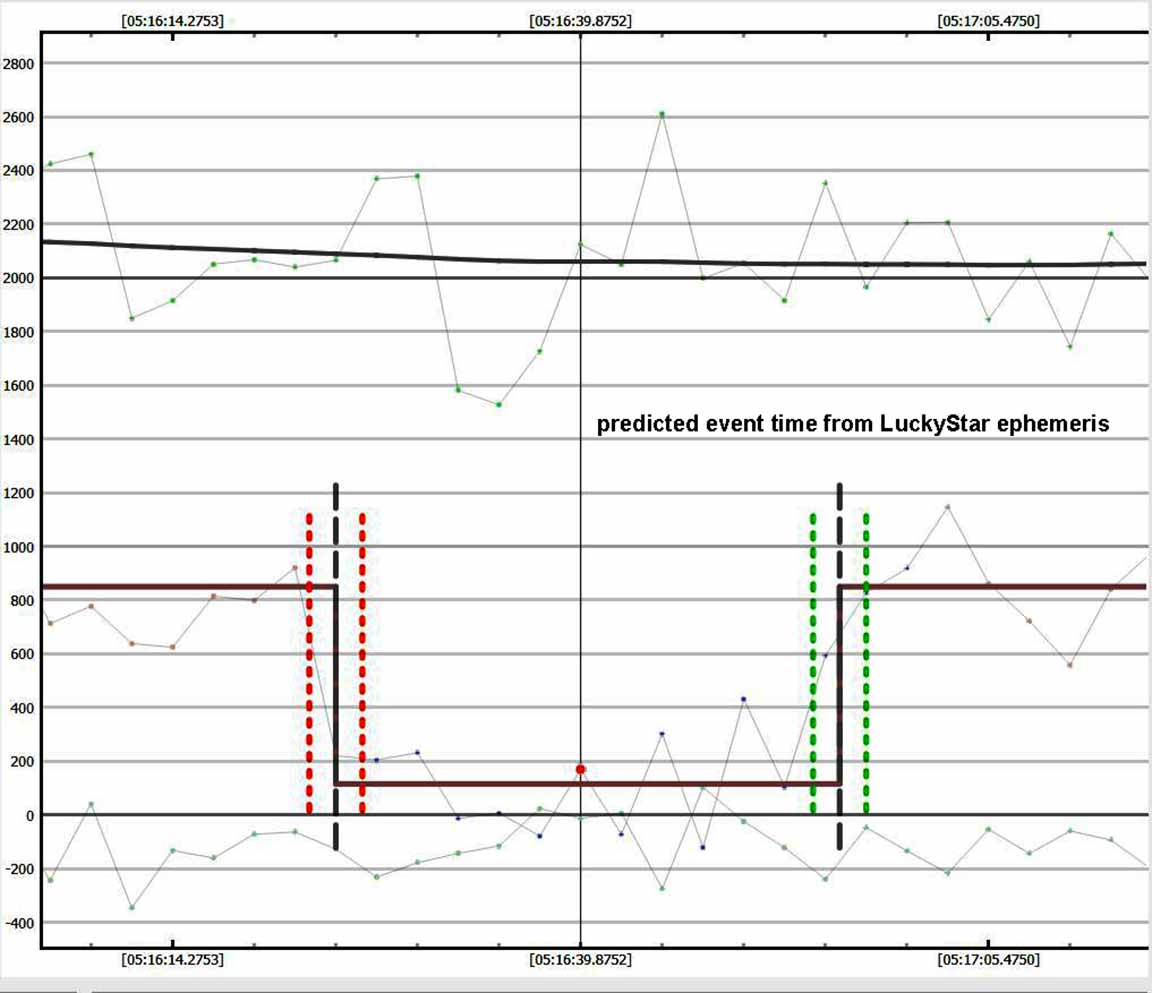
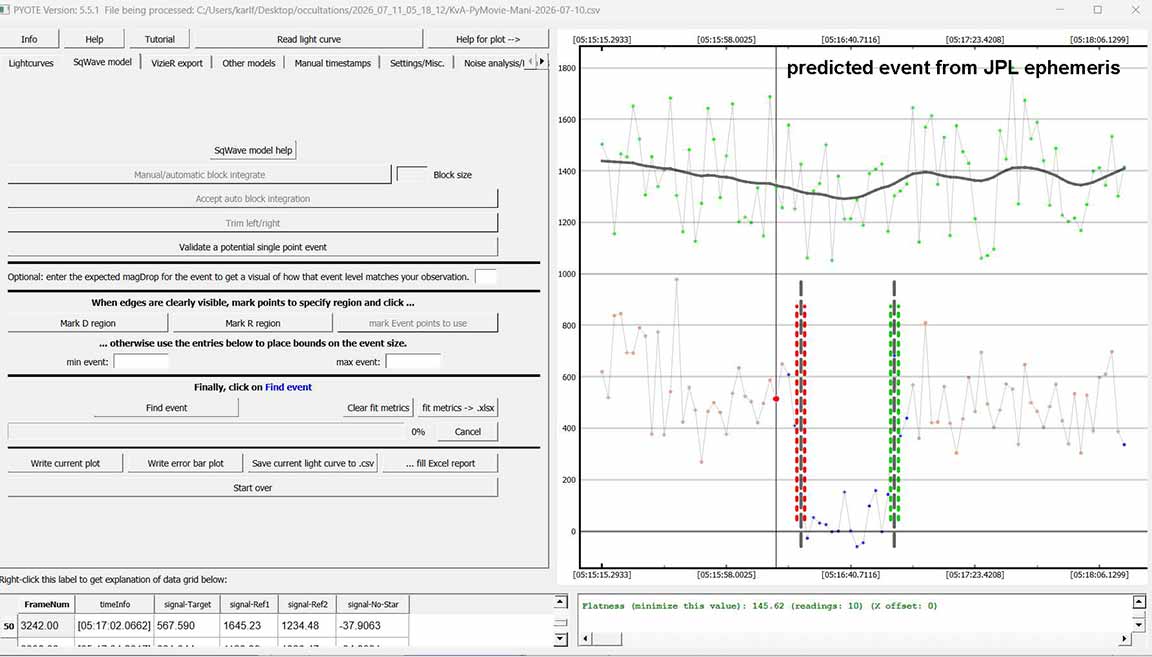
Before driving up to Bonny Doon I set up the scope in the driveway and got a flat field of about 15s duration, at 1/100,00s per frame, so highly unlikely there will be any stars, nor did I see any during the recording. The flat field looked normal. I didn't see horizontal or vertical banding as is more easily seen on the older PAL Watec that is now in OccBox4 which I hope will be used soon by Danika. After the recording of the occultation, I tried to get a dark video. It lasted only 3s before the video update seemed to freeze. I talked with Karl afterwards and he said that he's seen that on his Lenovo computer too, and figured out that if he just clicked anywhere, it restarted updating, and the computer did not drop any frames, They were recorded even though the visible computer screen wasn't updating. I've not yet checked if this is true. I had written predicted times based on the OWc JPL predictions. The predicted center time came, and went, w/o the suspected target star disappearing. I was about to conclude I'd had a miss, when the target disappeared clearly, and stayed disappeard until 5:16:57 UT. A very clear visual occultation. I asked PyOTE to find the best event lasting between 10 and 33 integrations in duration.
For "Start" below it is the un-interrupted restart after files cleanup. This is also what is on the IOTA report form. Actual first start was earlier, but inspection shows nothing remarkable in the early recording.
Start:6:14:31.9 UT
End 6:20:53 UT
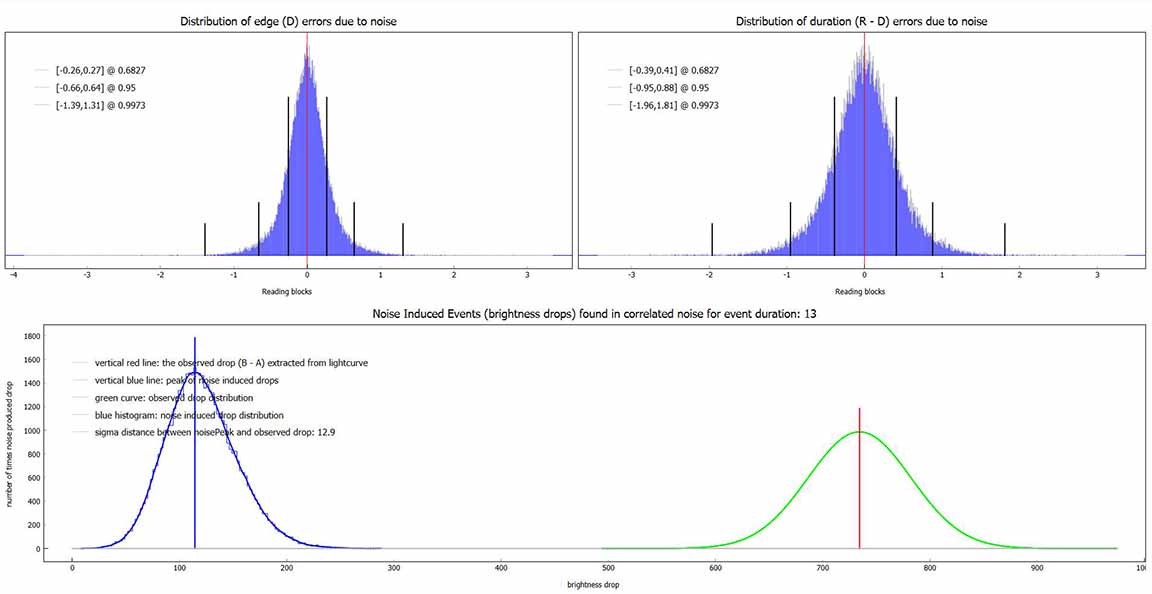
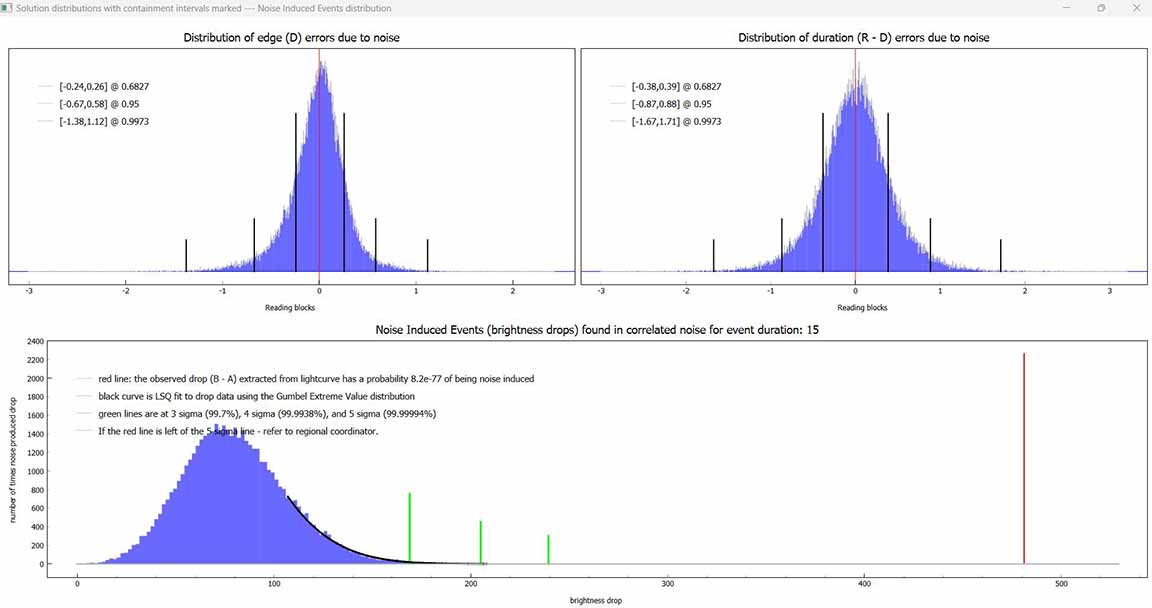
NIE test: 12.9 sigma
magDrop report: percentDrop: 86.4 magDrop: 2.167 +/- 0.922 (0.95 ci)
DNR: 4.34
D time: [05:16:24.5153]
D: 0.6800 containment intervals: {+/- 0.6688} seconds
D: 0.9500 containment intervals: {+/- 1.6645} seconds
D: 0.9973 containment intervals: {+/- 3.4538} seconds
R time: [05:16:56.1255]
R: 0.6800 containment intervals: {+/- 0.6688} seconds
R: 0.9500 containment intervals: {+/- 1.6645} seconds
R: 0.9973 containment intervals: {+/- 3.4538} seconds
Duration (R - D): 31.6102 seconds
Duration: 0.6800 containment intervals: {+/- 1.0199} seconds
Duration: 0.9500 containment intervals: {+/- 2.3443} seconds
Duration: 0.9973 containment intervals: {+/- 4.8264} seconds
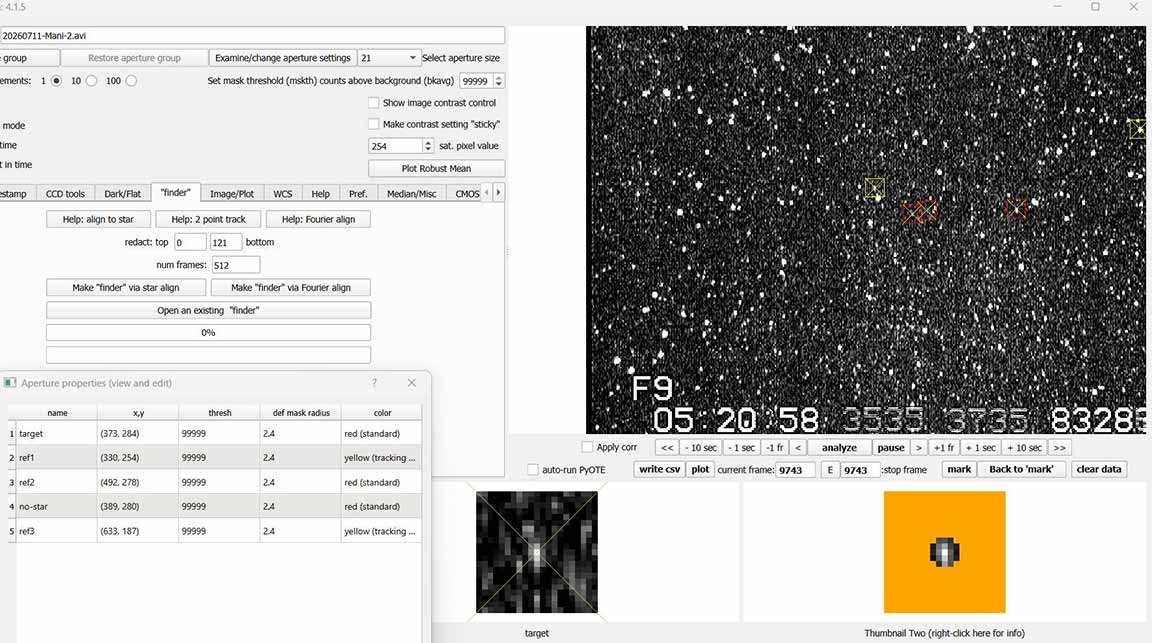
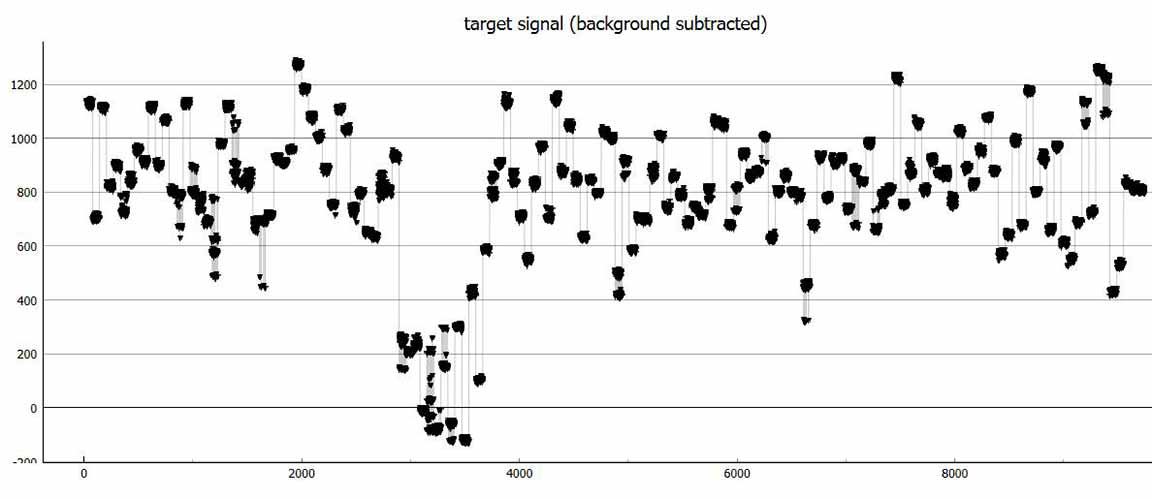
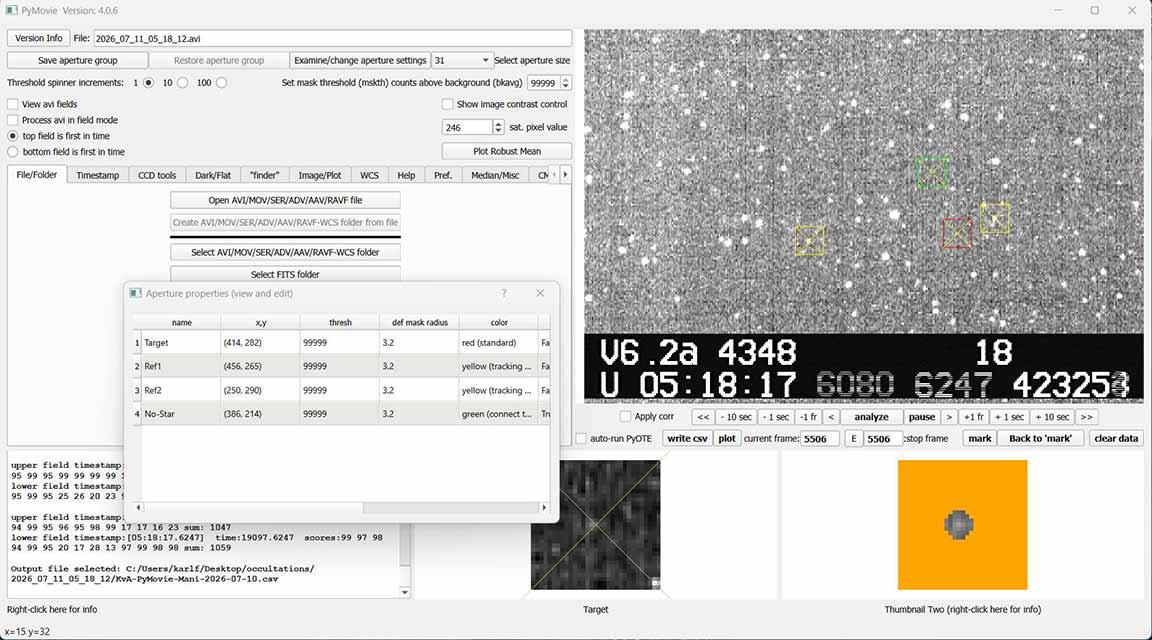
Screen capture of PyMovie and my mask on target star |
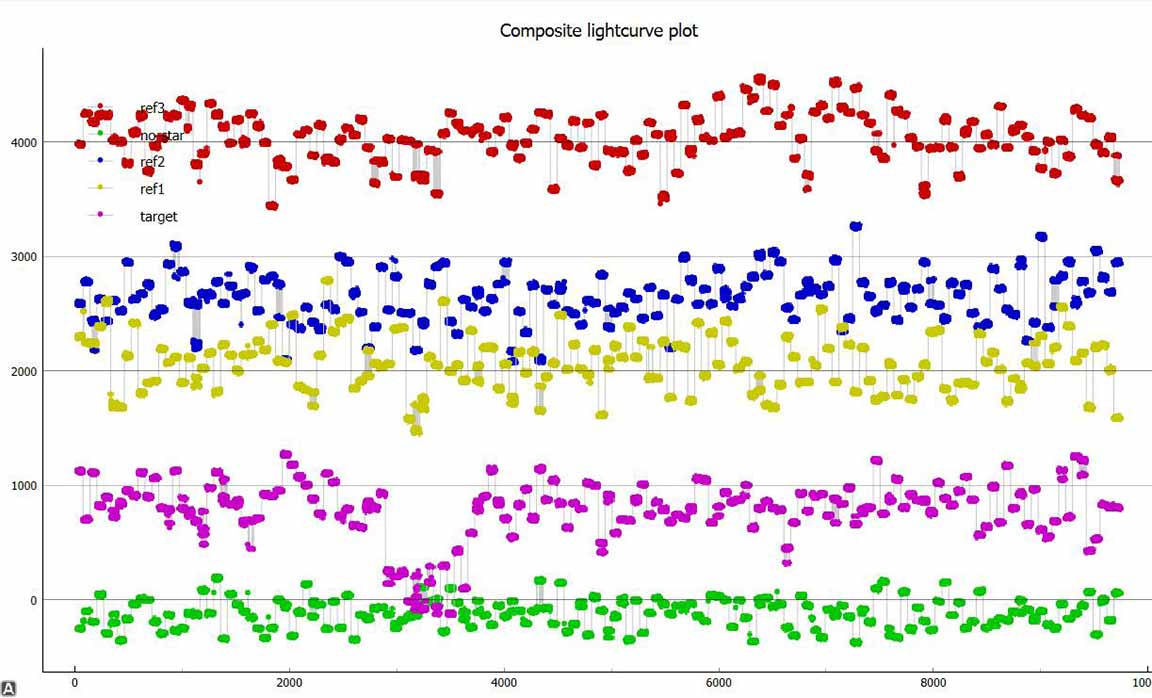 |
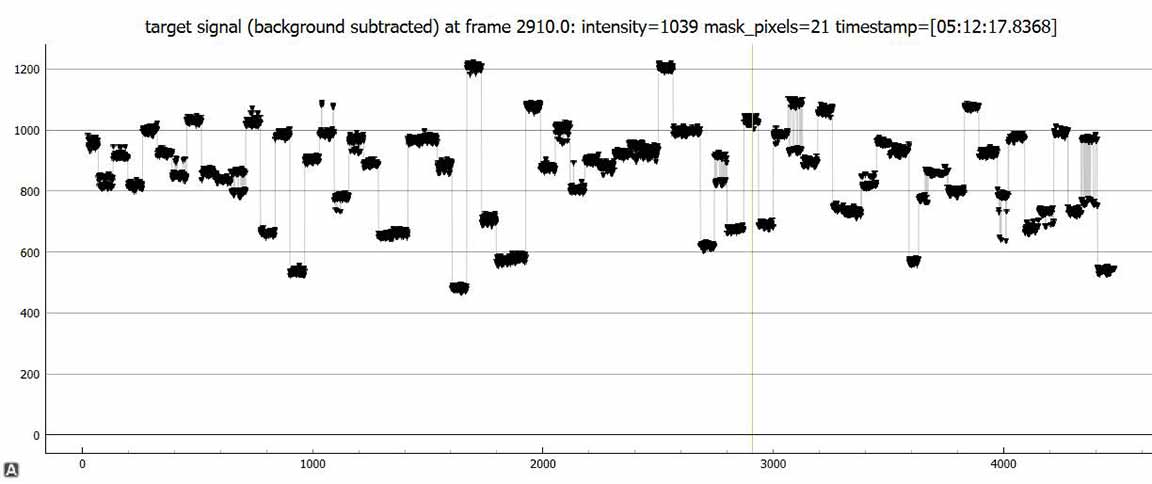
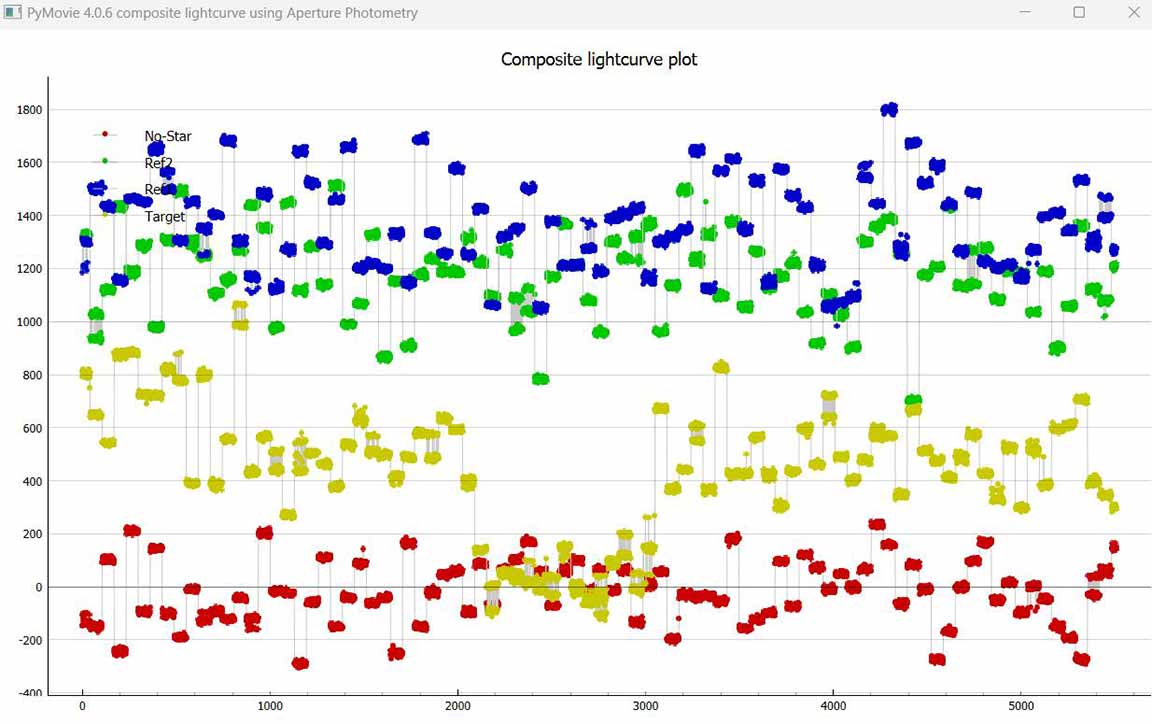
Raw PyMovie data. Mask set at 2.4px and stars were very well focused on screen. |
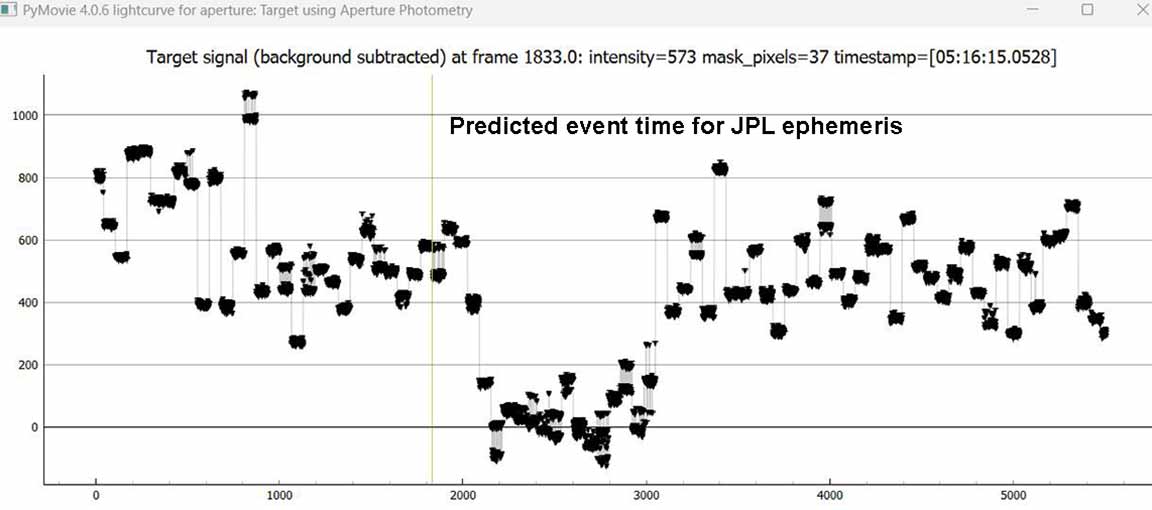
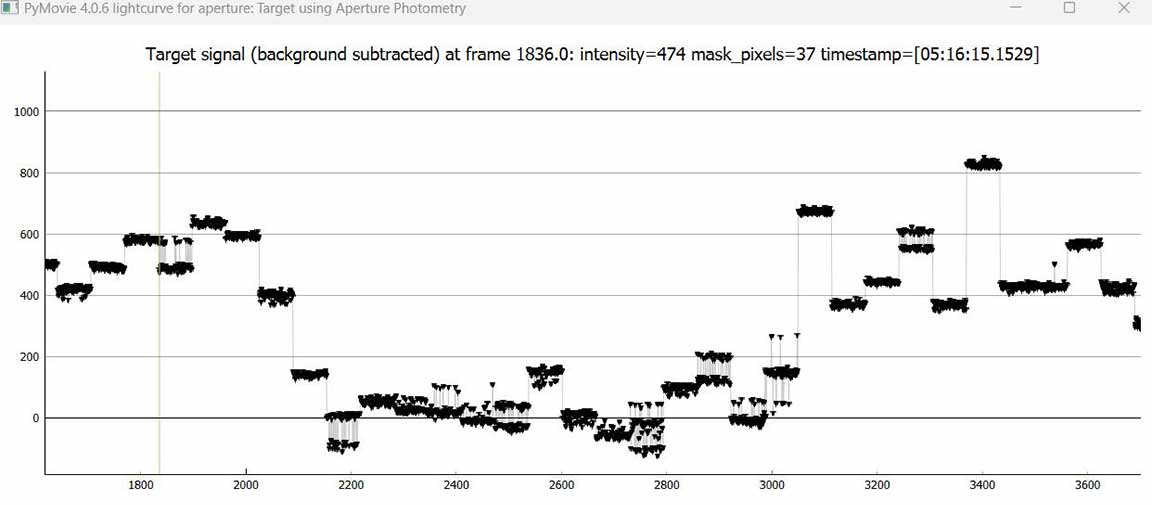
The LuckyStar ephemeris prediction looked to be bang-on. It said Santa Cruz was near the centerline and indeed my duration was the maximum of those reported and longer than the 24s predicted by GDR3 default in OWc predictions, and exactly as long as the LuckyStar max predicted event duration of 31.6s |
And the time of the event was perfect, to the second, in LuckyStar's ephemeris. There remains the possibility this is a binary star, and a faint companion = 14% of light of primary star, remained unocculted. |
Solid detection. Amazing for such a faint W=15.8 star. I'll have to revise my assumption of what can be reached by an 8SE scope with a good Watec under dark perfect conditions. |
Comments: The target does not go to zero value as it should if only the dim single KBO remained. Could the KBO be bright enough to show detection as seen here? It's a large object, one of the largest KBO's it would seem. LuckyStar had the correct diameter, it seems, predicting a 31.6s event which is what I saw. It said the magnitude of the KBO was then 20.3. That's 5 magnitudes dimmer than the unocculted image, so that the remaining light should be only 1%, not 14% as PyOTE finds (86% light loss).
The D for my event looks sharp, but the R does not, yet the duration argues I was near the centerline so that no grazing incidence was possible. Noise is possible as explanation, But I wonder - a binary star?? I'll await what is seen in other light curves.
No evidence of secondary events, not in either side of the interruption, or our other chords. Below is the interval from 5:10:20UT to 5:13:21 UT which is labelled as "-1" in my .avi names
No evidence of a drop in the target during the pre-event period I separately recorded. No moonlet lurking here, it seems. |
July 16- fixed IOTA report site elevation from an incorrect value, flagged by reviewer. Resent.
Observed from the SCAC Star Party in Zyante.
Got a clear positive from home.
magDrop report: percentDrop: 91.5 magDrop: 2.678 +/- 0.952 (0.95 ci)
DNR: 3.32
D time: [05:16:23.6280]
D: 0.6800 containment intervals: {+/- 0.5493} seconds
D: 0.9500 containment intervals: {+/- 1.4348} seconds
D: 0.9973 containment intervals: {+/- 2.9376} seconds
R time: [05:16:55.6598]
R: 0.6800 containment intervals: {+/- 0.5493} seconds
R: 0.9500 containment intervals: {+/- 1.4348} seconds
R: 0.9973 containment intervals: {+/- 2.9376} seconds
Duration (R - D): 32.0318 seconds
Duration: 0.6800 containment intervals: {+/- 0.8208} seconds
Duration: 0.9500 containment intervals: {+/- 1.8715} seconds
Duration: 0.9973 containment intervals: {+/- 3.6169} seconds
 |
 |
 |
 |
 |
 |