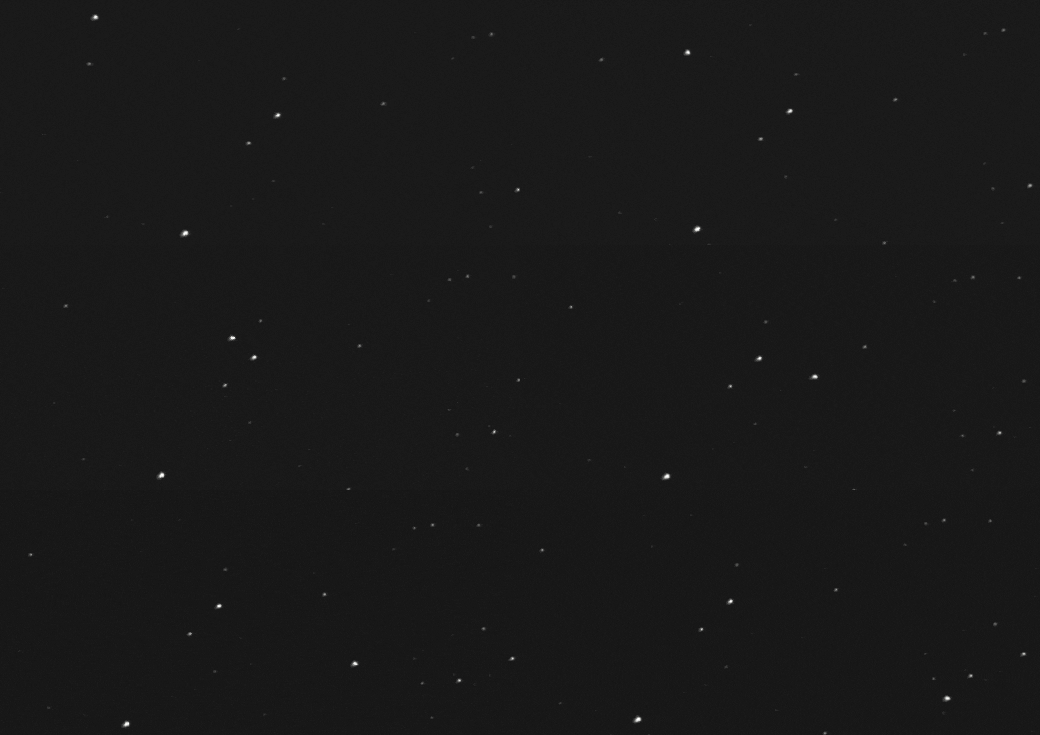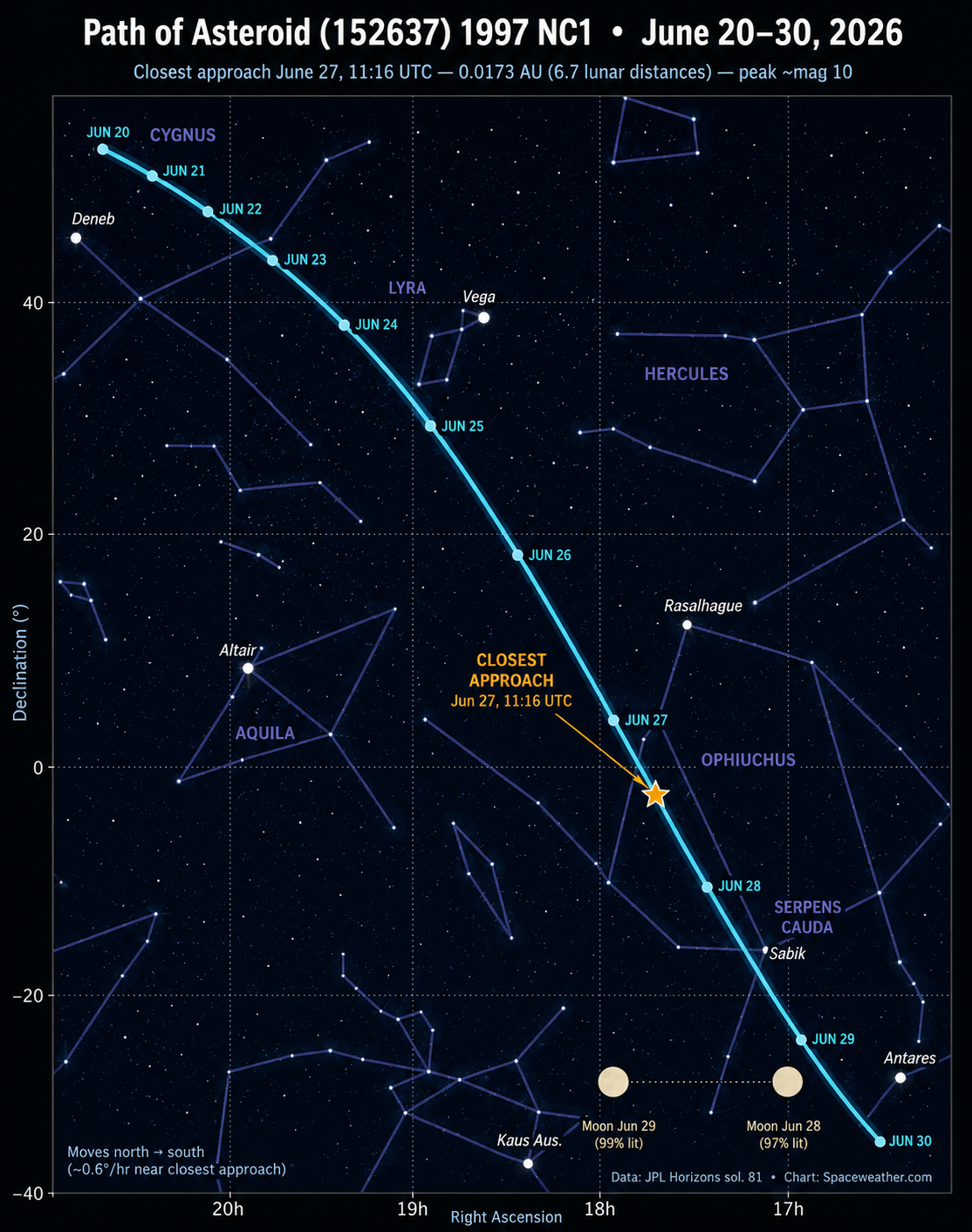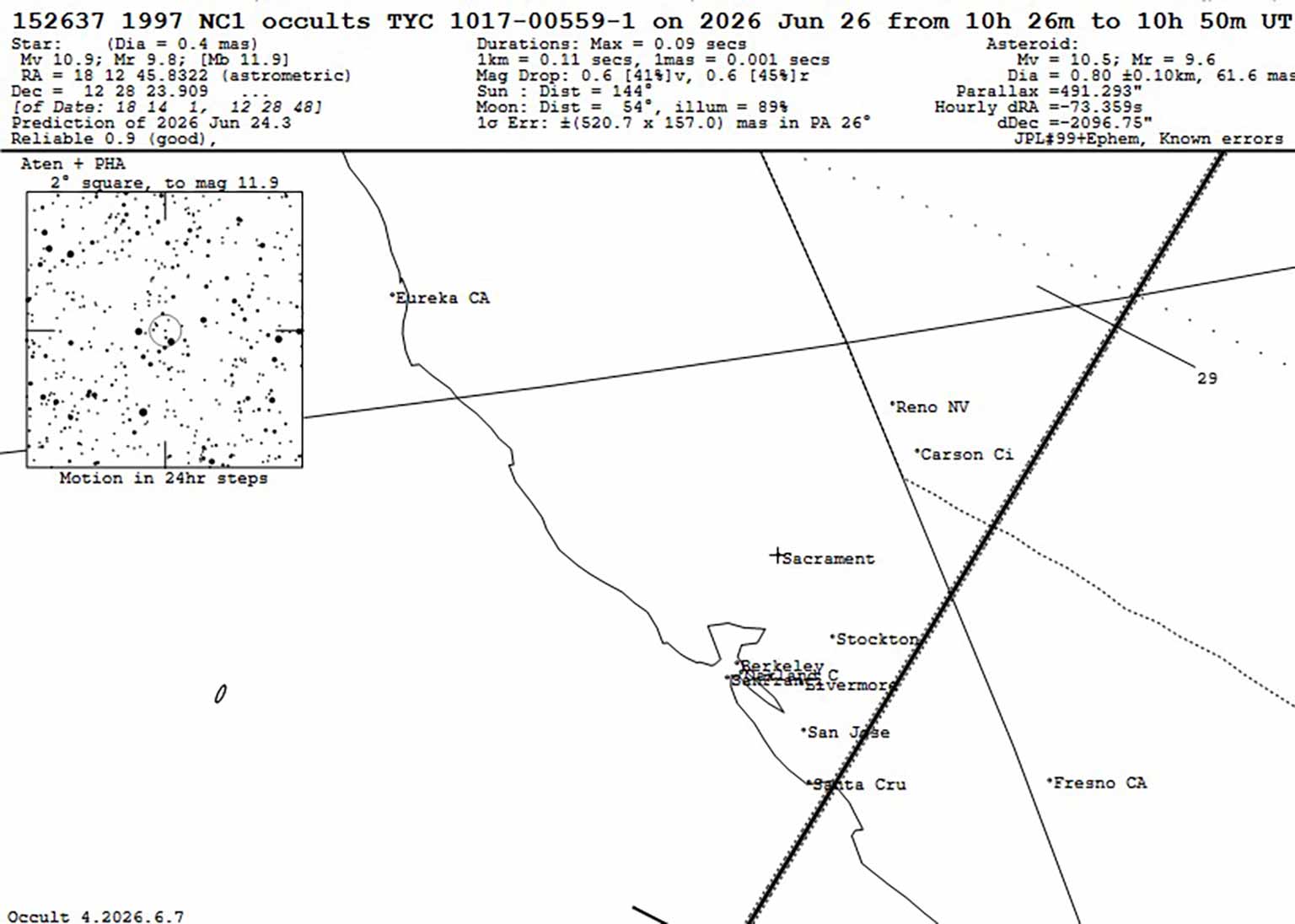
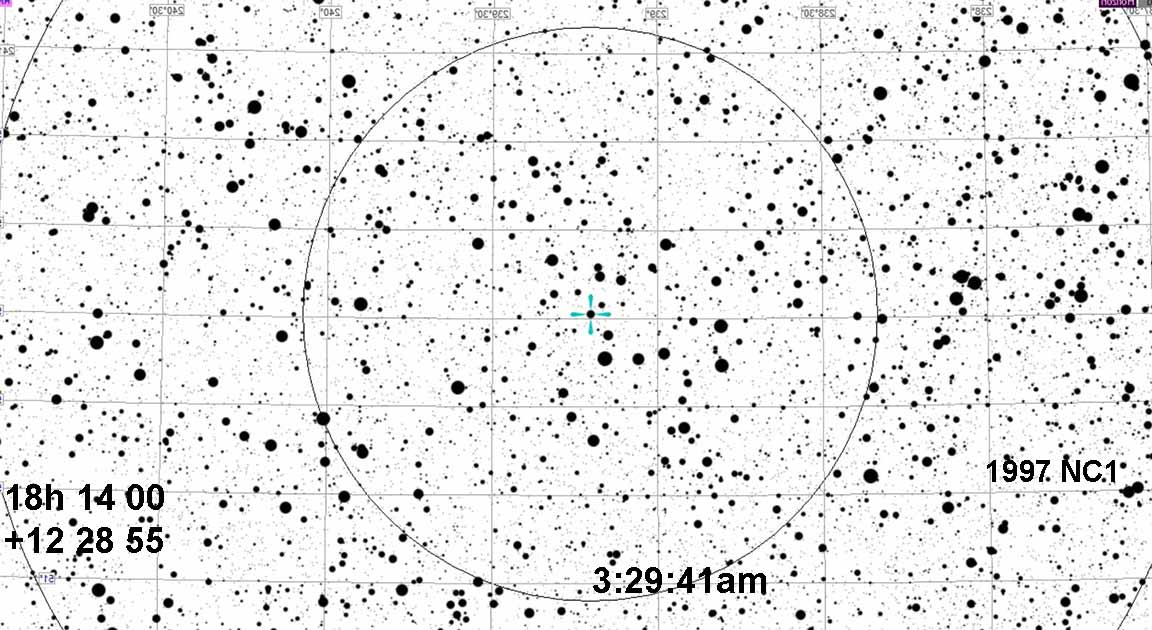
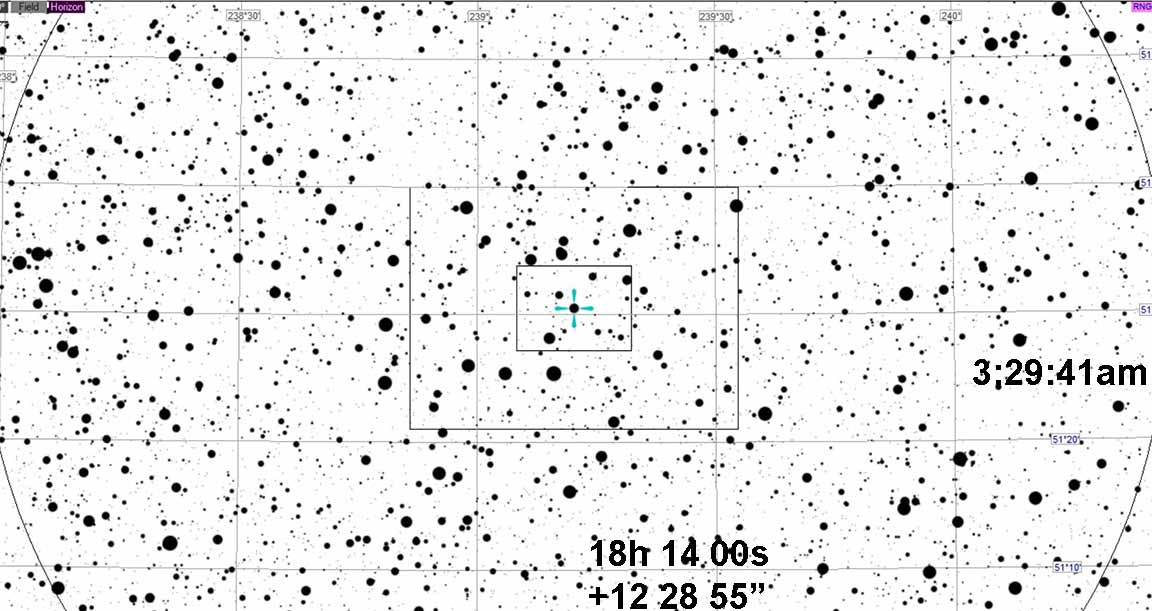
This is a very high value event, as this is an Earth crossing asteroid and making a close approach to Earth right now. Orbit modificaton much desired. Worth a paper in the Planetary Defense publications I'm sure. We have one positive already, from Norm Carlson, which refines the path quite a bit. Odds are rather good for an occultation if we're very close to the predicted path. That path goes right through Santa Cruz County, Aptos and SC mtns. Can we get above the fog???
1x setting will be essential, but quite do-able for such a bright star.
Alt=49, Az=238 in Ophiuchus, 10 deg above/left of Rasalhague (top of the cap).
|
|
|
Sites: Llagas Rd in San Martin: Lat=37 04 18.7"
Below is a cut/paste from Spaceweather.com. This Earth-grazing asteroid is big enough to cause global damage. We need to keep up with its changing orbit in this multi-gravitational attractor solar system.
"A BIG ASTEROID IS ABOUT TO FLY PAST EARTH:It is often said that Earth is in a shooting gallery. This weekend, amateur astronomers can watch one of the bullets streak by."
On June 27th, near-Earth asteroid 152637 (1997 NC1) will fly past Earth at a distance of 2.6 million kilometers. There's no danger of a strike, but the flyby is significant anyway. This is a large, kilometer-class asteroid (between 0.7 and 1.6 km across) making its closest approach in more than 400 years. And it will be visible in backyard telescopes. Six-inch optics are enough to see it. The asteroid will brighten to 10th magnitude as it races through the constellation Ophiuchus not far from red giant Antares. At closest approach, the speedy space rock will move so quickly that observers can watch it drift against the background stars in only a few minutes.
If 1997 NC1 struck Earth, it would blast a crater ~10 km wide and loft enough dust to alter global climate for years. There is, however, no danger of a collision for at least a century. Over the weekend, NASA astronomers will use a Deep Space Network radar to investigate the asteroid in case it ever becomes a hazard in the distant future. |
I could not get a response from anyone else in my team. Kirk needed sleep, Karl was going to try from home, but fog killed that idea. No one else on the list responded. So, it was just me this time.
This was a high enough priority event. I made the choice to go for it, even if it meant driving to Morgan Hill, a 100 mile round trip at 3:30am. I got there OK, after a nice dinner with Kent and Barb at Kent's cabin, and probably too much wine and fine beer as we grilled the latest news and projects, and also grilled black cod...
I set up at the coordinates above, on Llagas Ave in San Martin under mostly foggy skies. There was a clearing (thinner anyway) around the target, and I got a 2-star align on Altair and Rasalhague, and successfully got on target and started recording 2 min early, when it was clear enough to ID the star field. But 1 minute before the event, the star faded into the thickening fog as it rolled up from the south, as it comes through the Pajaro River gap. Snapped one picture of the set up. I was 110 ft southeast of the power pole opposite the entrance to a home.