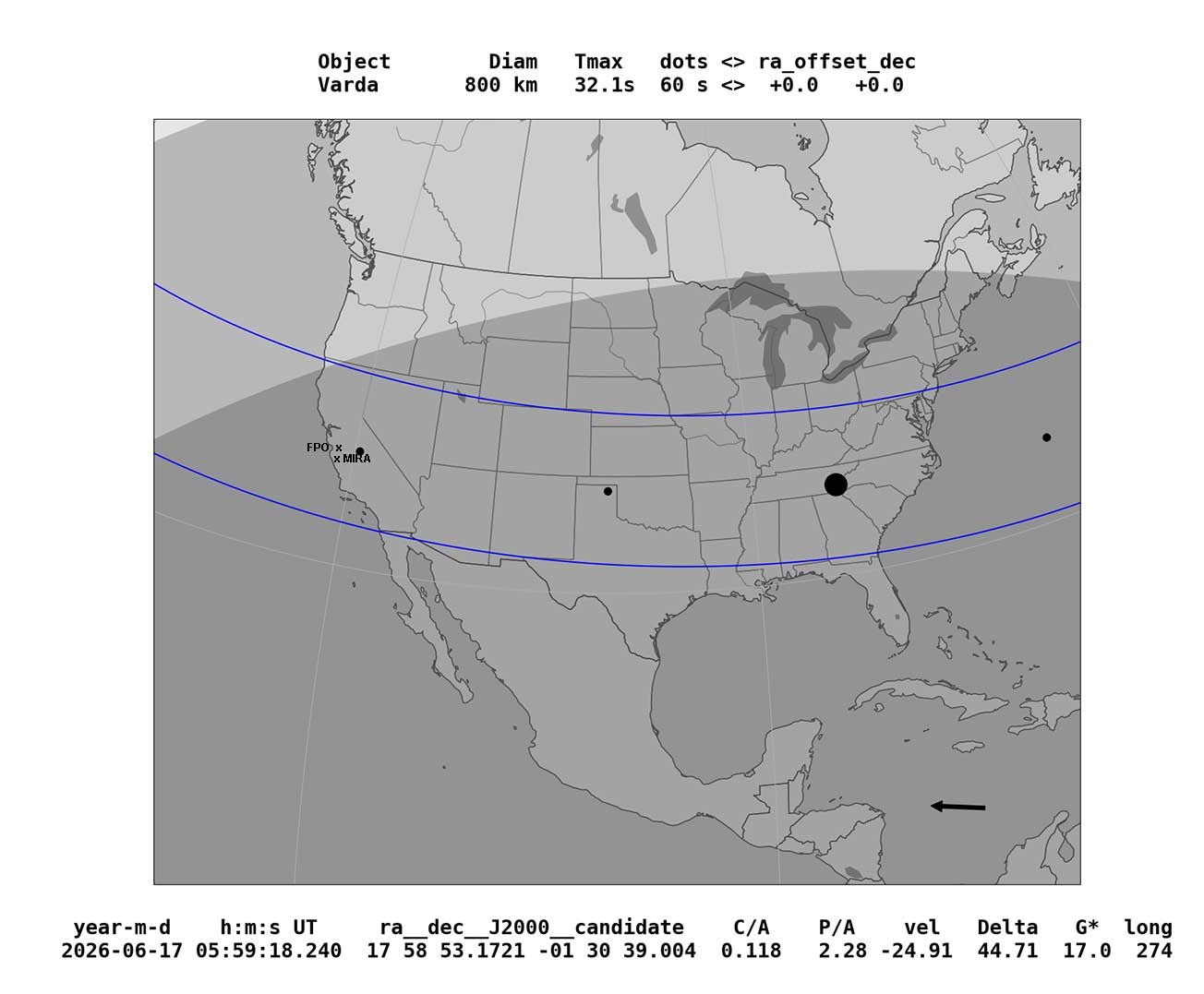
This is the LuckyStar -NIMA path, includes all of California
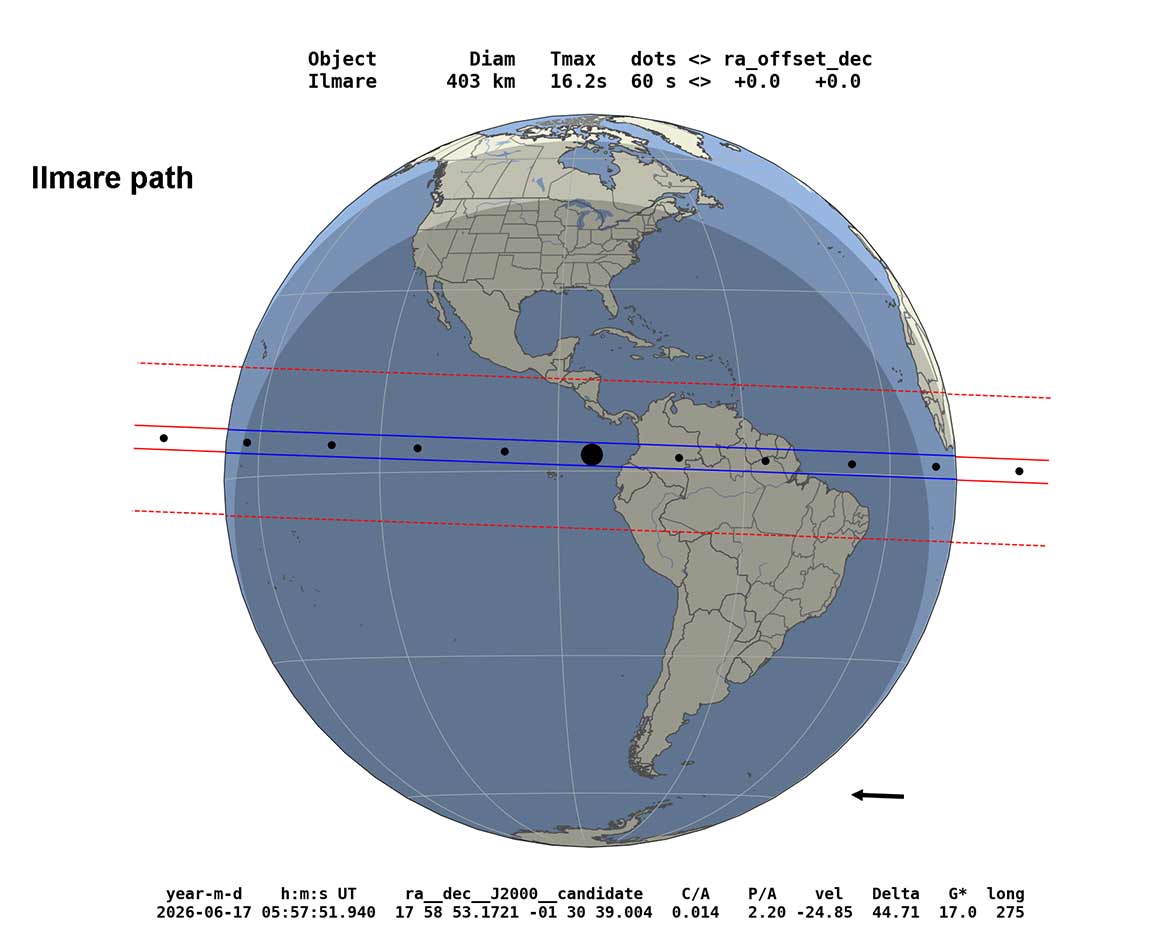
Varda's moon Ilmare, path is far south
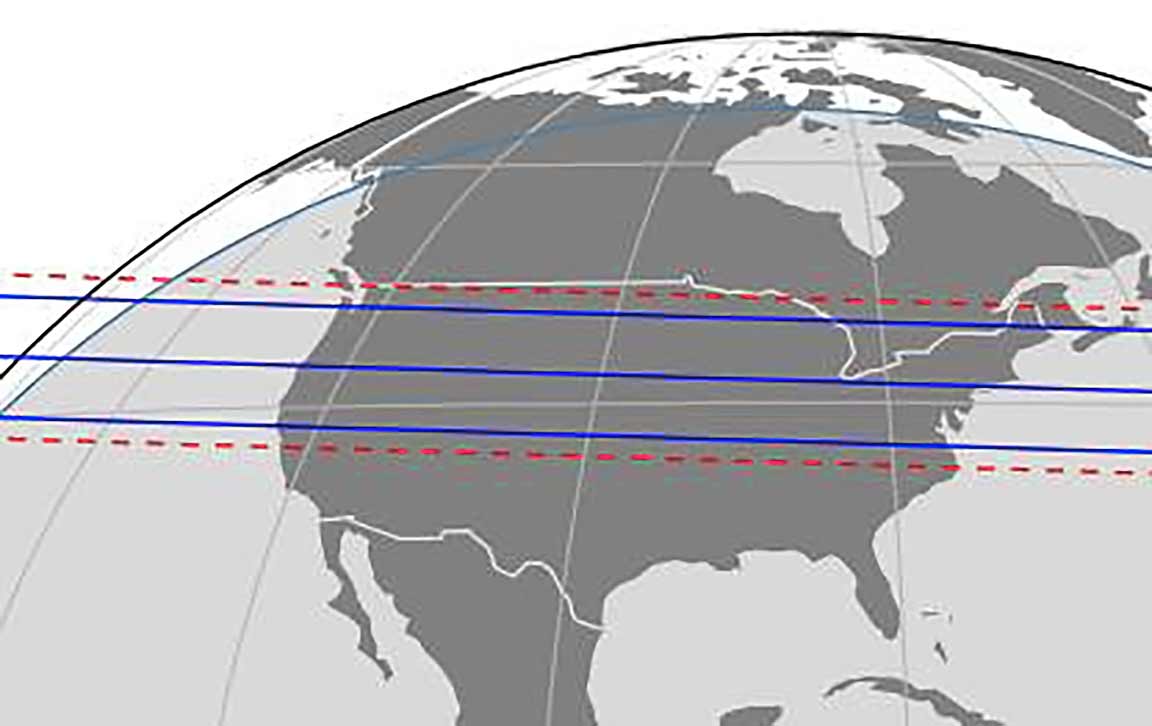
The more northern JPL path, which Ben feels may be the favored one. The accuracy limits seem likely to be worse, I'm guessing.
This object is a special research project of Ben Proudfoot, and the Wiki article summarizing what's known about this object shows that despite being a known binary, there are important uncertainties in the solutions to key parameters and therefore its history. The elongation as a triaxial ellipsoid is uncertain, as is the density and there is mention of only 1 stellar occultation having been observed so far.
Ben Proudfoot relates on the IOTA Message board: "Varda is a particularly compelling target as one of my recently accepted papers (and now available on arXiv) found that Varda’s elliptical limb was pointed towards its satellite during a 2018 occultation. We think this means that Varda has an elongated shape that was 'frozen-in' from before it eventually tidally locked to its satellite. The alignment with the satellite could be a coincidence, so we need to catch another occultation to confirm it."
There are two ephemeri available. The one from JPL is thought by Ben to be the more reliable, but does not include stellar occultations. The LuckyStar /NIMA orbit does include the stellar occultation. One path has the Bay Area just outside the southern limit. The Lucky Star orbit has Santa Cruz on the centerline. The moon Llarma is known well enough to be pretty sure it's well south of the U.S. and not in play for us. Fremont Peak Observatory is a good compromise, being just a bit south of the southern limit of the northern path, and centered well on the southern path.
Target coordinates at date of event:
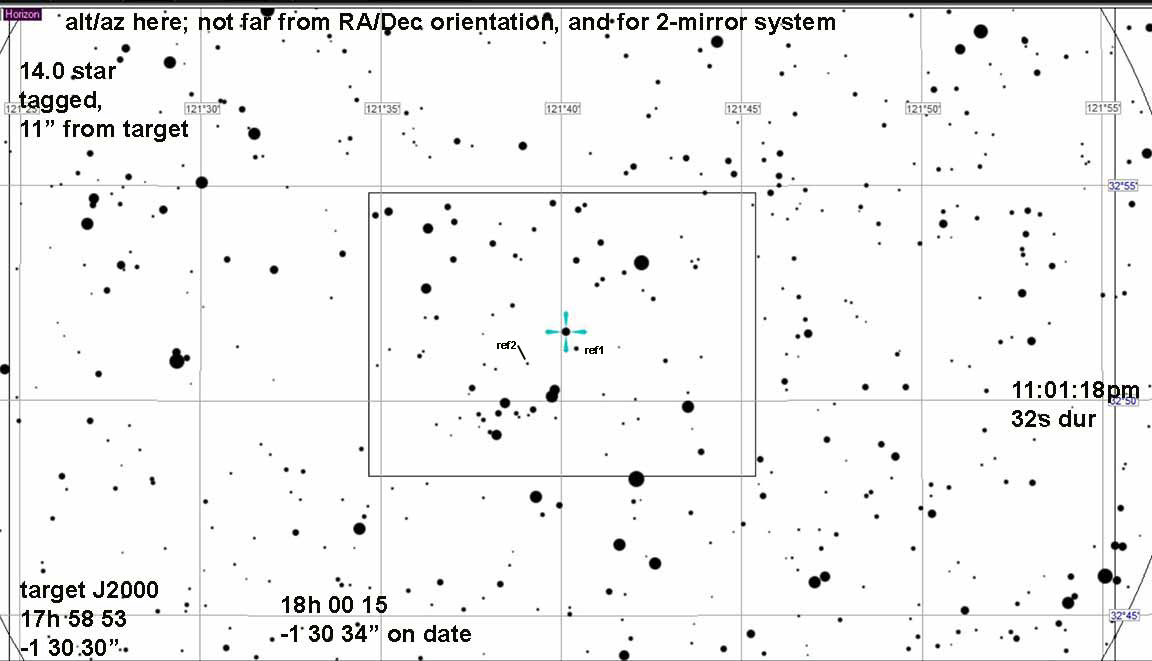
RA=18h 00 15s, Dec= -1 30 35"
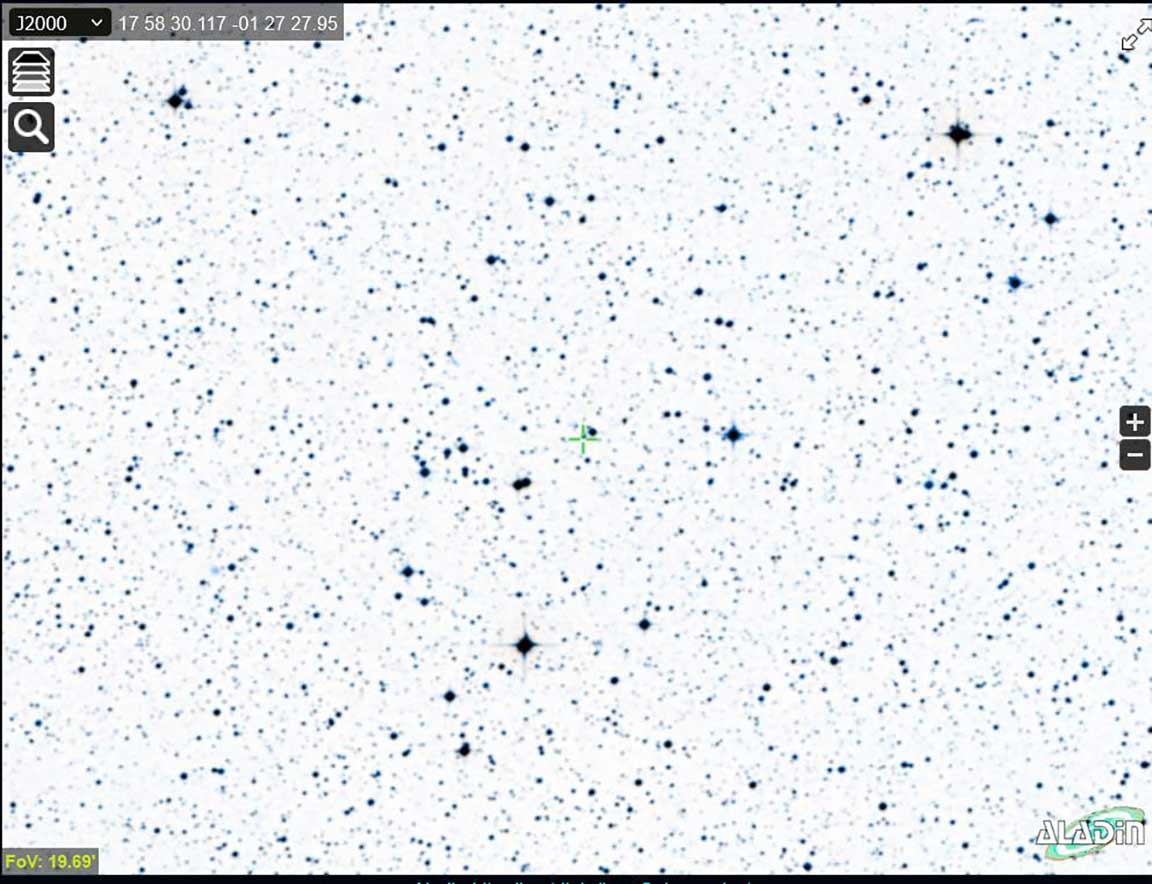
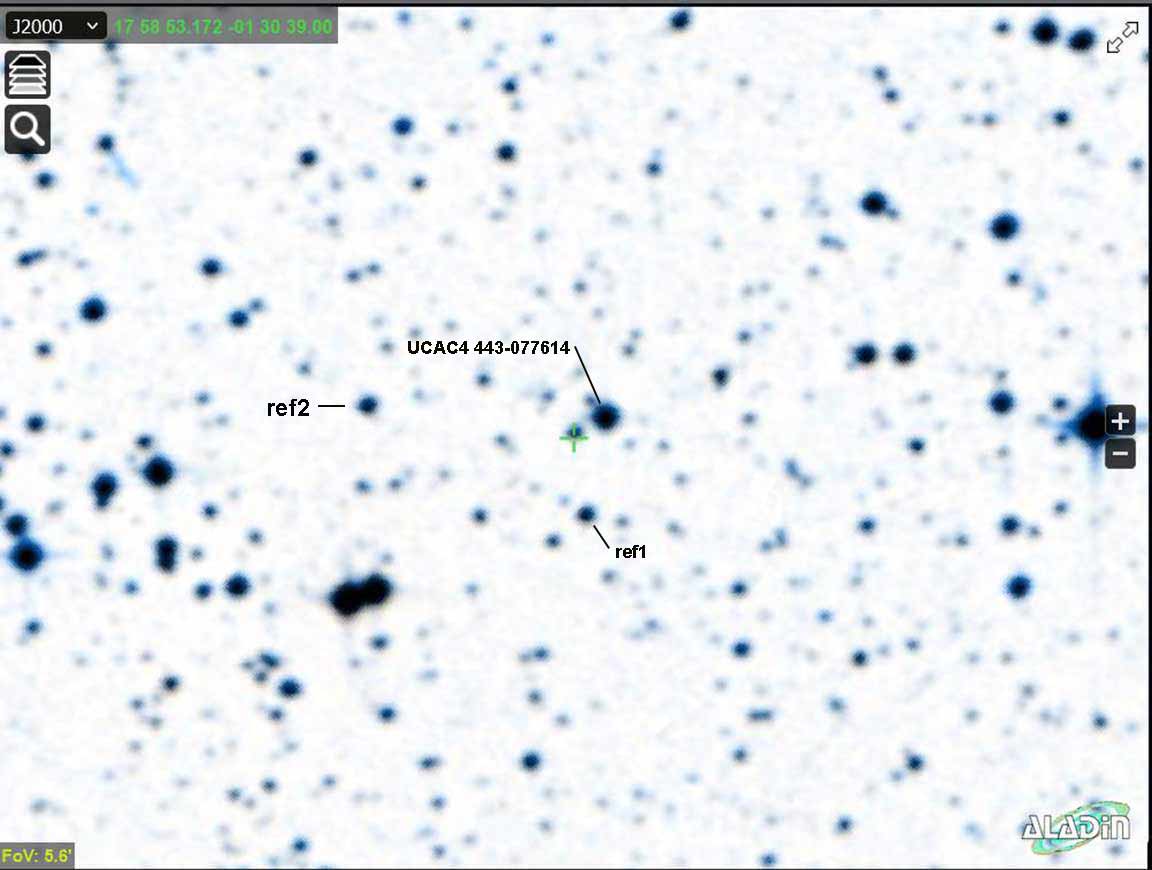
Alt=32, Az=121 and is 11" away from UCAC4 443-077614 which is shown on the finder charts with the cross. Target is not in UCAC4.
This is the LuckyStar -NIMA path, includes all of California |
Varda's moon Ilmare, path is far south |
The more northern JPL path, which Ben feels may be the favored one. The accuracy limits seem likely to be worse, I'm guessing. |
Ted Swift points out that we may be able to gain about a magnitude of observability by using the 3DNR feature on the Watec's. This smoothes over pixels and over time to dramatically reduce sky and time noise and give a much smoother background. I've not yet experimented with this on my Watec but I do use this on the PC 165DNR at Cabrillo Observatory which is at the end of our Orion ShortTube finder scope (not used for data, just a finder scope) and indeed it does smooth the sky noise. Given the full duration estimate of 32s, even 4s integrations and perhaps using 3DNR as well, may give enough, using adjustments on the IOTA VC 2.4 capture brightness/contrast, to get this even on an 8SE scope? That's a wild guess at this point. The 30" at Fremont Peak should be able to get this decently well with 1s integrations, also the 36" at MIRA.
Diagonal dimensions 19 arcmin, about equivalent to our 8SE field in equatorial mode, with f/3.3 reducer. |
5.6' diagonal field, Aladin. Closer to what the Fremont Peak 30" would see on-chip. The bright star to right of target is UCAC4 443-077614 |
C2A chart for 2- mirror system, oriented alt/az but not far from RA/Dec orientation. Inner box is still likely bigger than chip in FP 30". |
June 12 - Chris Angelos has agreed to open up the Fremont Peak 30" f/4.5 so we can get the occultation from there. The charts above are only guesses for relevant sizes to help ID the field.
June 14 - Dan Cotton and Jean Perkins confirm we can also use the 36" at MIRA - OOS on Chews Ridge. Our plan is for me to go to MIRA and Kirk Bender to go to Fremont Peak.
Observability:
The target is W=16.6 magnitude, compared to W=14.5 for the 6/25/25 Quaoar occultation on the 36" at MIRA at f/10. The Challenger 30" at FPO is f/4.8, so star images should be only 40% as large in diameter, concentrating more light into an area only 16% of the area of the star image linked here for the Quaoar June 25, 2025 event
https://www.dr-ricknolthenius.com/events/20250625-Quaoar/RN-PyM-SC.jpg
Therefore, for an equivalent star, the pixels will be illuminated 6.25 times brighter. But the target however is only 14% as bright. So the pixels will be 6.25 x 0.14 = 0,875 times as bright. So picture the star image linked above but dim the pixels a tiny bit, and make the star image only 40% of the diameter seen. That data was taken at 16x setting. We can easily get great data at 1s cadence, given the 32s predicted duration, so that's 64x setting or 4x more light per pixel. 32x might be a good compromise to get good resolution and adequate brightness of the star, as a guess, for equivalent good sky conditions as we had at MIRA.
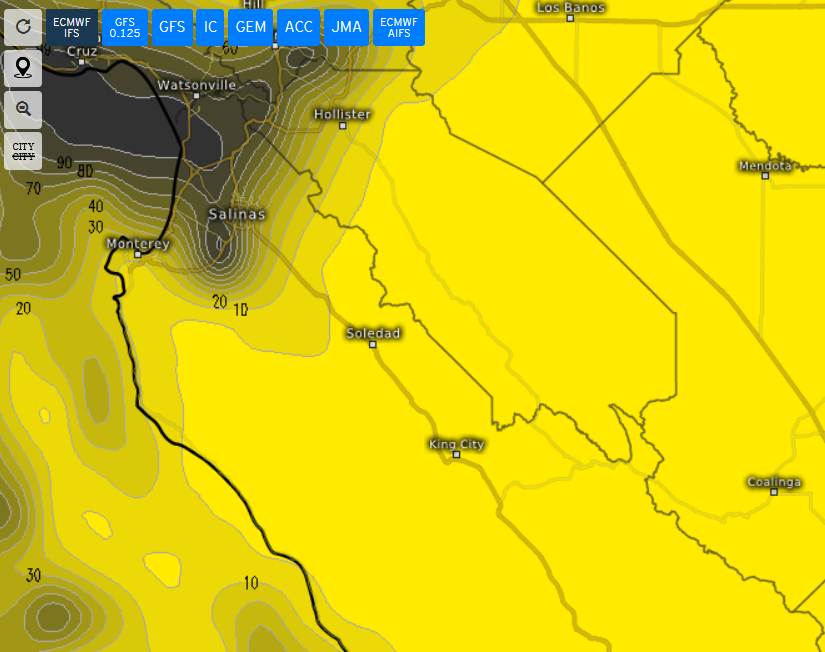
Weather prediction as of June 14 4pm looks like fog in low elevation regions. This will help darken the skies at both FP and MIRA-OOS.
Kirk Bender, at my suggestion, used the 30" f/4.5 reflector with Chris Angelos at Fremont Peak. But, it was windy, and the telescope's declination clamp was not working well enough, and getting and staying on target was not possible. No data.
I took the MIRA invitation, as it was farther and I had the van which was more suitable for the rough road to MIRA. The MIRA 36" scope is bomb-proof and despite a good breeze, there the scope tracking and vibration were excellent. Dan Cotton and I tried diligently to accommodate my desire to use the f/3.3 reducer on the f/10 36". We had several versions of the pieces of the optical chain so it took some time to assemble and test them, before concluding it was going to be impossible. The focal point was too deep and unreachable. We didn't have time to then try with the f/6.3. Nor the 0.5x nosepiece reducer (which has terrible optics, anyway) so, I went with the f/10 optics as we'd done with Quaoar a year ago. Still, the target at 64x was easy to see and would give good enough S/N to detect an occultation. I used 64x, full gain=41. Warm'ish night in the low 60's, breeze which did not affect the telescope in part because of the 5foot high walls. No moon. Clean dry air. The image scale was so large that stars still spilled over many pixels.
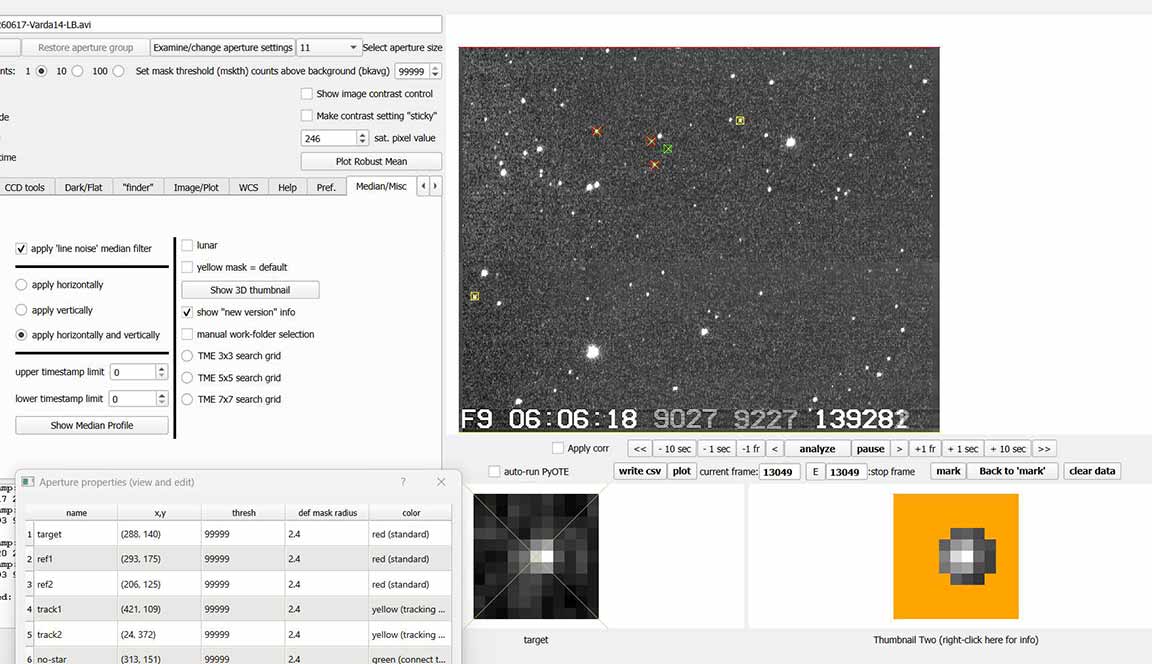
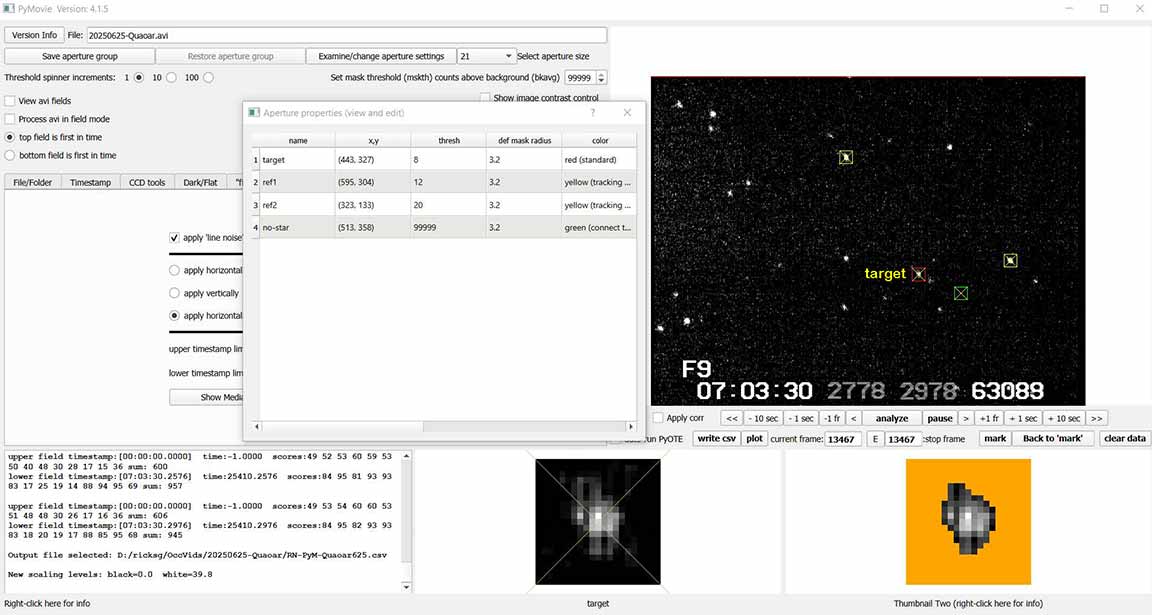
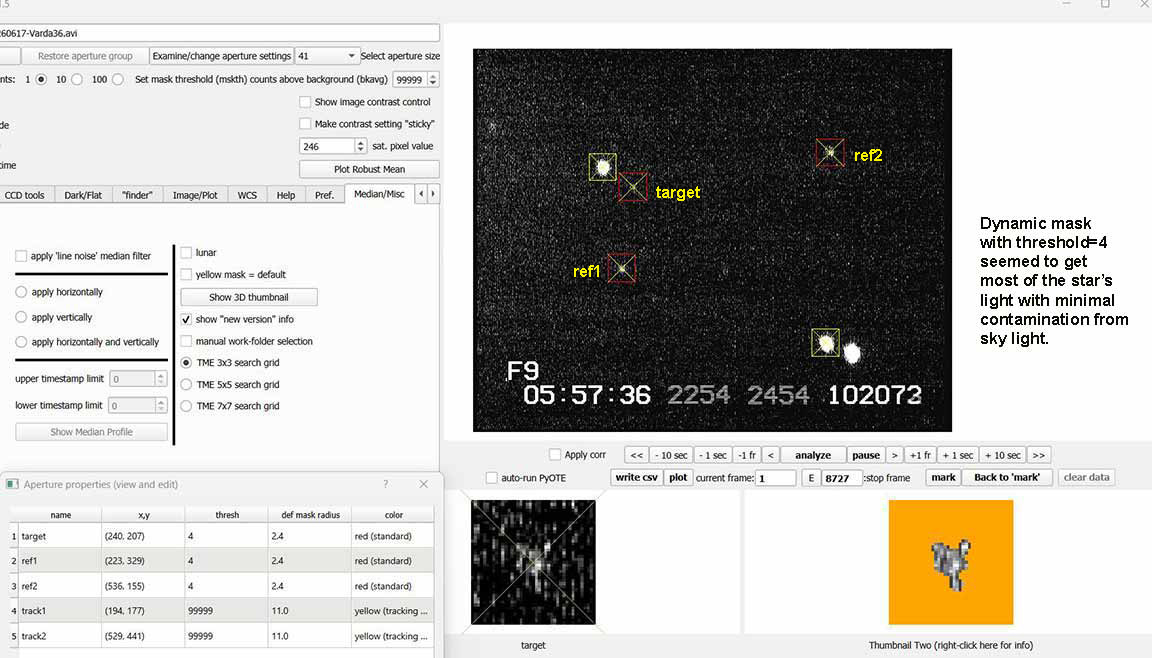
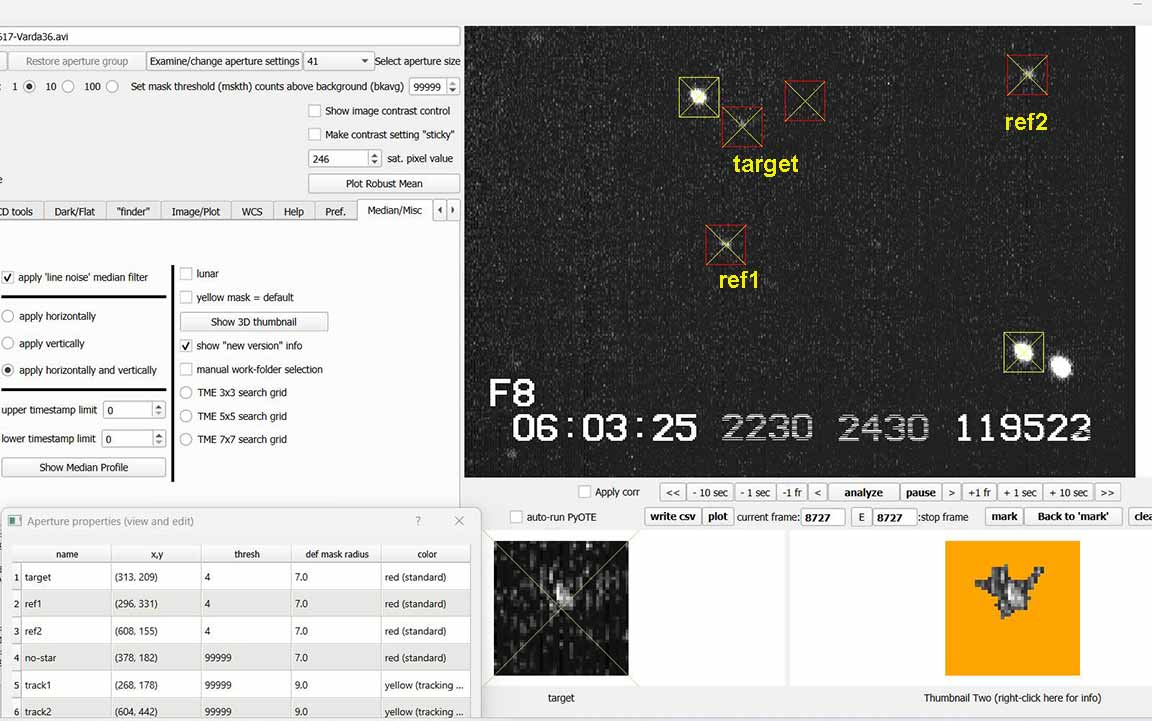
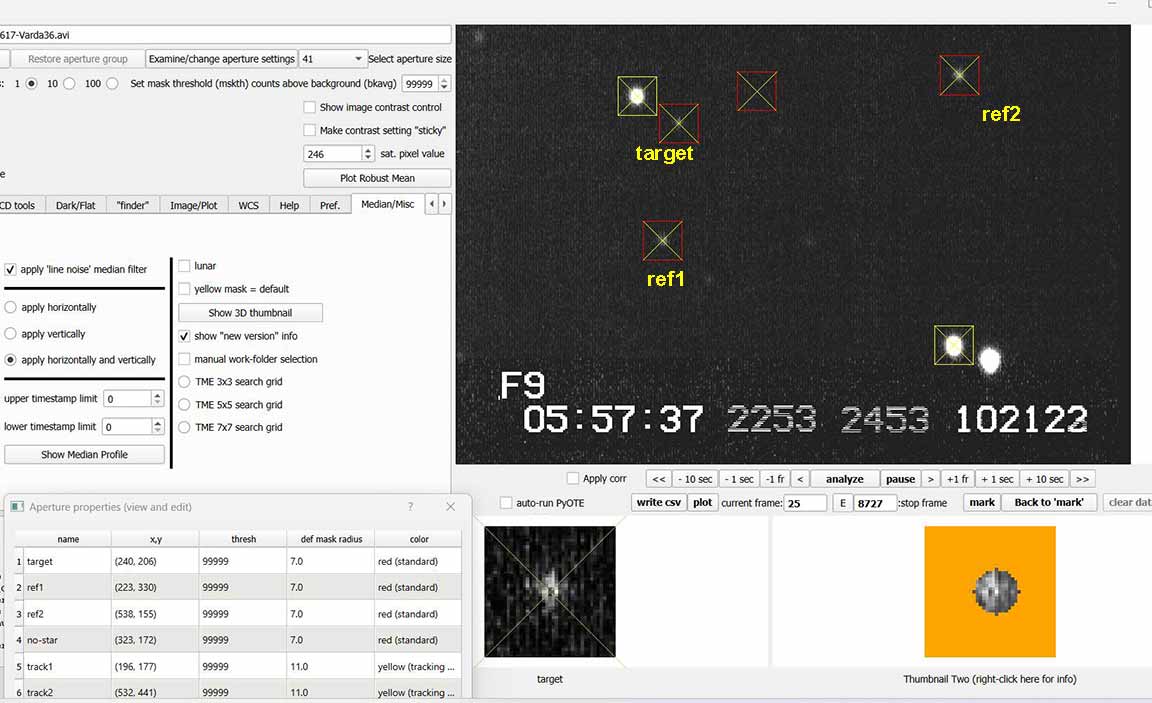
Like for Quaoar a year earlier, I chose for my first PyMovie run to use dynamic masks on the target and reference stars. For the two bright tracking stars, I used static cirular apertures large enough to capture virtually all star photons; 11 pixel size masks. Tracking during the recording and also during the PyMovie analysis, was very good; little jumping around to set the mask from integration to integration. I chose the following reference stars:
Ref1 = UCAC4 443-077616
Ref2 = UCAC4 443-077630
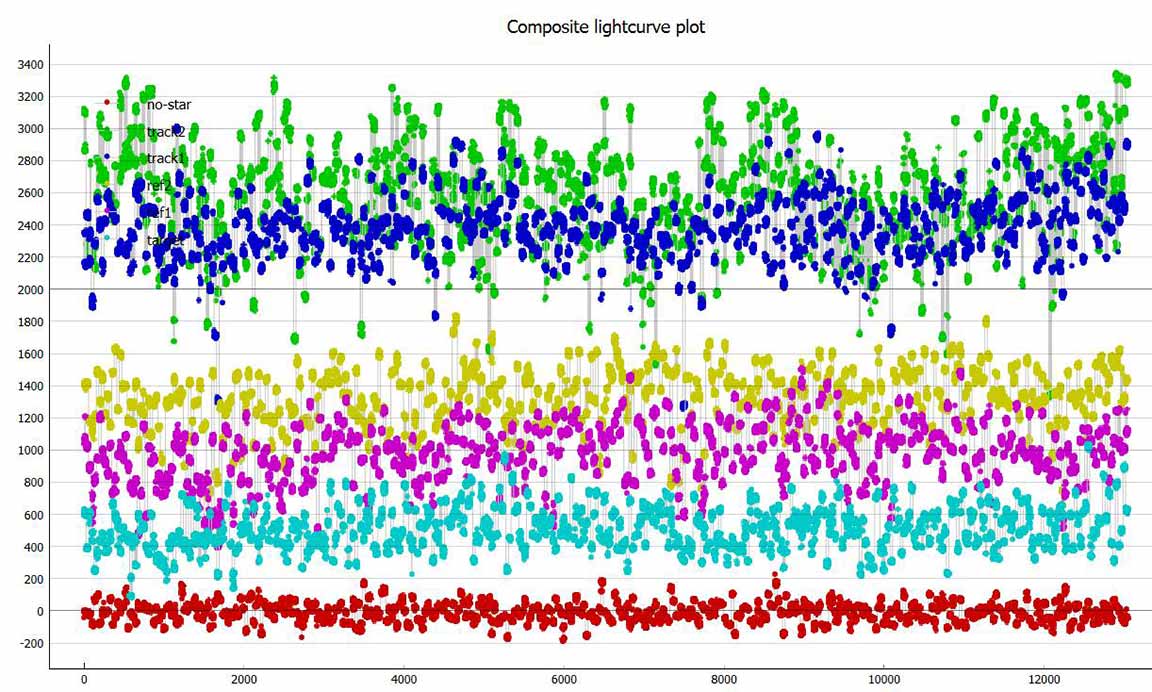
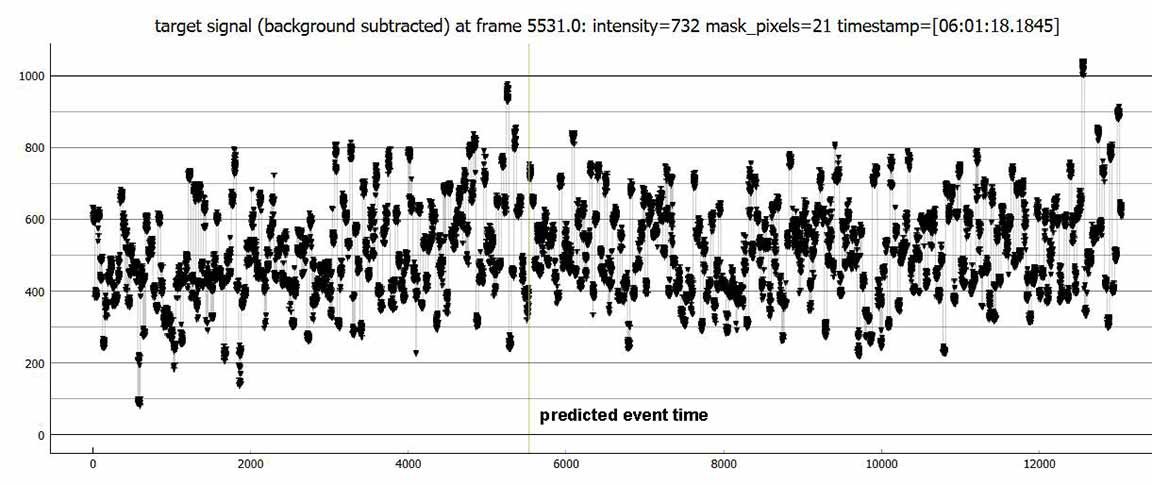
In agreement with my live watching on the Lenovo screen, the target looked present for all integrations. Below is results from my first run through PyMovie, which used dynamic masks on the stars, and a threshold as small as 4 to pick up the pixels that were judged to be dominated by starlight. Data display on the laptop using IOTA VC 2.4 on the 36" setup seemed to freeze 2 minutes or so after the event and while it turns out data was still being recorded, I ended the recording early. The parallel recording on the 14" CDK scope has the full 10 minutes intended.
 |
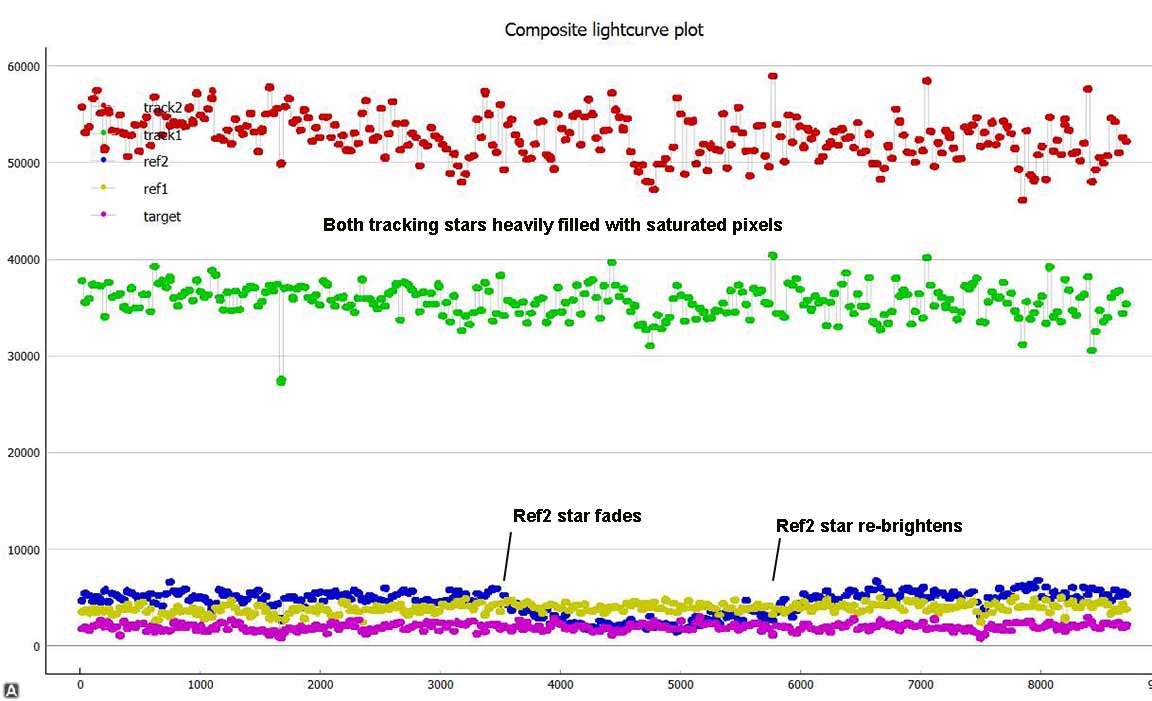
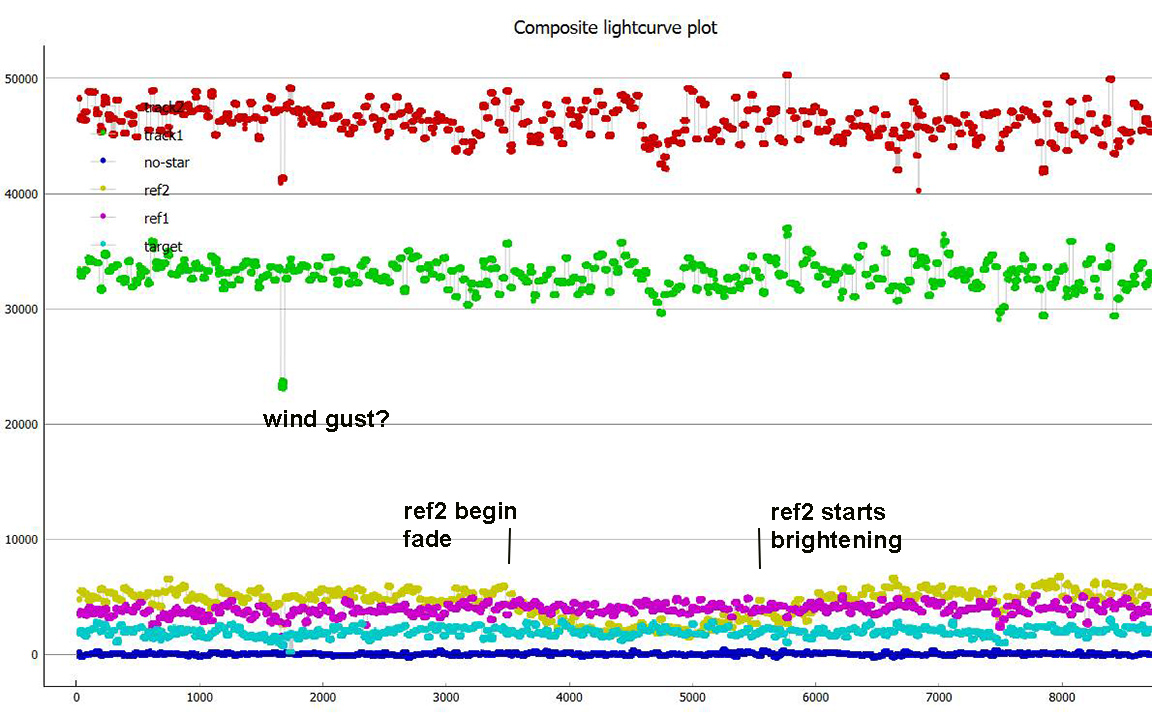
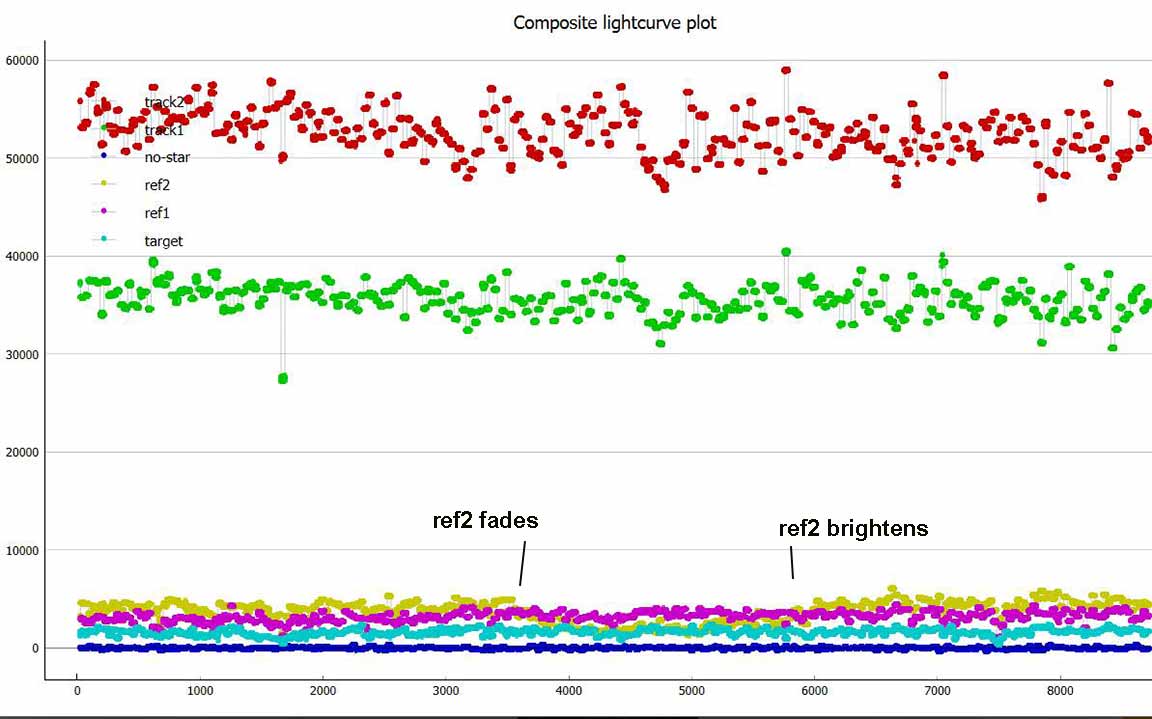
Composite light curves. The two bright tracking stars were dominated by saturated pixels. The reference and target stars were not. |
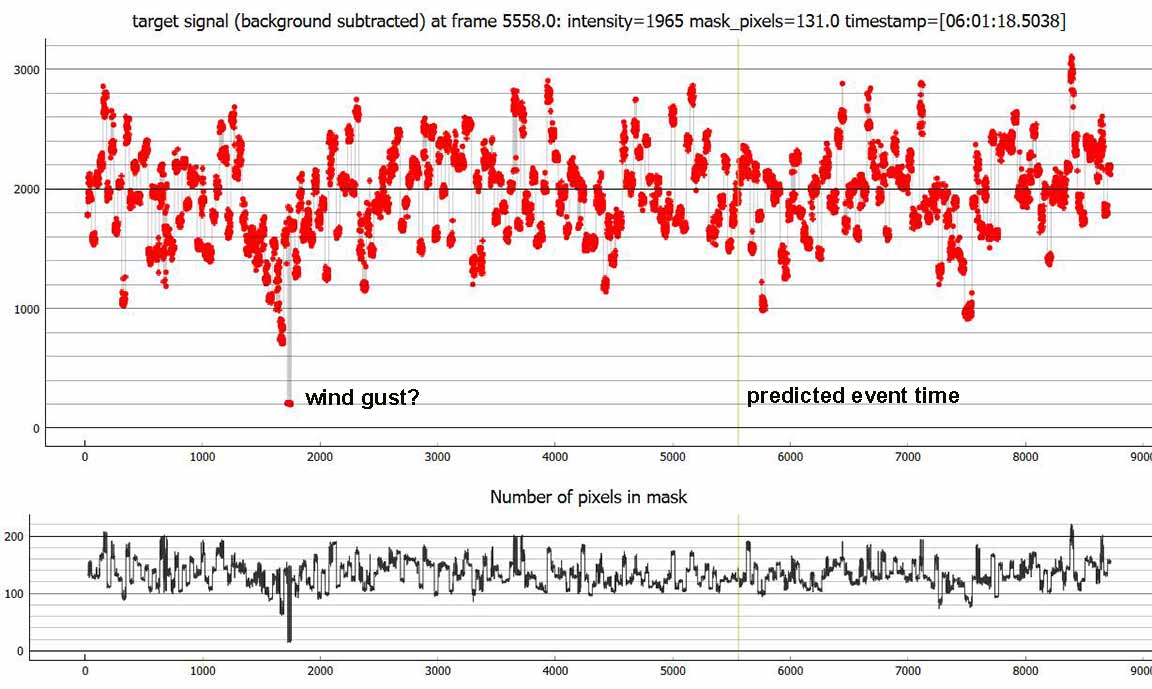
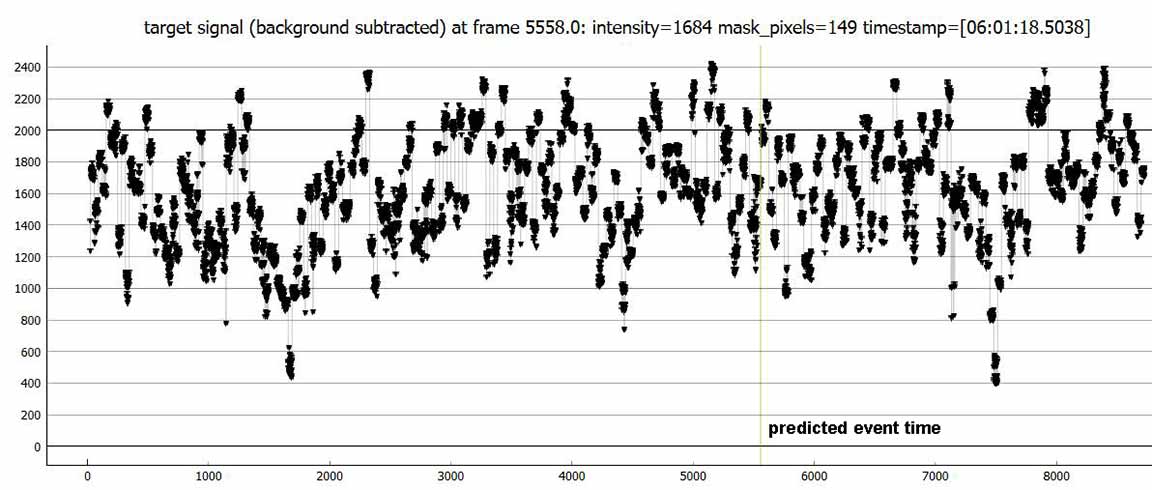
Target star light curve. A drop from a near central occultation would send points to ~0 level for 30s. None of the points dropped to zero |
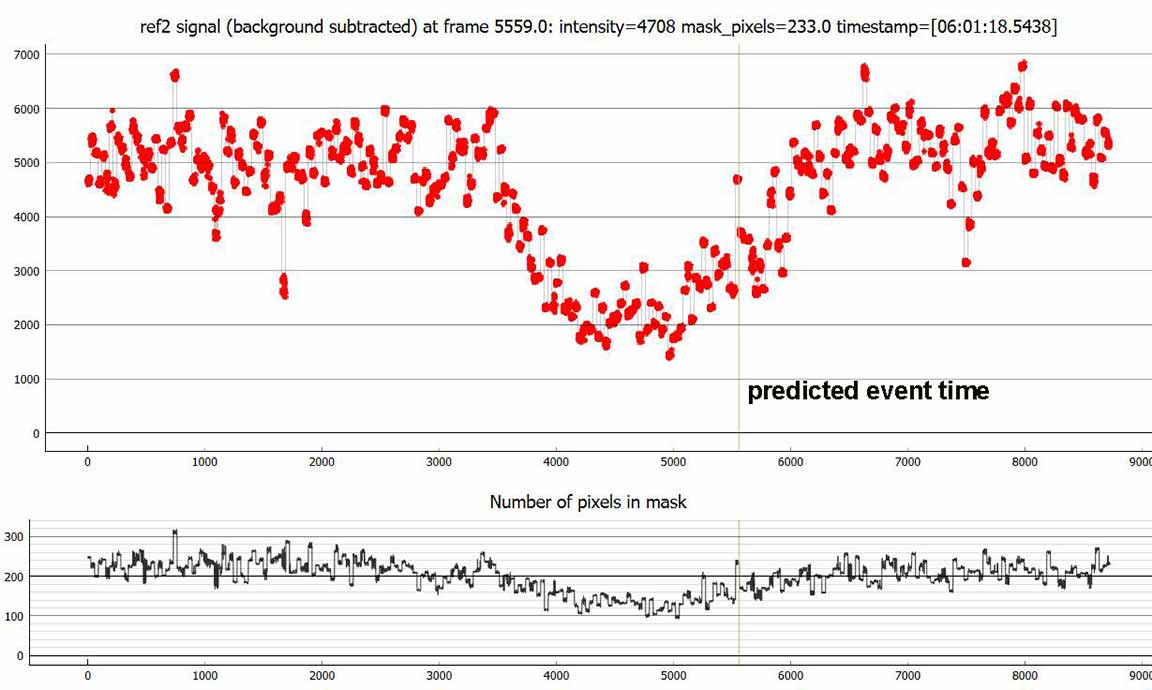
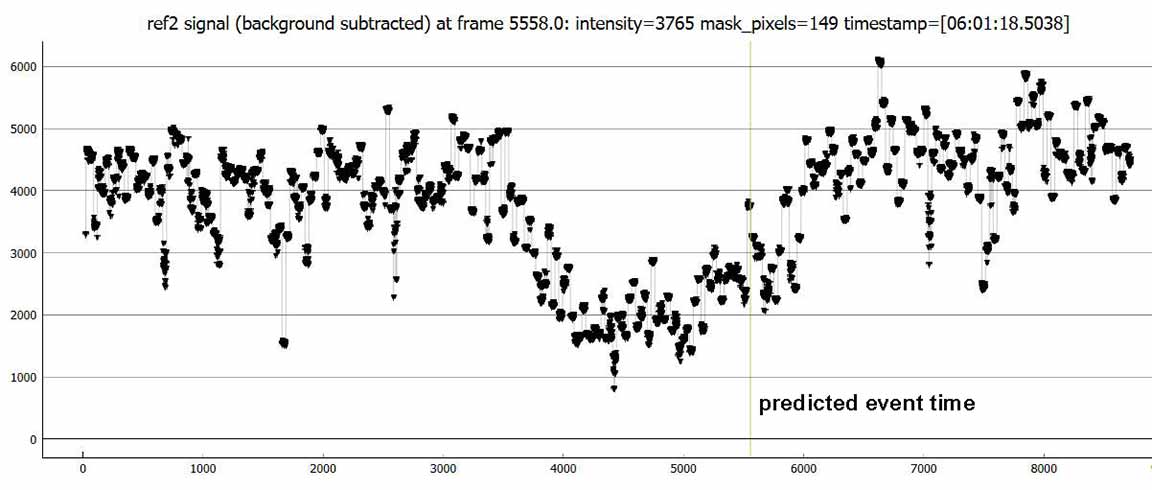
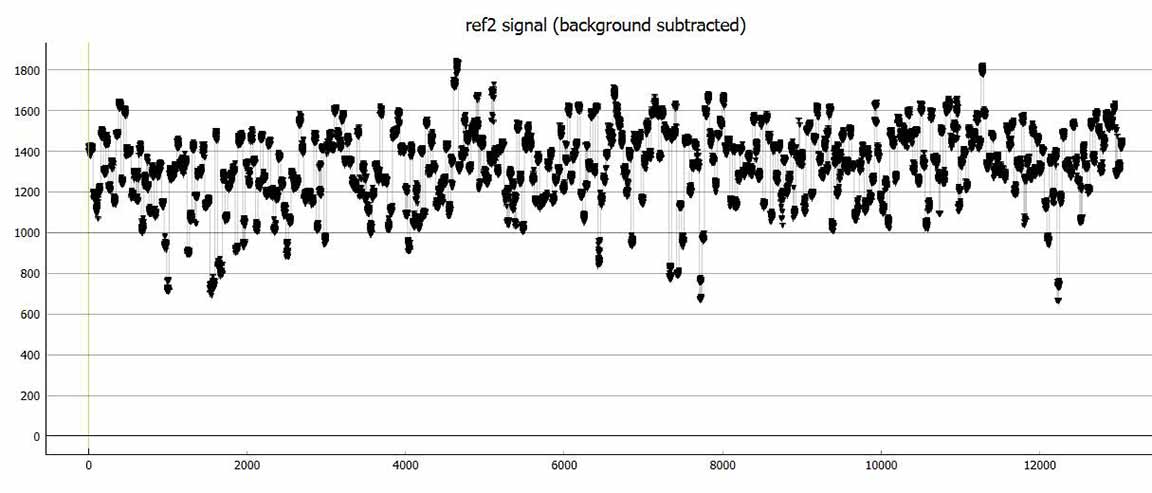
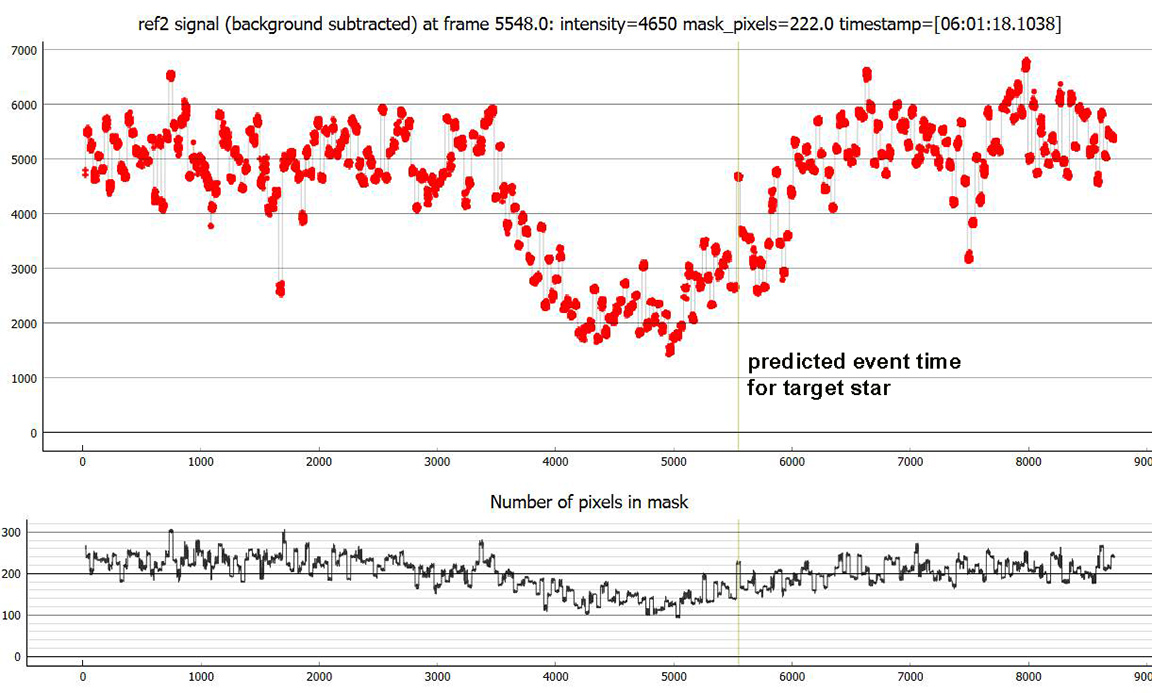
But most bizarre, the reference star Ref2 showd an 80s fade to only 1/3 normal brightness and then returned to normal brightness. It turned out to be due to a large dust grain on the chip which remarkably lined up with star ref2 and tracked with it for this remarkably long period. |
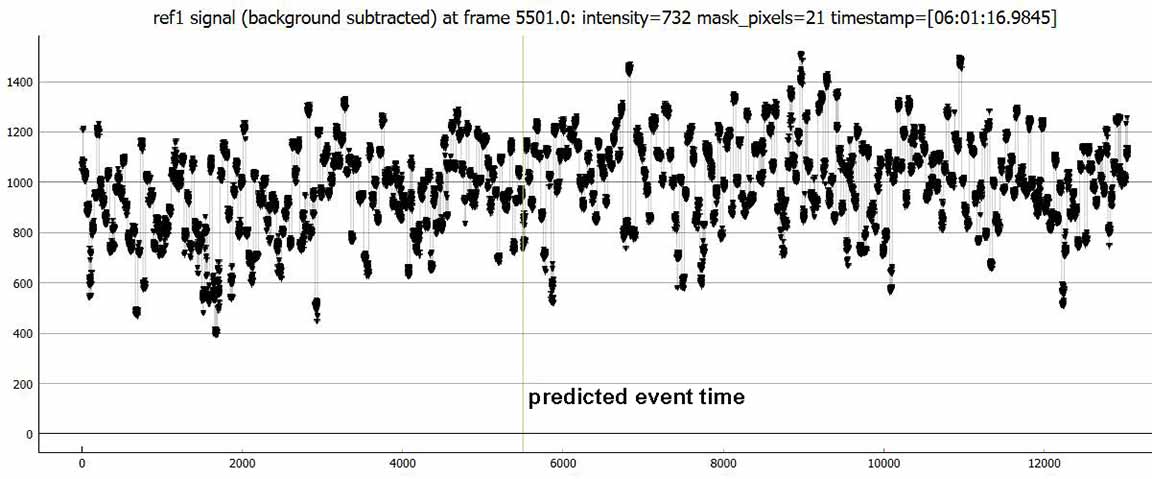
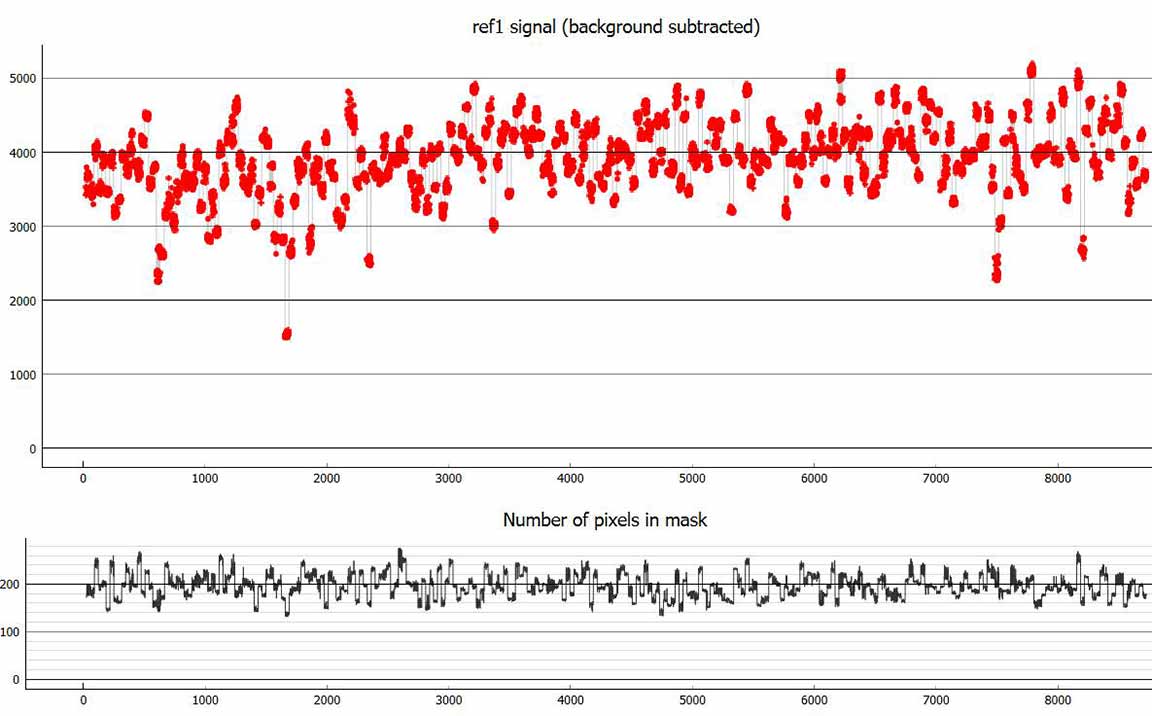
Here is my 2nd run through PyMovie with dynamic masks, and a more complete set of light curves. These provided the basis for the PyOTE run and the report forms.
 |
 |
 |
 |
 |
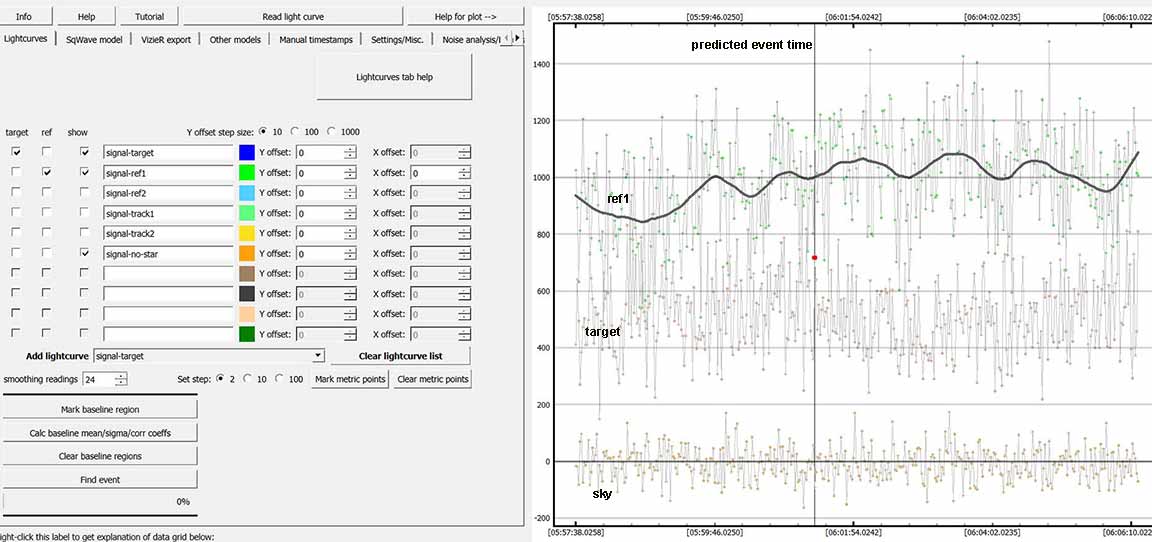
PyOTE reduction. Just like the Quaoar event on the same 36" f/10 telescope, the large focal length made a big difference in how the photometry proceeded. Blurring by seeing causes significant loss of signal and even when using dynamic masks with very low threshold=4, still the dips in brightness due to correlated seeing effects over 1-s integrations mean that the minimum metric happens at a very short smoothing length and no offset in the time direction. |
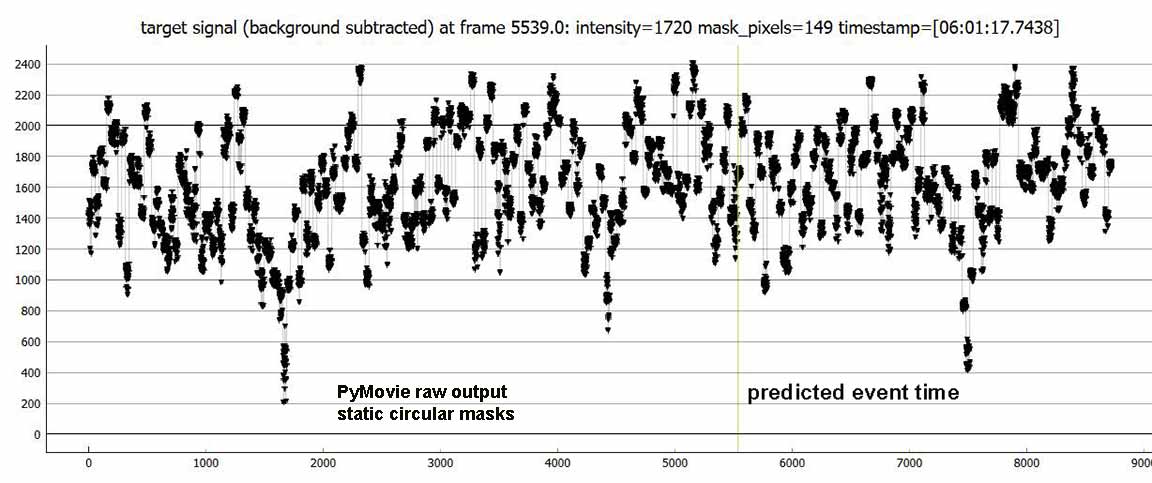
Below is a different run, still on the 36" data, using static circular masks, in PyMovie. Comparing to the "dynamic mask" run, this static circular mask data looks a little noisier. I will use the dynamic mask run as basis for the report. Both runs, however, clearly show a miss. The expected positive would have about 30 points all ~at zero level. In fact there are none. The dip in Ref2 was not real but casued by a dust mote it was later learned. Very low odds that this star would be right on the chip spot containing a rather high opacity dust mote, and that the tracking of the telescope would be so perfect that this star would remain on that dust mote for over 1 minute. But, there it is.
 |
 |
 |
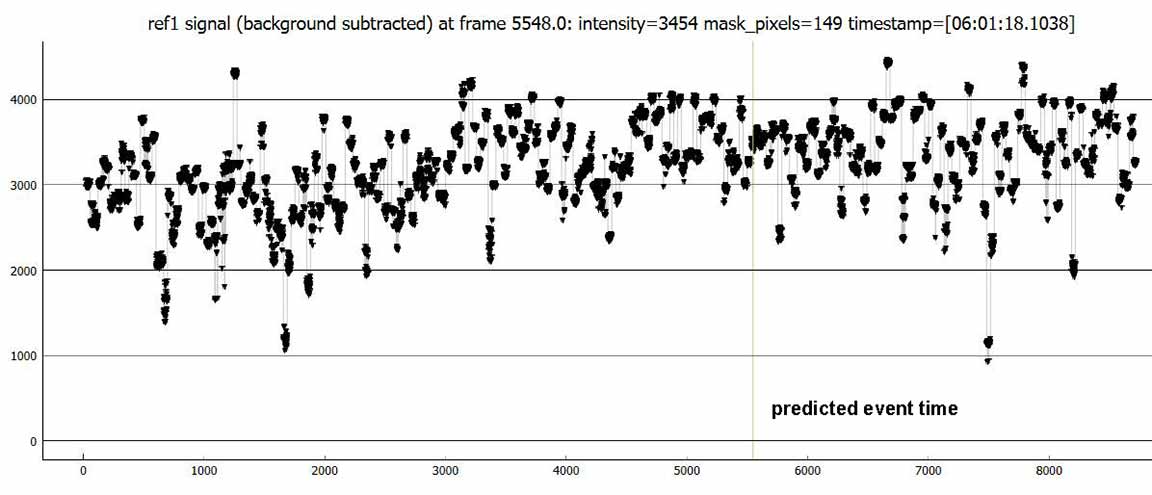 |
The shape of the dip is clearly not related to using a dynamic or static mask. Essentially identical here to the dynamic mask case. Instead, it is light absorbed by the dust mote occupying most of the mask pixels triggered by starlight. |
The Mysterious Dimming of Star=Ref2
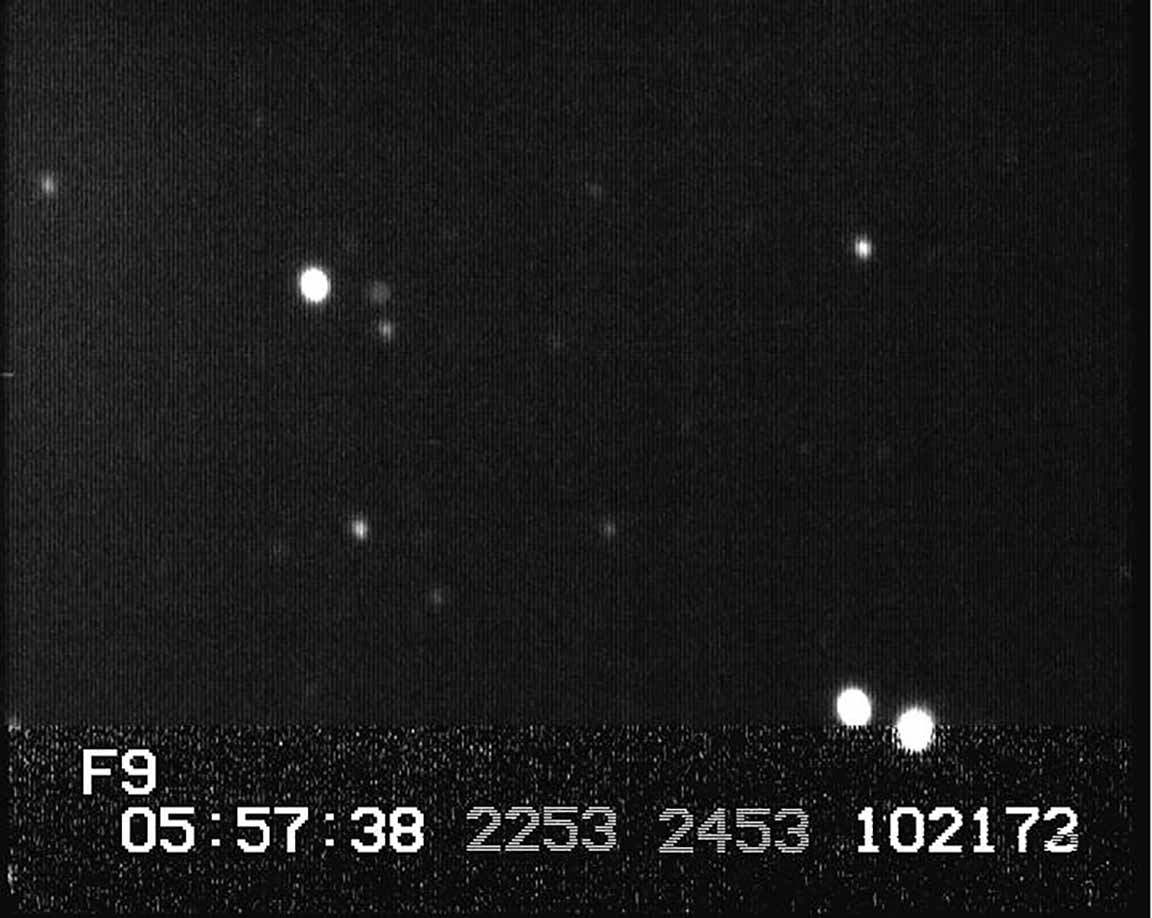
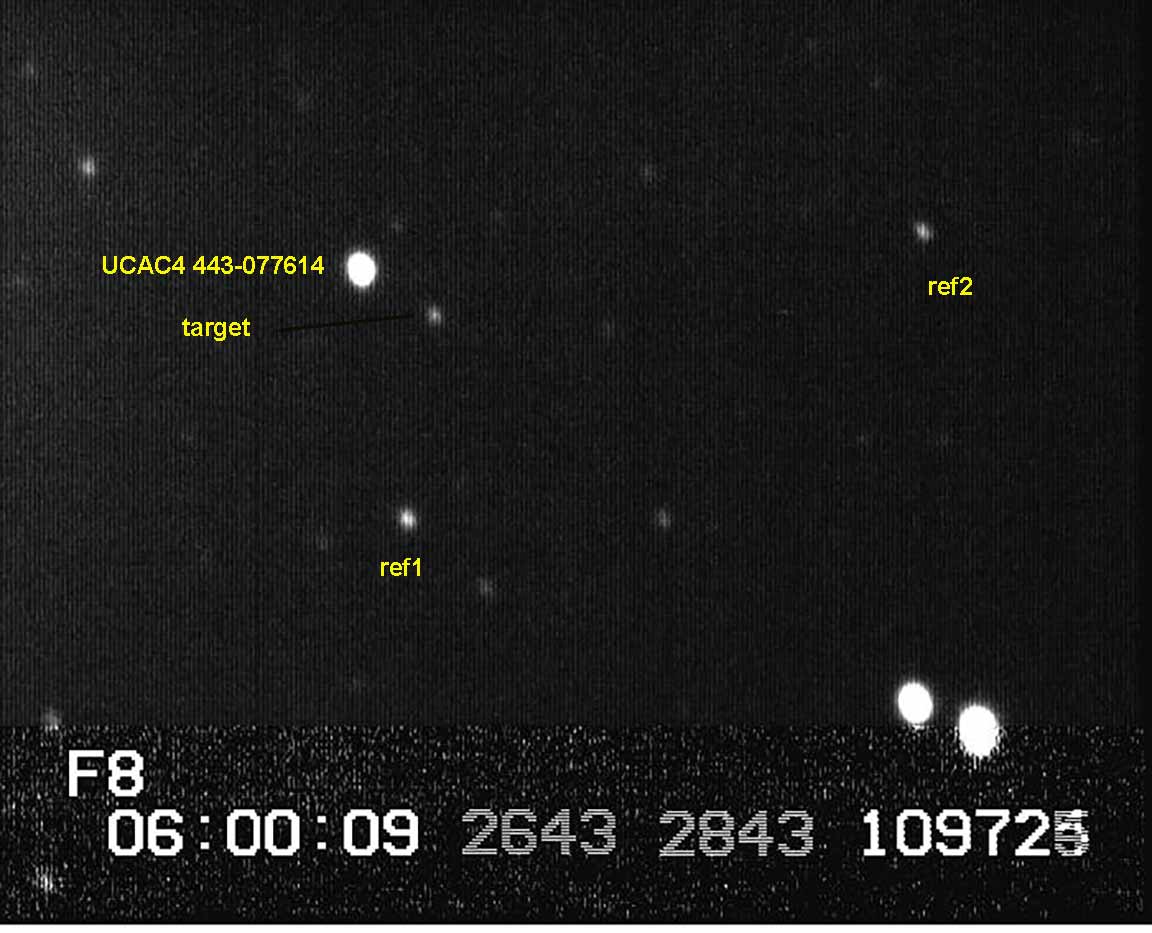
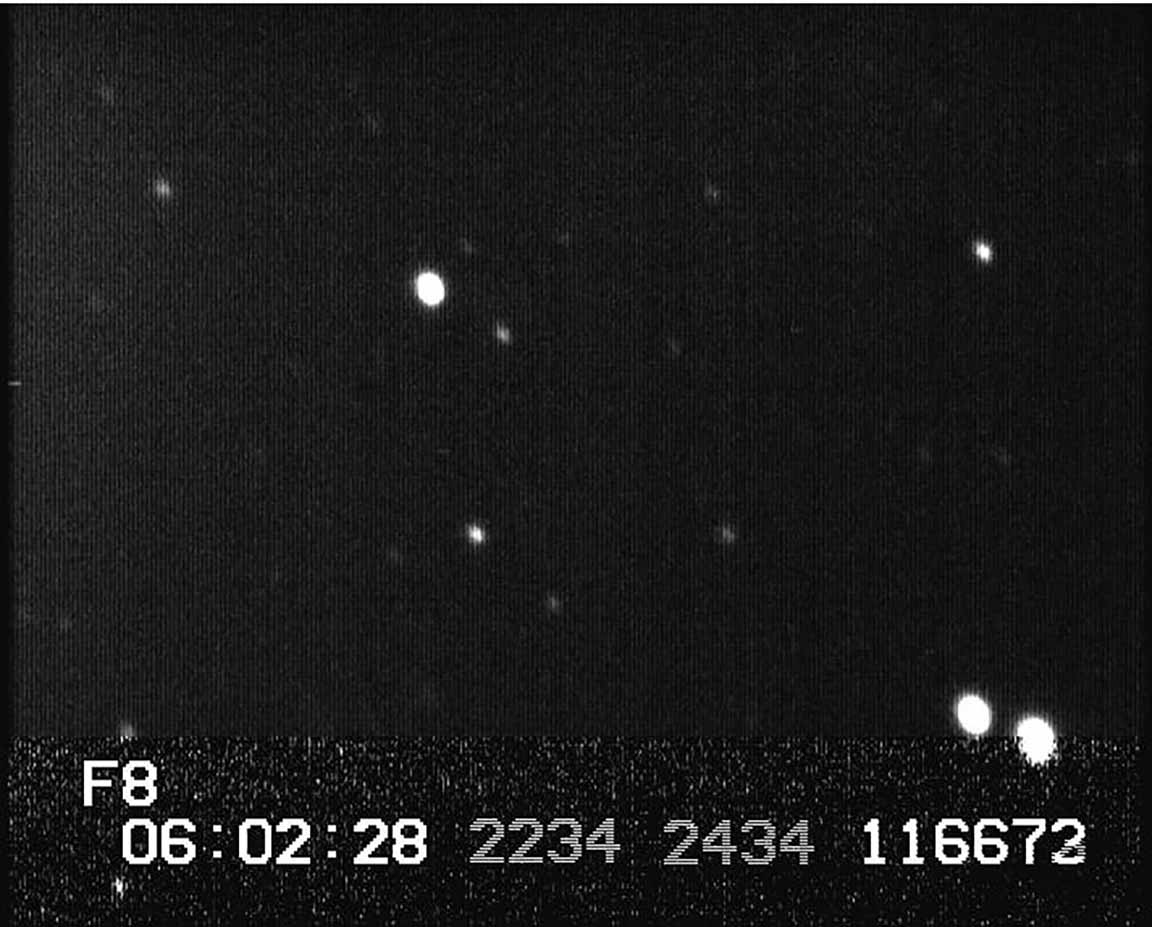
I took 3 "finder" images in PyMovie. The begin times of each finder are on the images below. 666 frames per finder, which is 666 frames/25 frames/sec = 26 seconds imtegration per "finder" for each. What cinched the cause of the dimming was the parallel data from the CDK 14", which showed no dimming of Ref2; yet the dimming of the signal is real and not noise. This was a new Watec 910hx camera that had not yet been used on a successful event and in the care of a student until now. It turns out it was caused by a large bit of dust right at the position of this star, by random very bad luck, and the long duration was caused by the excellent tracking of the telescope, to keep that star on the dust mote for over a minute.
The initial 26s of the recording, Fourier stacked as a "finder". Note Ref2 looks brighter than Ref1 |
The first 26s of the period of dimming. Ref2 now is fainter than ref1 |
Well after the dimming ended, the final 26s of the recording. Ref2 is clearly brighter than Ref1 |
The Data from the 14" CDK Telescope - final recording operation during the event by Logan Barrett
Again used 64x. I decided to try and get 5 minutes on either side of the predicted event time, in agreement with the usual advice for objects which may have an undiscovered moon, and also to get a good period of time for statistical noise characterization. 64x gave a clear obvious signal for the target star. I (Nolthenius) did the reductions of the data, and used the same ref1, ref2, no-star, and tracking stars as for the 36" scope. Logan on the 14" actually got a fuller time interval of data, since the intense labor and decision making on trying to get focal reduction on the 36" pushed back the time I could start the recording. I was able to record only 4 minutes ahead of the event time, Logan recorded beginning 5 minutes ahead and 5 minutes after the event prediction, as I requested. For the 14" analysis, I used static circular masks for this run.
Note how much wider the FOV is, and how much tighter are the starlight concentrations on fewer pixels on the CDK 14" scope. The target and comparison stars, as I directed, were kept in the upper half of the chip, which has more consistent sensitivity and don't cross the boundary to the lower half of the chip. There is a discontinuity in sensitivity at the mid line (horizontal) visible when the contrast is amplified greatly, it becomes visible. |
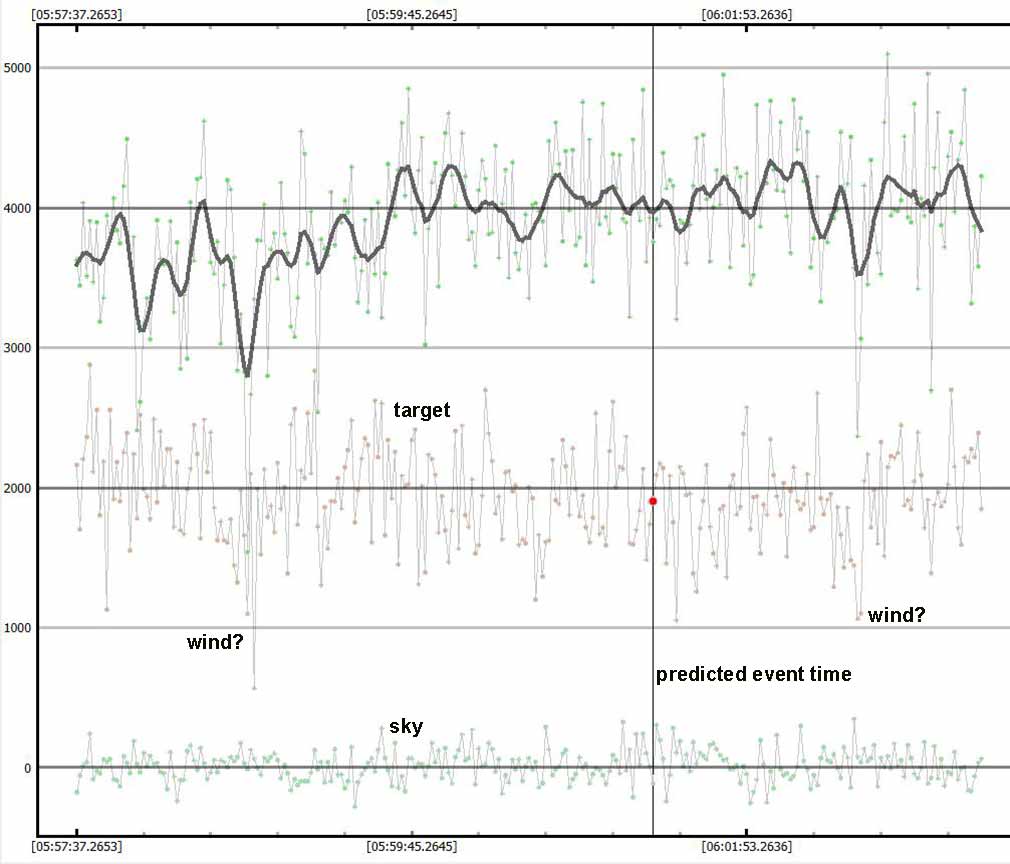
Composite light curves. No dip in Ref2 happens. |
Target star. Again, an occultation would be visible as up to 32 point clusters consecutively clustered near zero. None are seen except almost for a couple of moments affecting all stars. |
Ref1 light curve |
Ref2 light curve. No dip happens, yet this telescope is only a meter or two away from the 36" scope. |
PyOTE light curve after calibration. I notice that the tighter star images resulted in less point to point blurring noise and the minimum scatter was achieved not at smoothing length=2, but smoothing length=24 for the 14" CDK data. This emphasizes how important it is to get good focal reduction. But there's a happy medium. You want to avoid saturation of pixels which would result from too few pixels getting all the star light as well. |
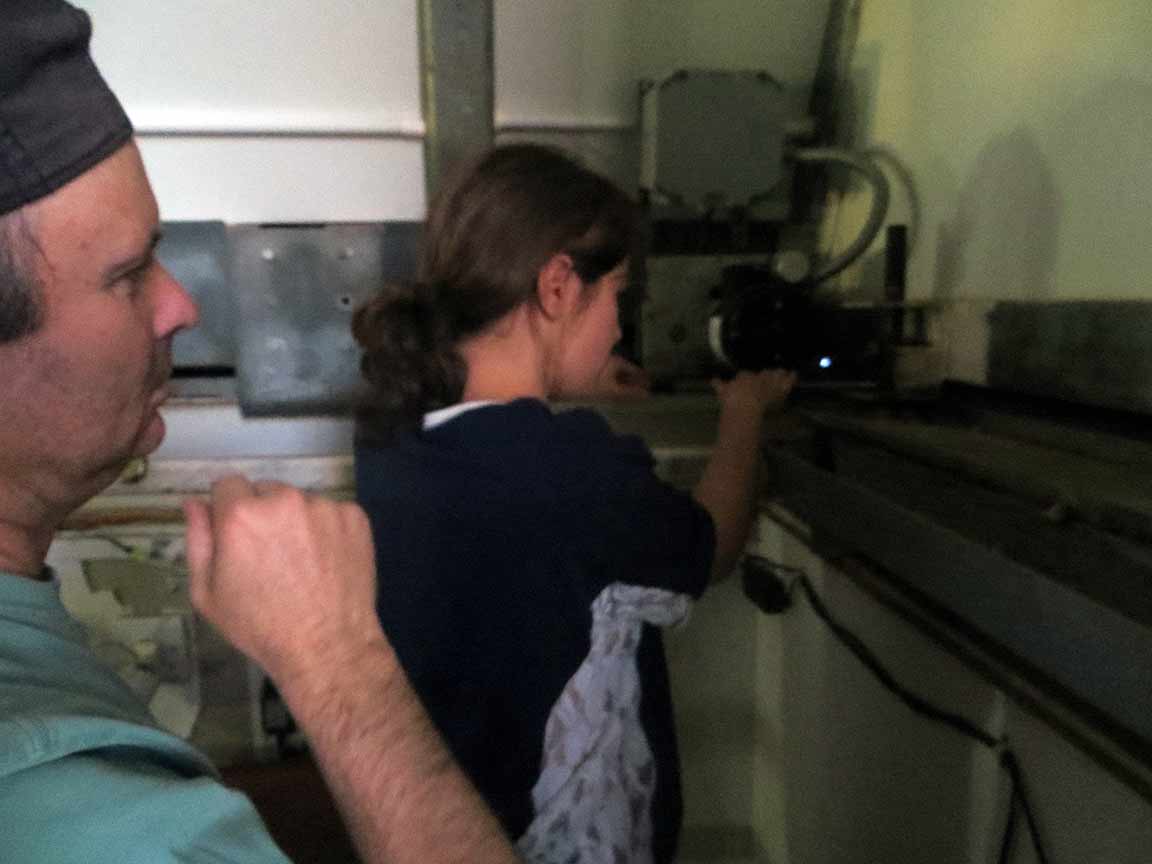
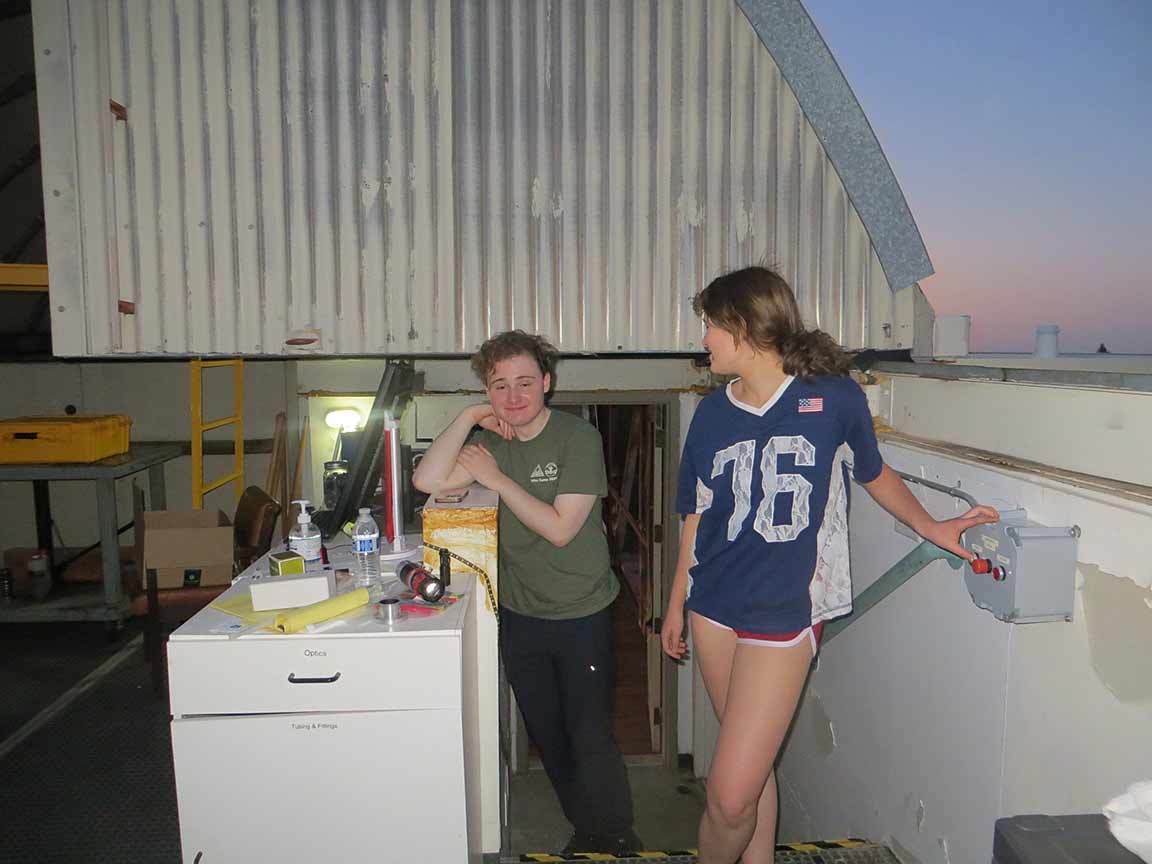
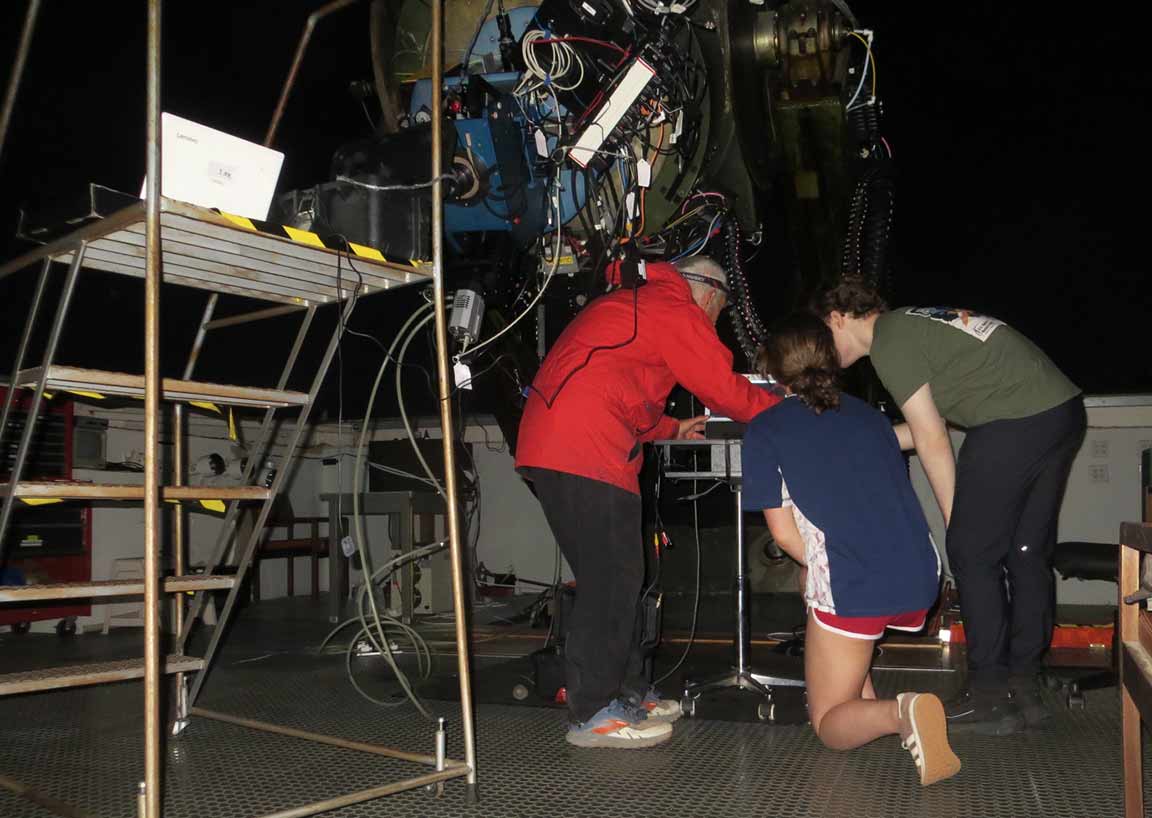
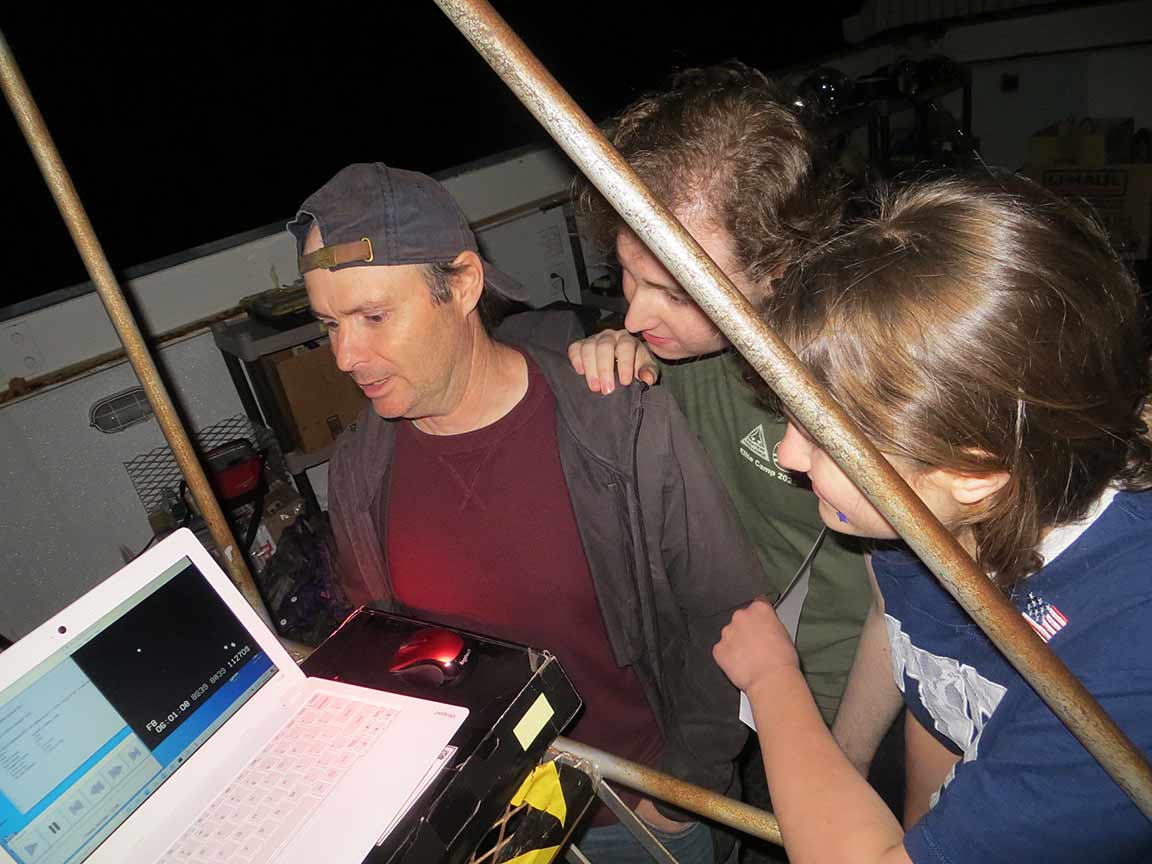
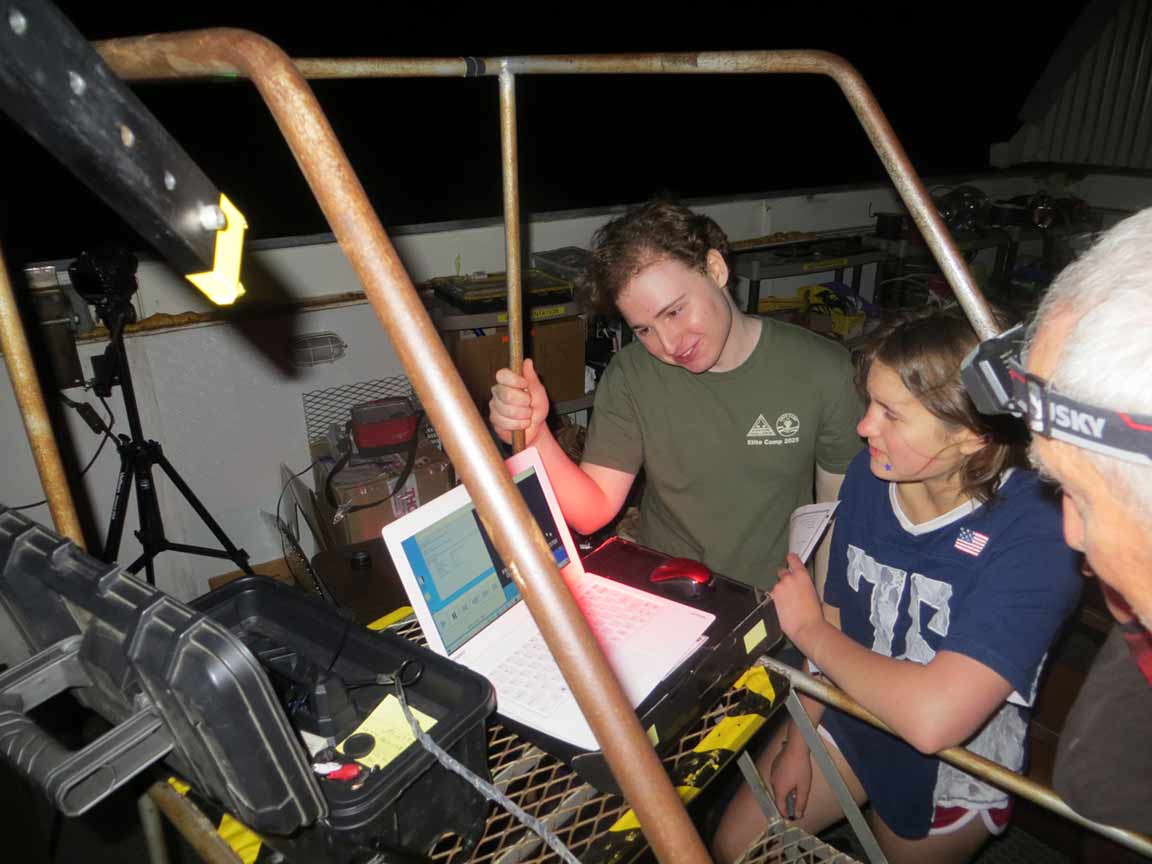
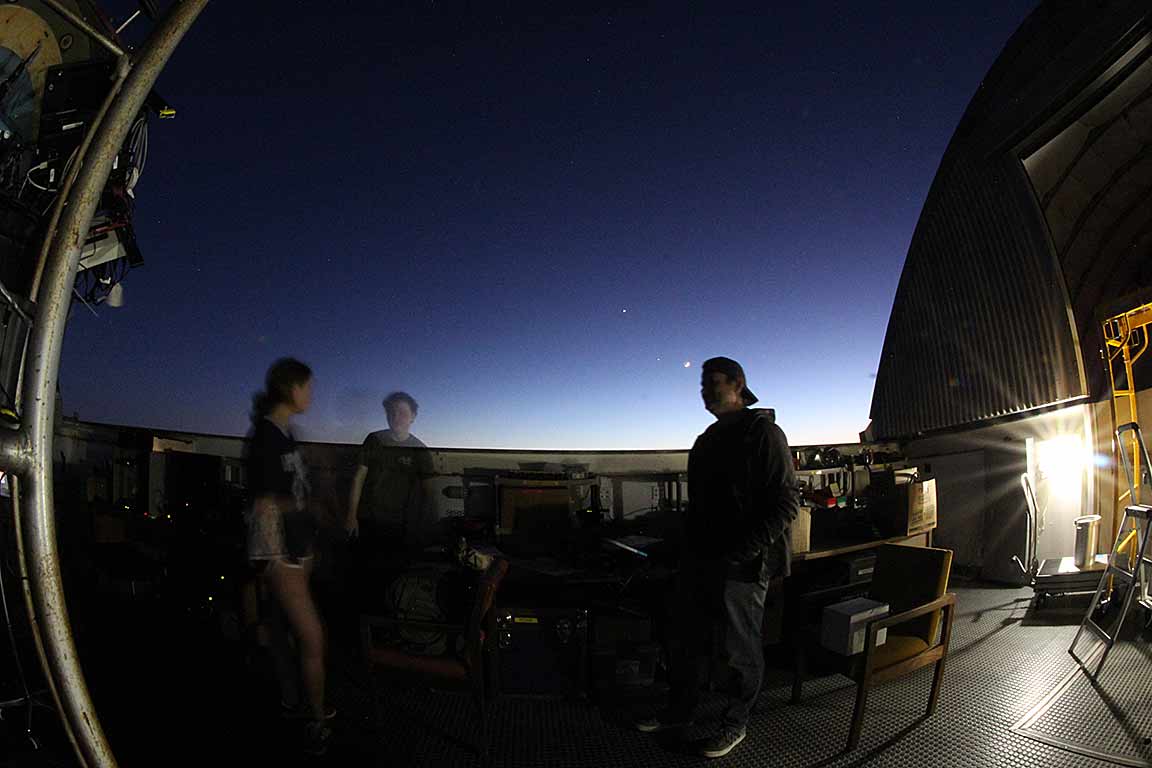
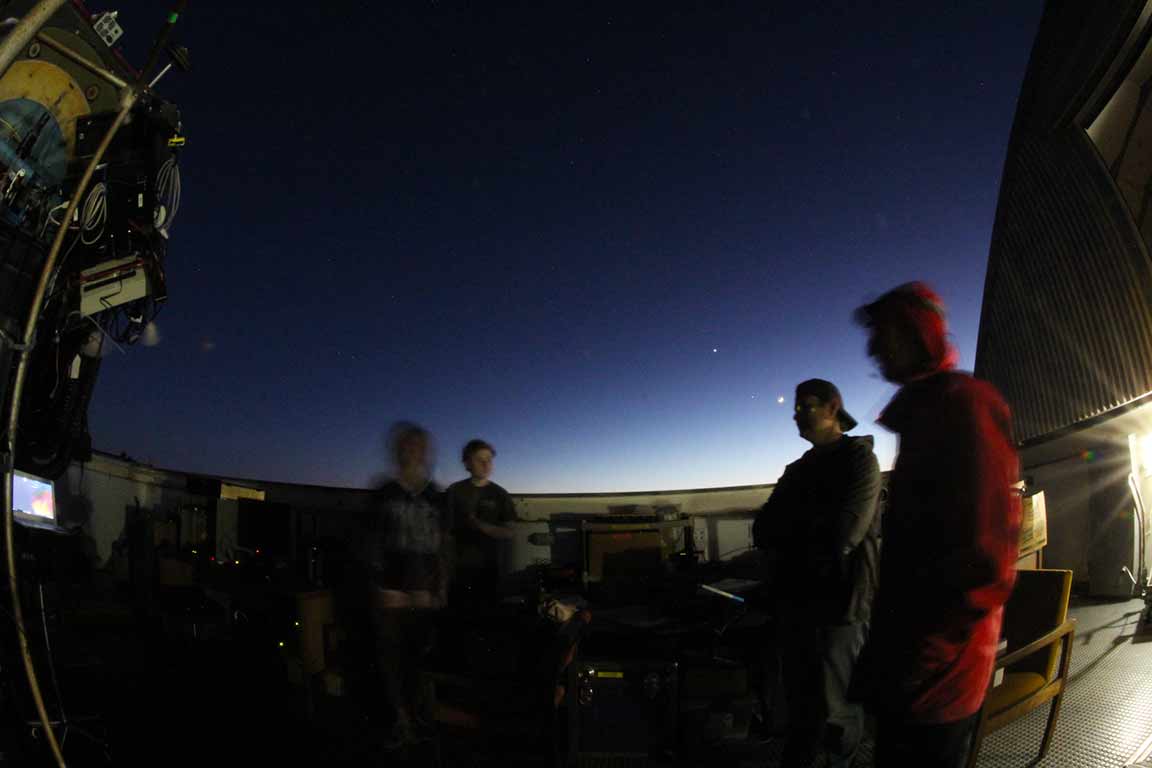
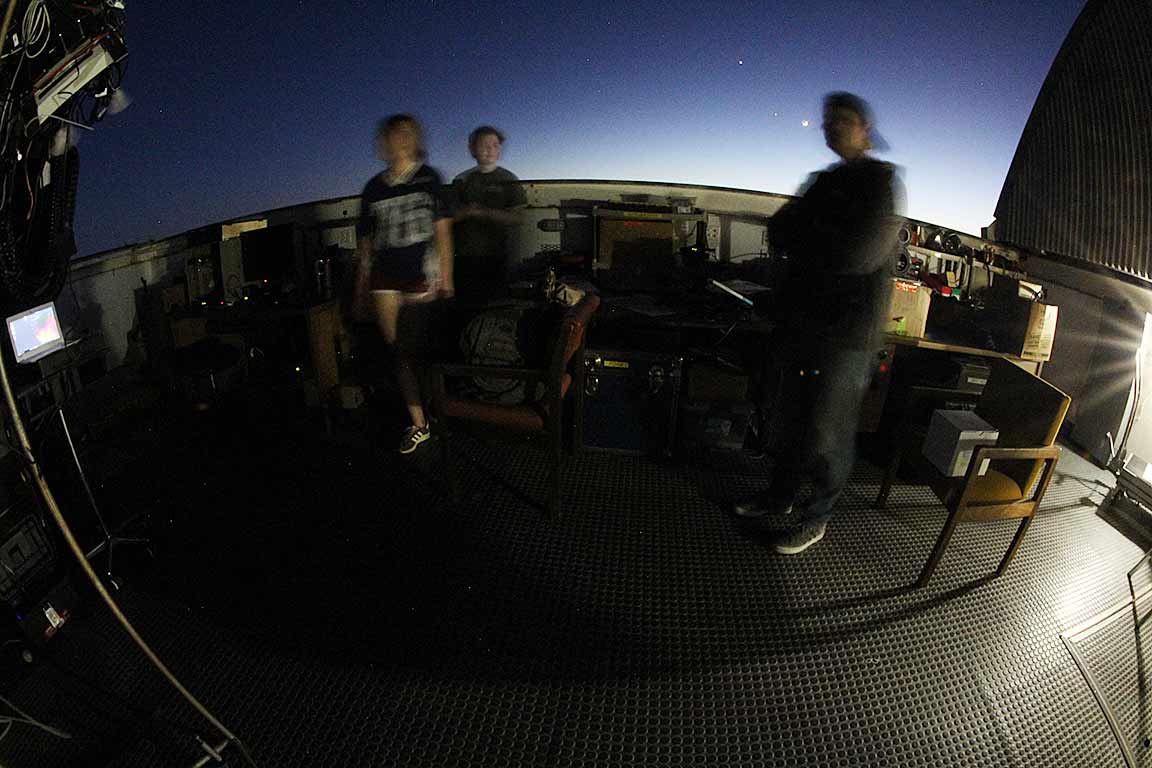
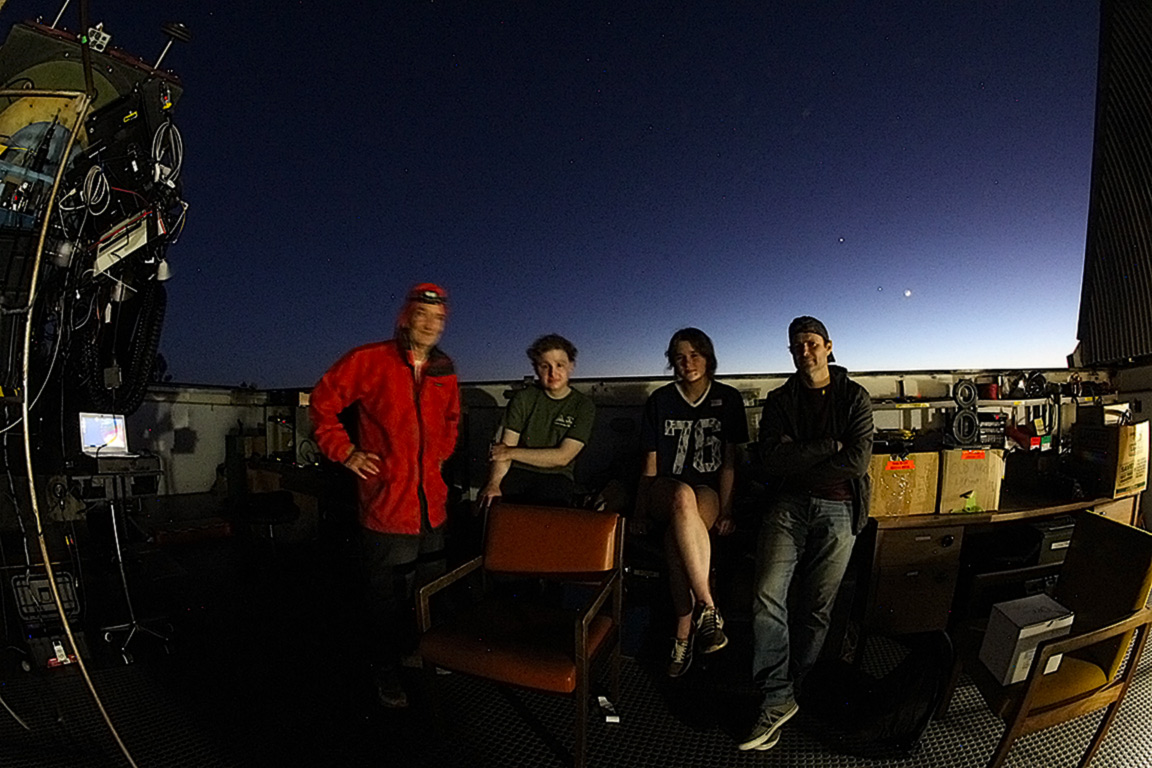
1. The Personnel: MIRA intern Logan Barrett was put in charge of initiating the recording on the 14" CDK telescope, of triggering the recording start and end, and recording weather information. MIRA intern Viktoriia Gusieva was in charge of monitoring the sky near the target for any airplanes, and as aid for supporting unexpected needs during the flat fields and dark frames and occultation data acquisition. Daniel V. Cotton was the resident MIRA astronomer and prepared all the power systems of the Observatory and was essential in the optical set ups, focusing, aiming of the 36" and 14" CDK telescopes. Fine focusing and fine position on the 36" was done by Nolthenius, and on the 14" by Logan Barrett and Daniel V Cotton.
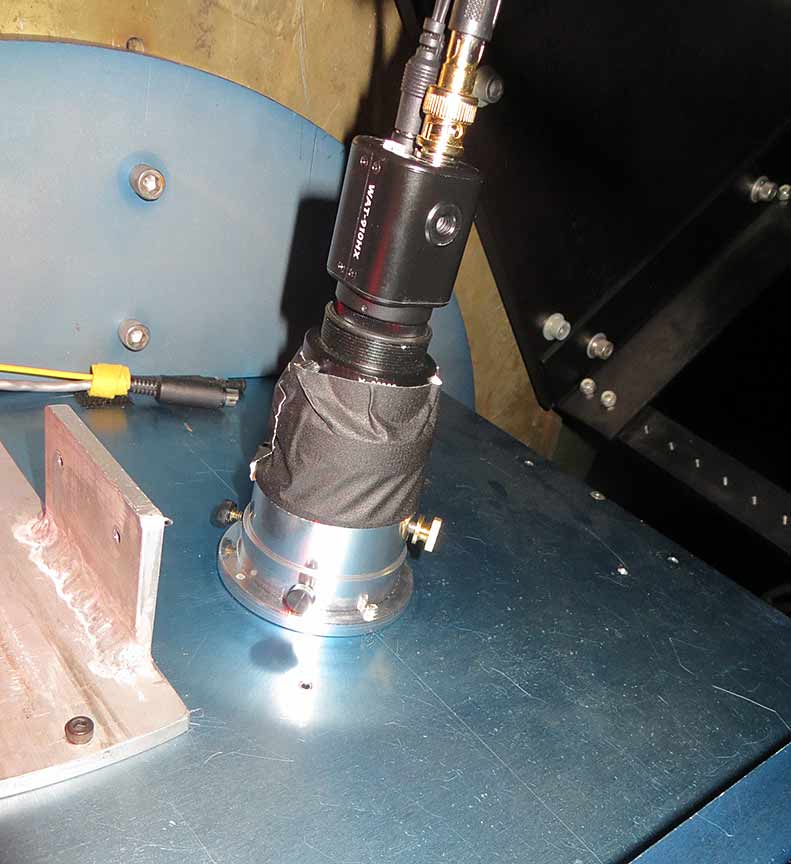
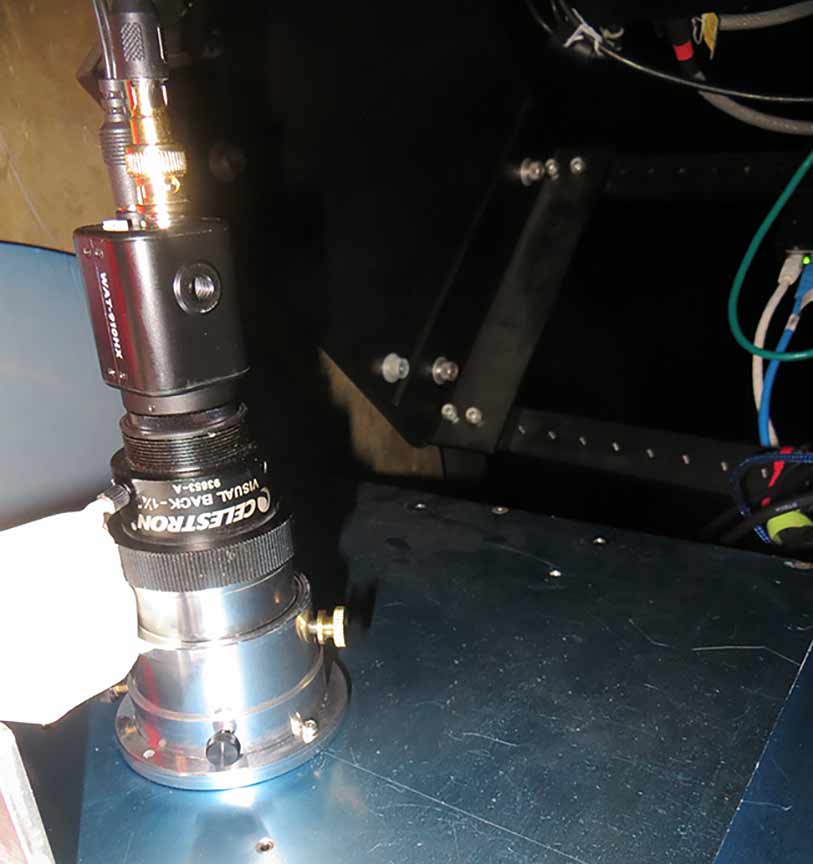
2. Watec cameras swapped. Also, evaluation of the Watec detector signals convinced Nolthenius after the dark and flat fields were done in twilight, to swap the cameras (14" vs 36") to improve the signal on the 36" telescope with the newer Watec camera. This was done while it was still too bright to try and get on-target. The OccBox's (containing stand-alone battery power, IOTA VTI ver 3 time stamping, and power/data switching, and routing) were left as is during this swap. OccBox 4 was on the 14", OccBox 3 was on the 36" telescope. Only the Watec cameras were swapped. Now and going forward, it is the Nolthenius OccBox 3 which has the new Watec 910hx with the better chip, and the older Watec 910hx which had been the workhorse for Nolthenius's past PAL Watec recordings, which now is dedicated to OccBox 4, a unit not currently in regular use, but put into service for this special event. This means that the flat field for Nolthenius' 36" telescope recording was actually done on the CDK 14". However, both chips take up such a small part of the focal plane that there is no visible vignetting on either telescope's flat field, and the importance of the flat field therefore is in the individual pixel and column noise unique to that camera, and not on the telescope it was mounted on for the flat field. For much shorter focal length telescope use, this may not be the case, but it was the case here for these large long focal length telescopes.
3. Optical issues: There is better signal to noise when focal reduction puts the star on fewer pixels. This is such a strong effect, that the S/N on the 14" f/7.5 telescope is about the same as on the 36" f/10 telescope as revealed by the light curves above and visually on the brightness and steadiness of the target star. Nolthenius uses an f/3.3 focal reducer on the 8" f/10 Celestron 8SE scope and it makes a strong difference. It was desired to also use the f/3.3 reducer if possible, for these events. While enough adapters were located and employed to get the f/3.3 focal reduer to be in the optical train, the focal point was unreachable. In the end, we had to remove it and go with the native f/10 configuration. During the 80 minutes after twilight flat fields and locating and ID'ing the star fields, several different adapters were tried to reach focus with the f/3.3 adapter, all failed. During this time, an adapter was put into the train which did not allow the adapter above it to make a snug connection, and with time running out, we did a hasty duct-taping to secure it. It's possible that the two deep drops in all stars brightnesses during the light curves (all stars, therefore not of astronomical origin) were due to a shift in that connection before auto-centering by PyMovie rescued the signal. This is only a guess, but seems plausible. There were no clouds at all seen, and the target was 31 degrees up. Particle counts were well inside tolerance range.
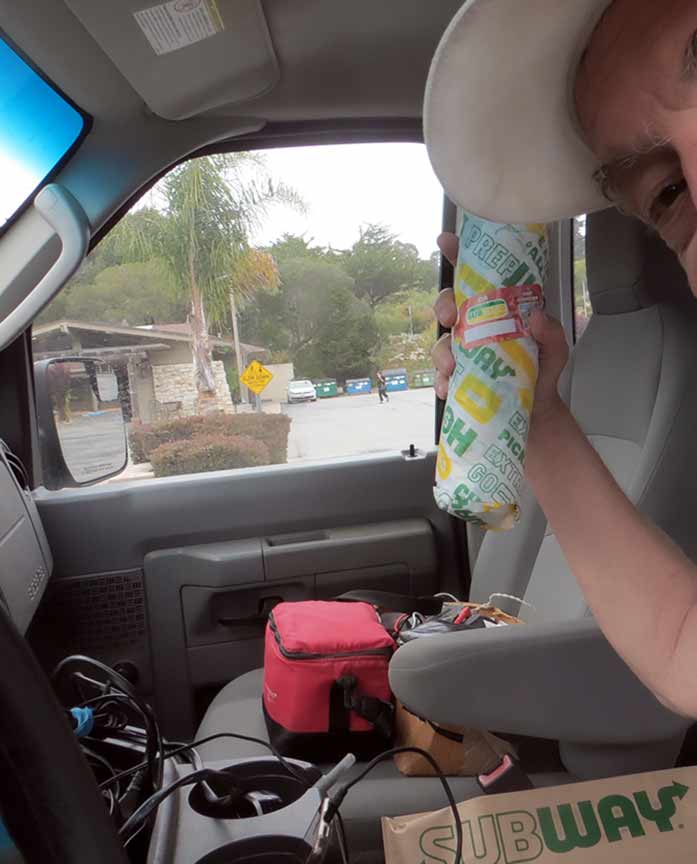
A stop in Carmel at the local Subway for a VegeDelight foot-long, to get me through the night. |
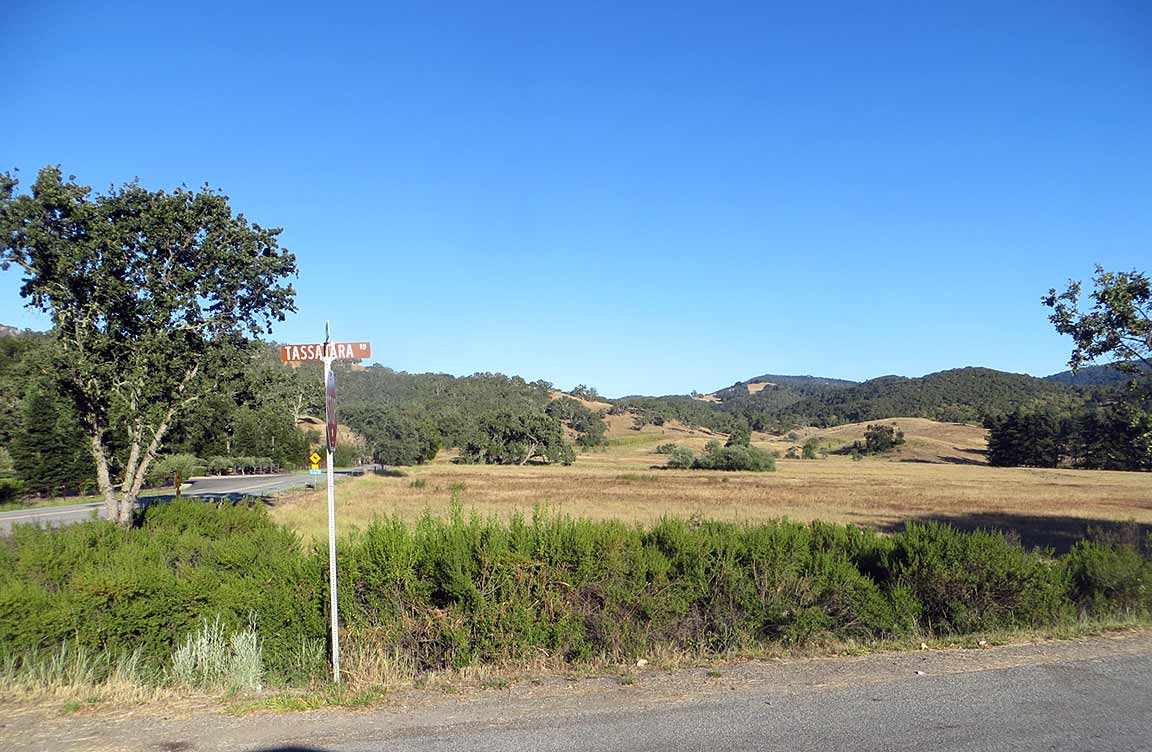
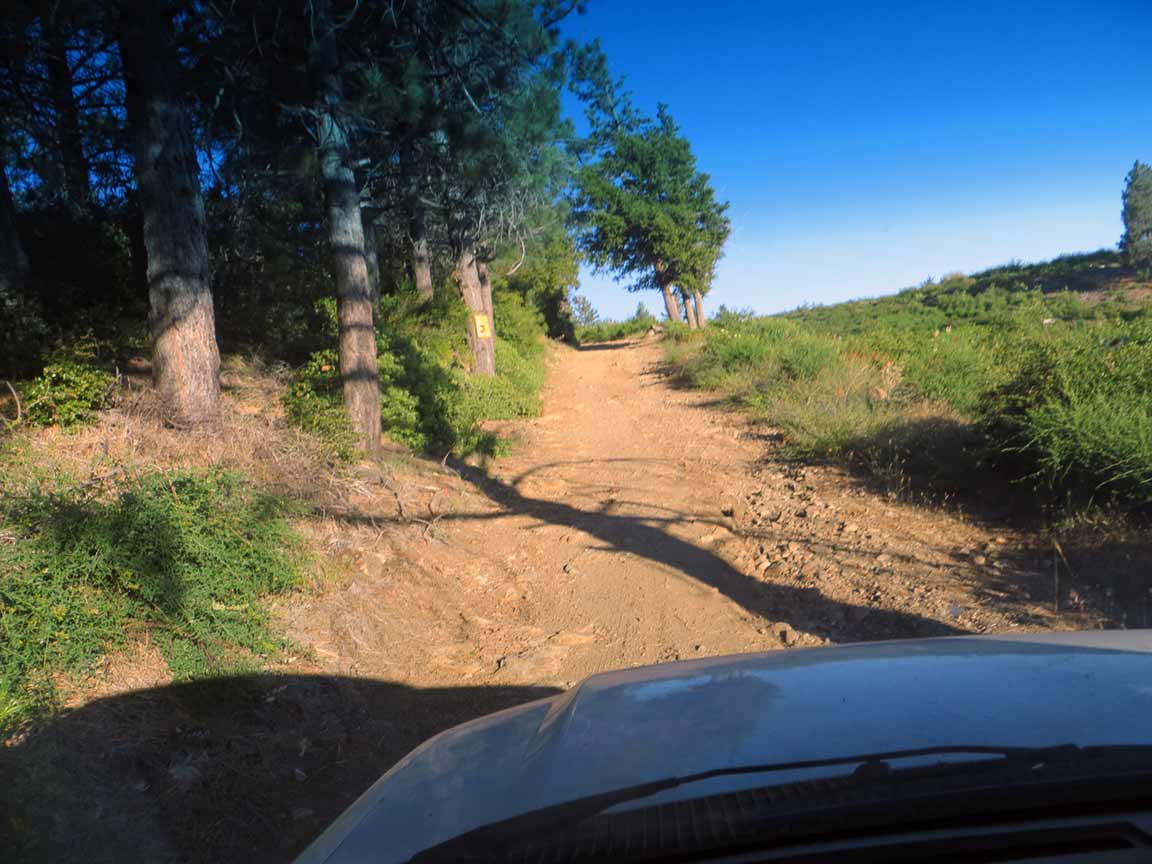
The turn off onto Tassajara Rd |
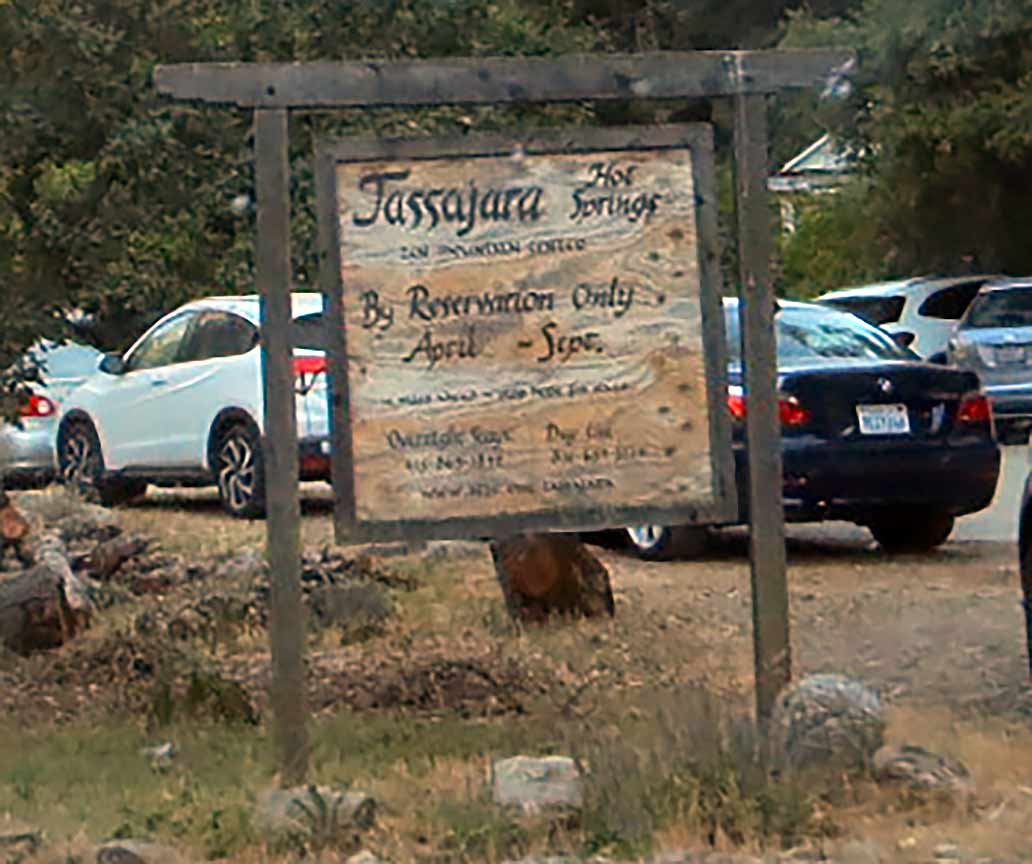
The Observatory is at the top of the ridge before descending to the famed Tassajara Zen Retreat Center. Zen students park here and there's a daily shuttle that takes them over the rough road to the Center. |
At the summit, a gate gets you onto this "road" to the Observatory |
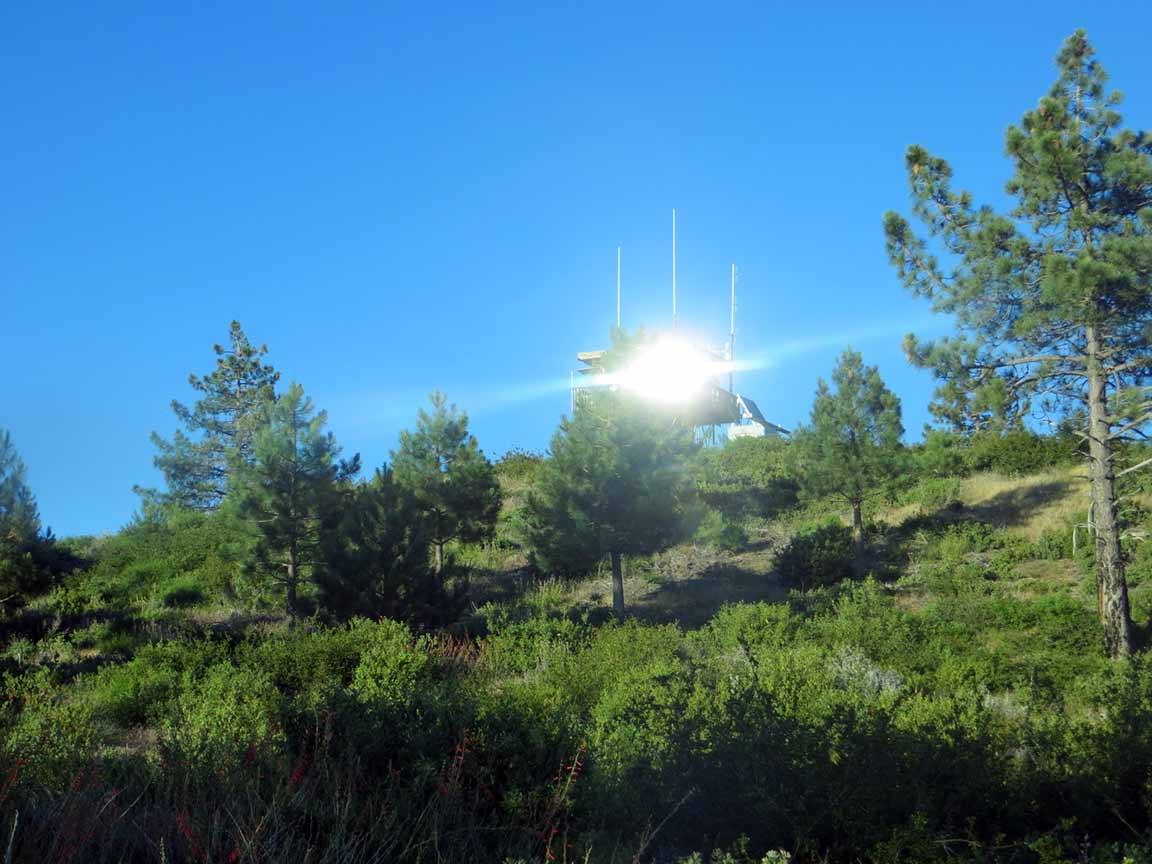
The old fire lookout. I have fond memories whenever I see it - of 1978 and my impromptu drive up this road to the fire lookout to camp, and meeting a very friendly old guy who monitored for fires. We talked into the night, grateful to have company. Now, it's locked up but still there are some instruments that are maintained. |
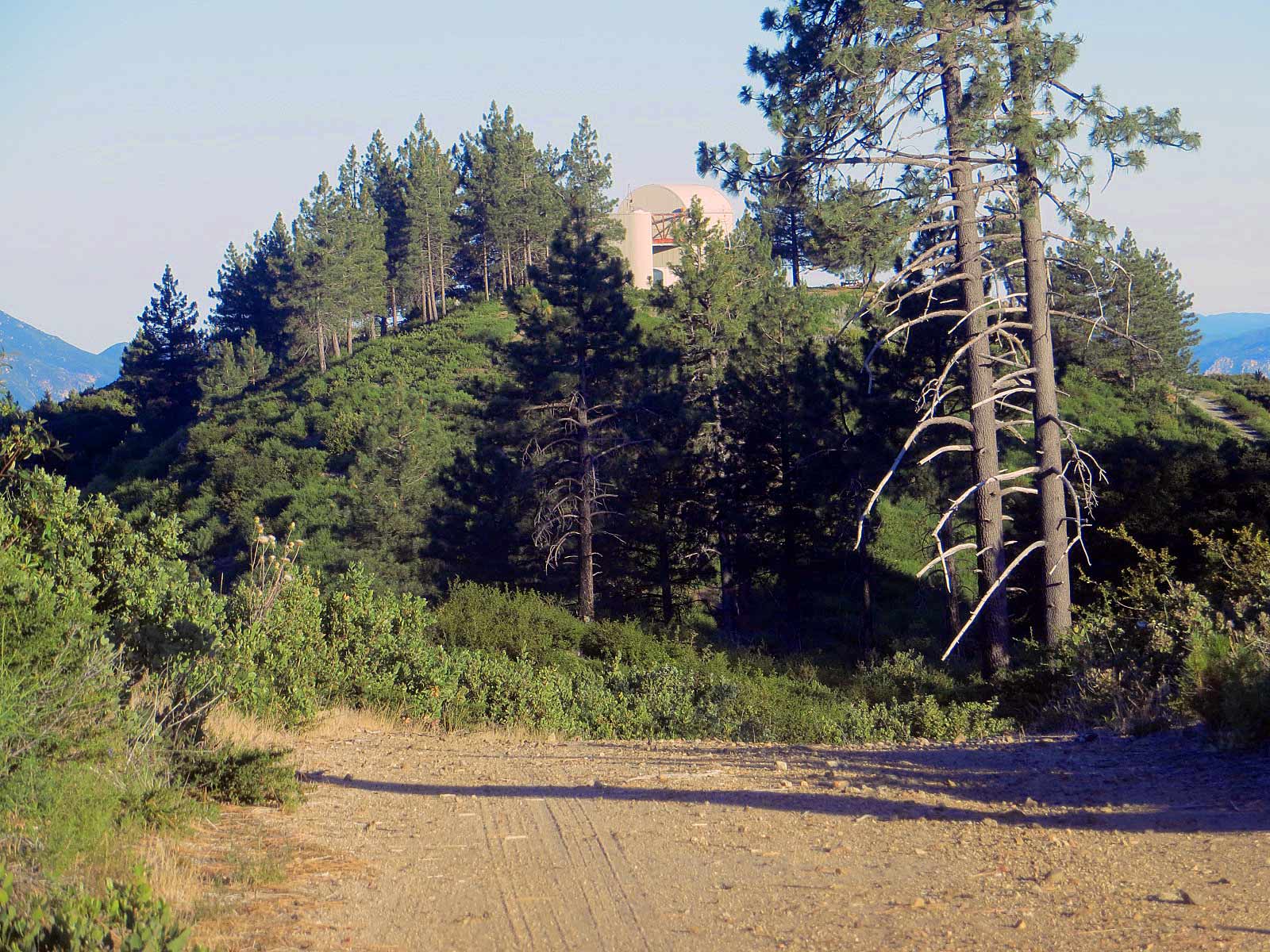
Through the tree, MIRA Oliver Observing Station is visible |
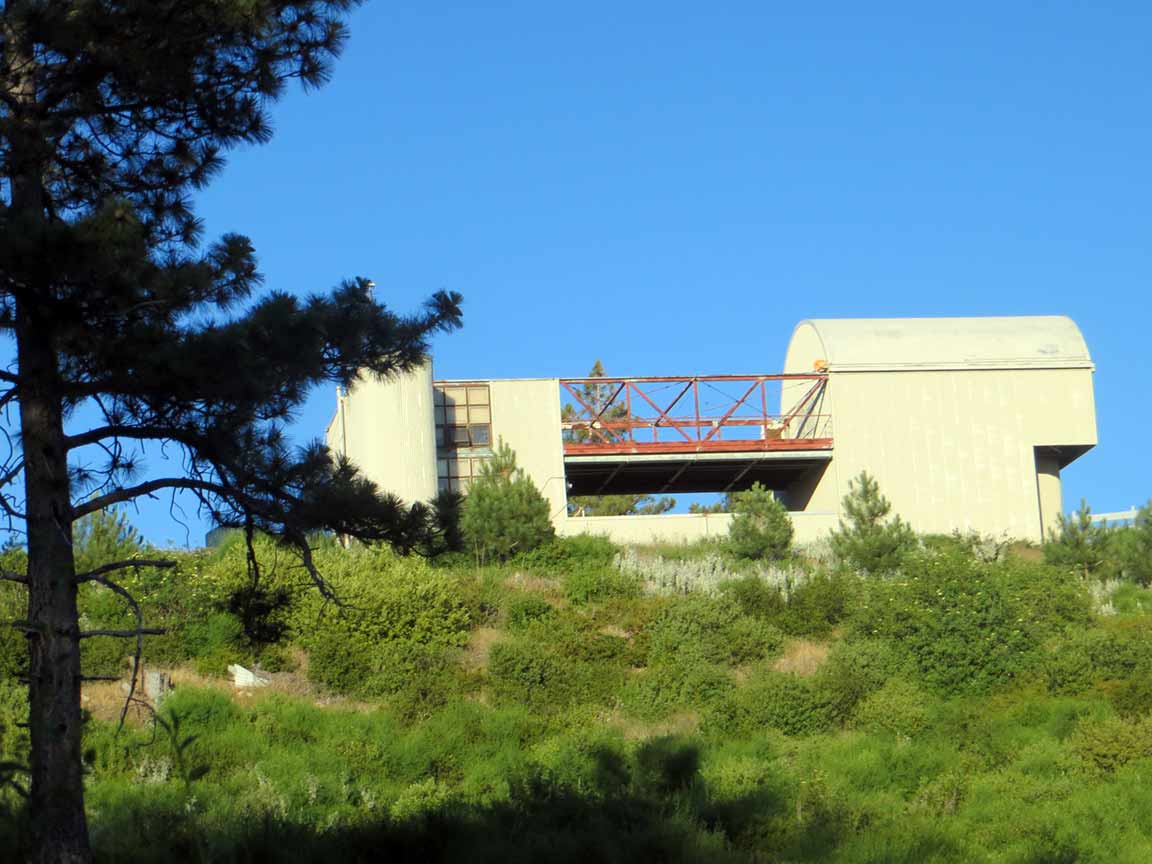
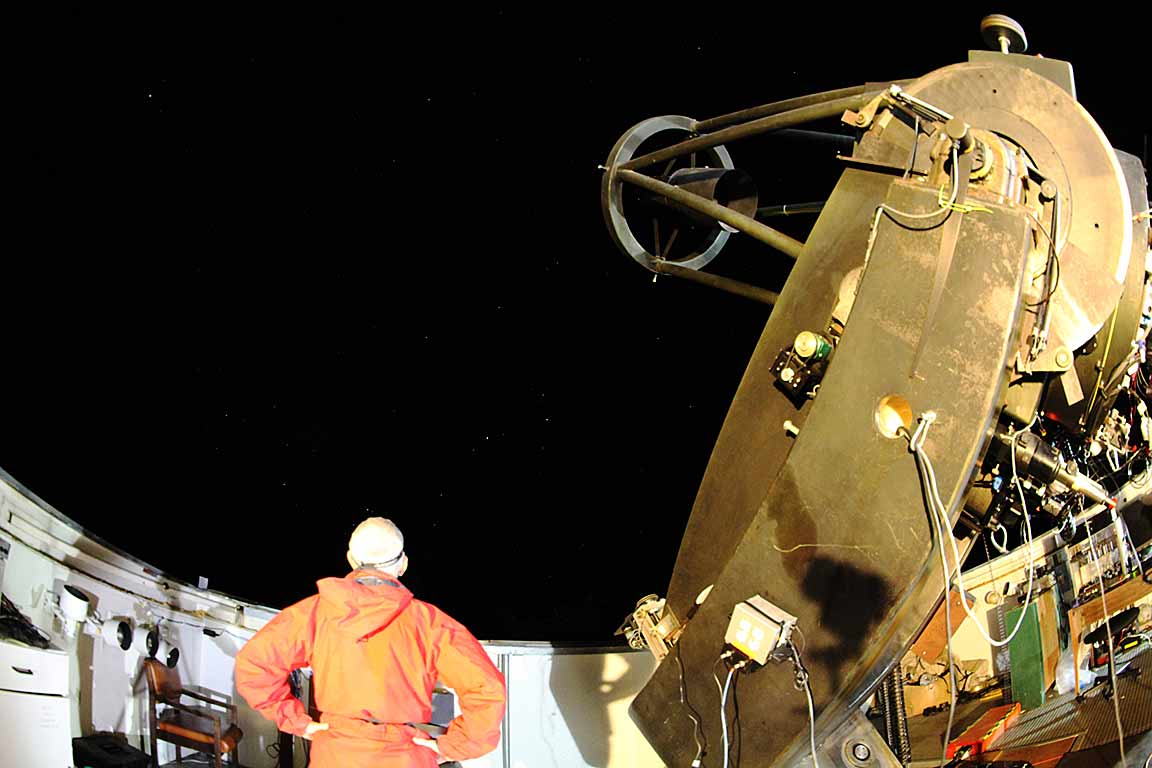
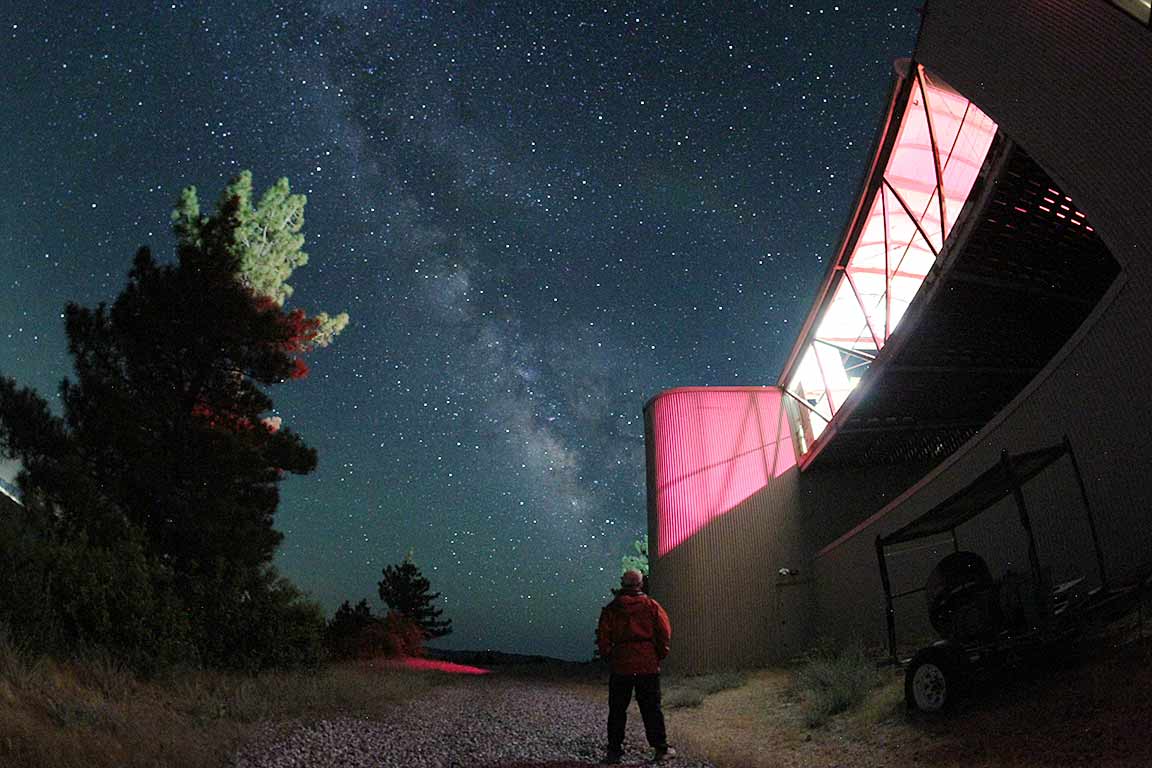
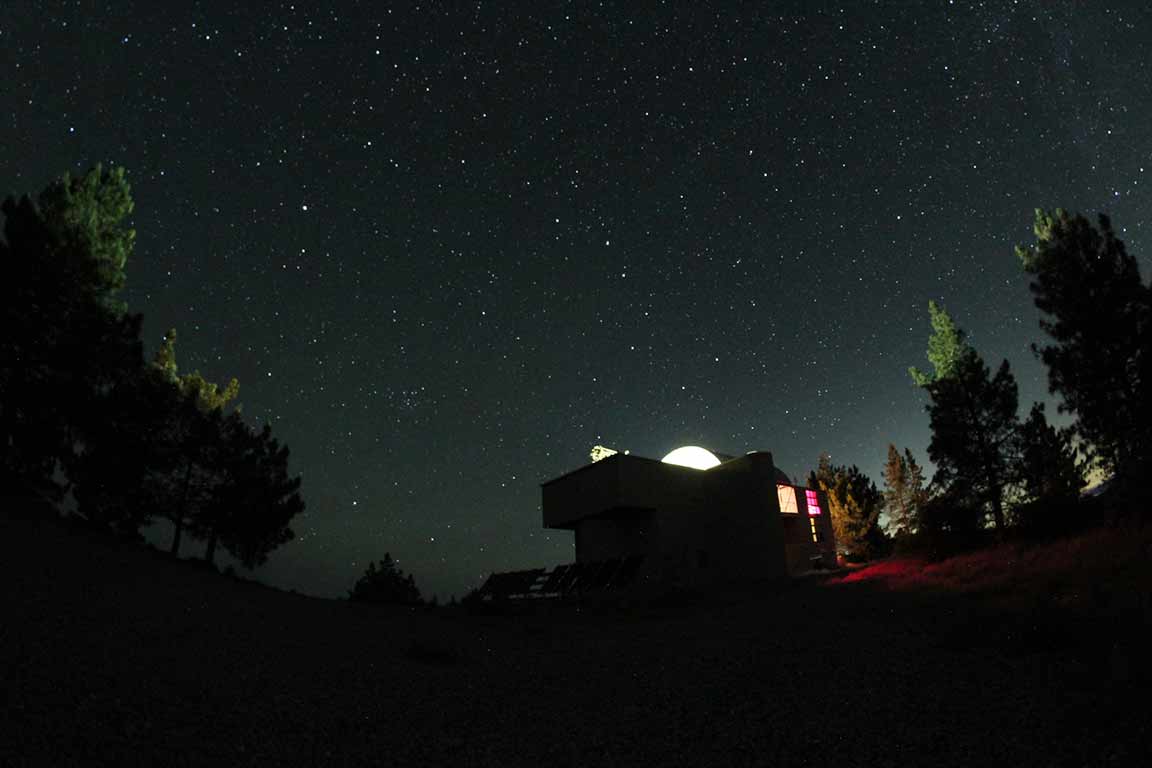
Quite an impressive structure, 3 stories tall with living quarters, machine shop, telescope room under a roll-off roof - all powered by solar and wind installed on the grounds, with lots of batteries. |
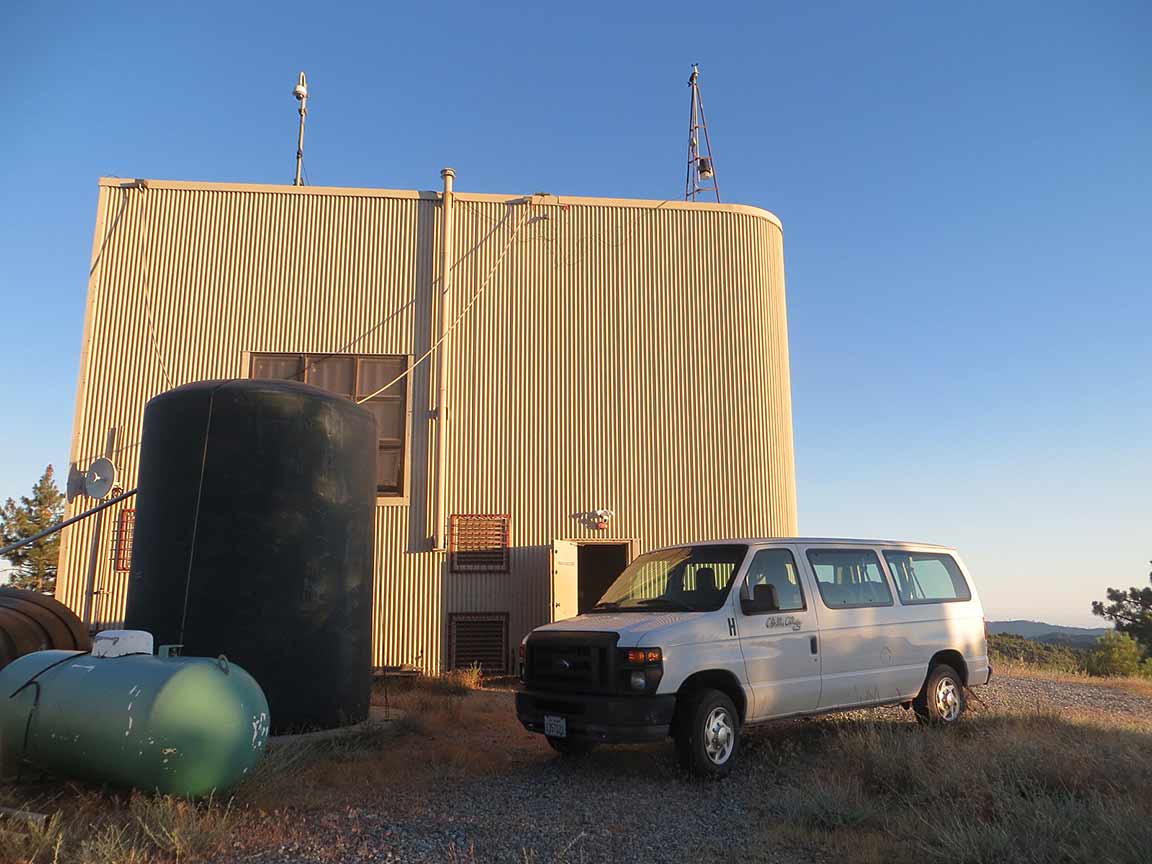 |
 |
At sunset, preparing to roll back the roof and get the scope thermally equilbrated for taking flat field videos as part of the data. Victoriia handling the duties, as Dan monitors. |
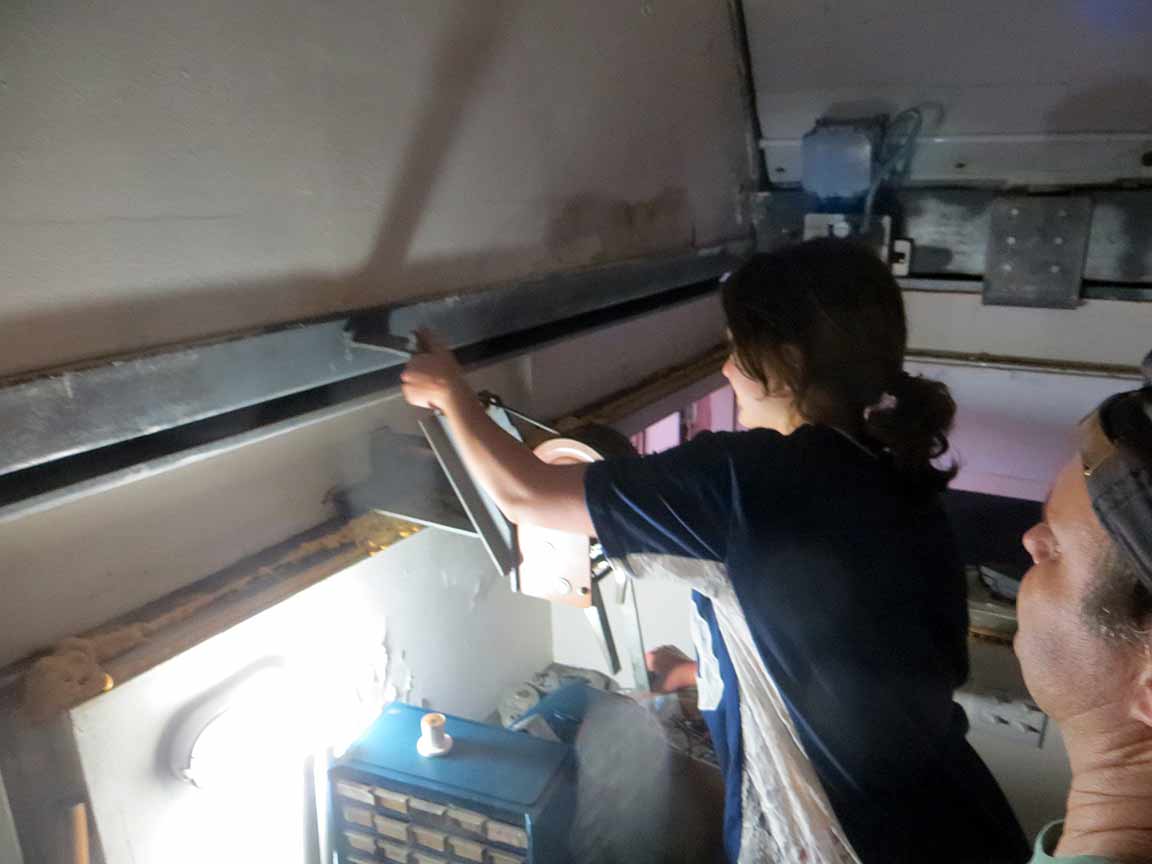 |
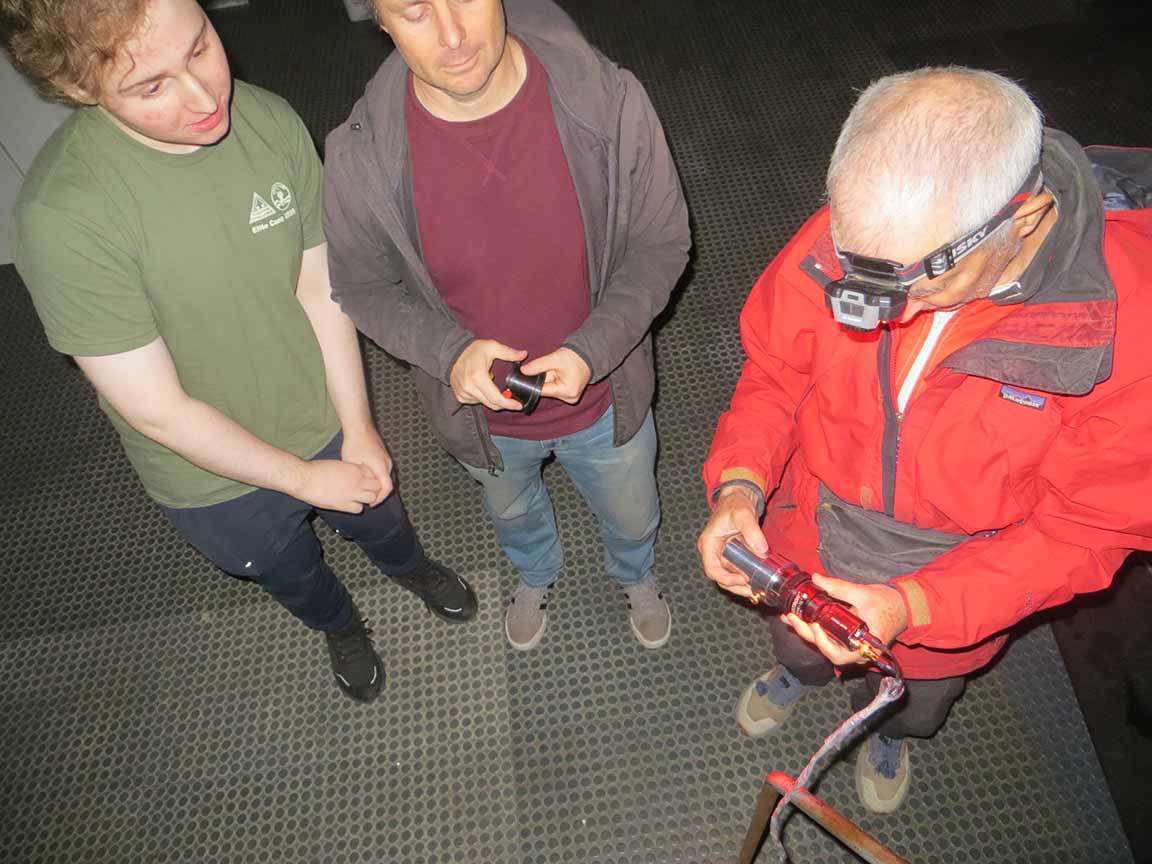
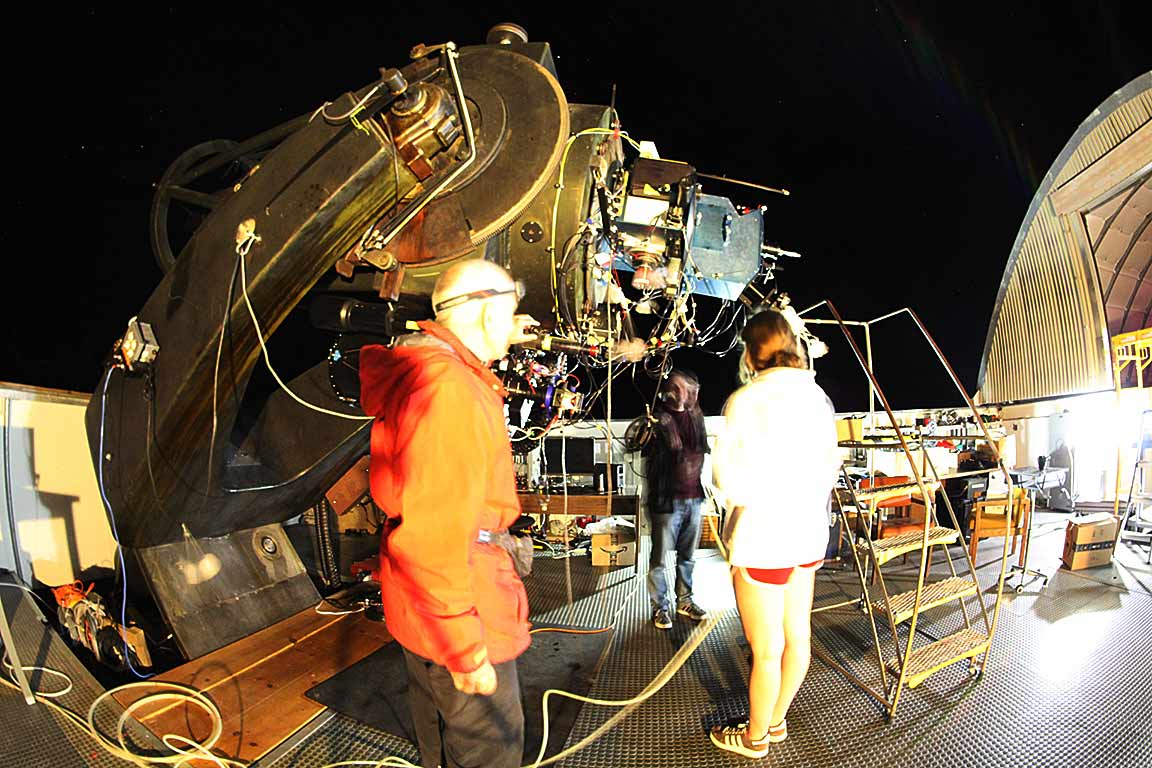
Logan and Victoriia were college interns, here to help with the project. |
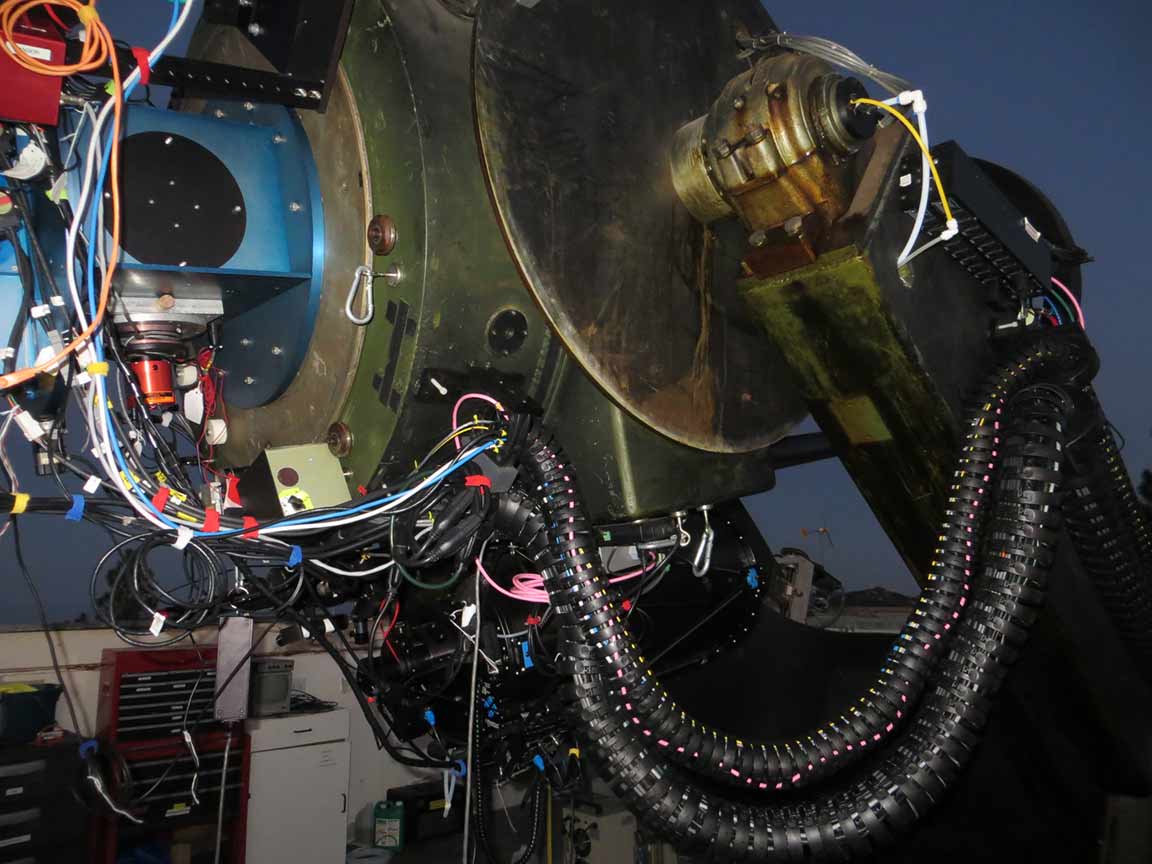
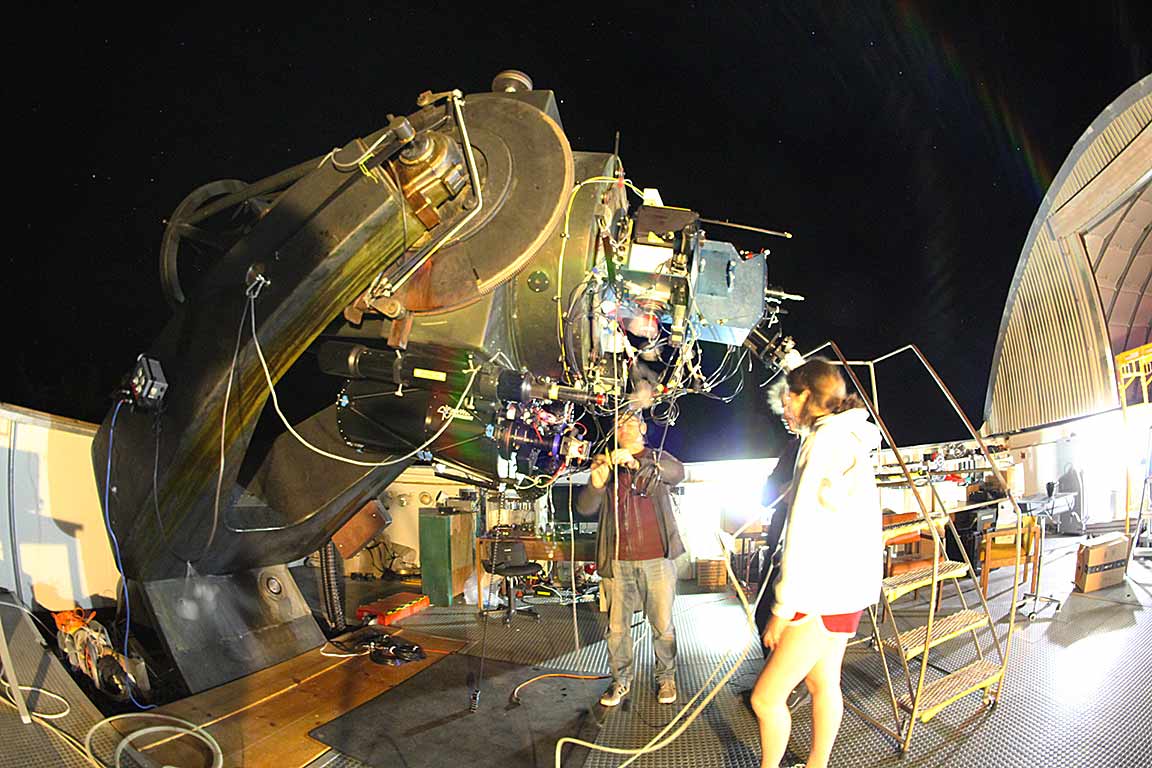
Telescope improvements continue - most obvious is the tidy data/power cabling for all the instruments, now routed and enclosed efficiently. Soon there will be special occultation camera gear on a new port being made. For tonight, though, we're still using the visual 2" port on the rotating instrument assembly |
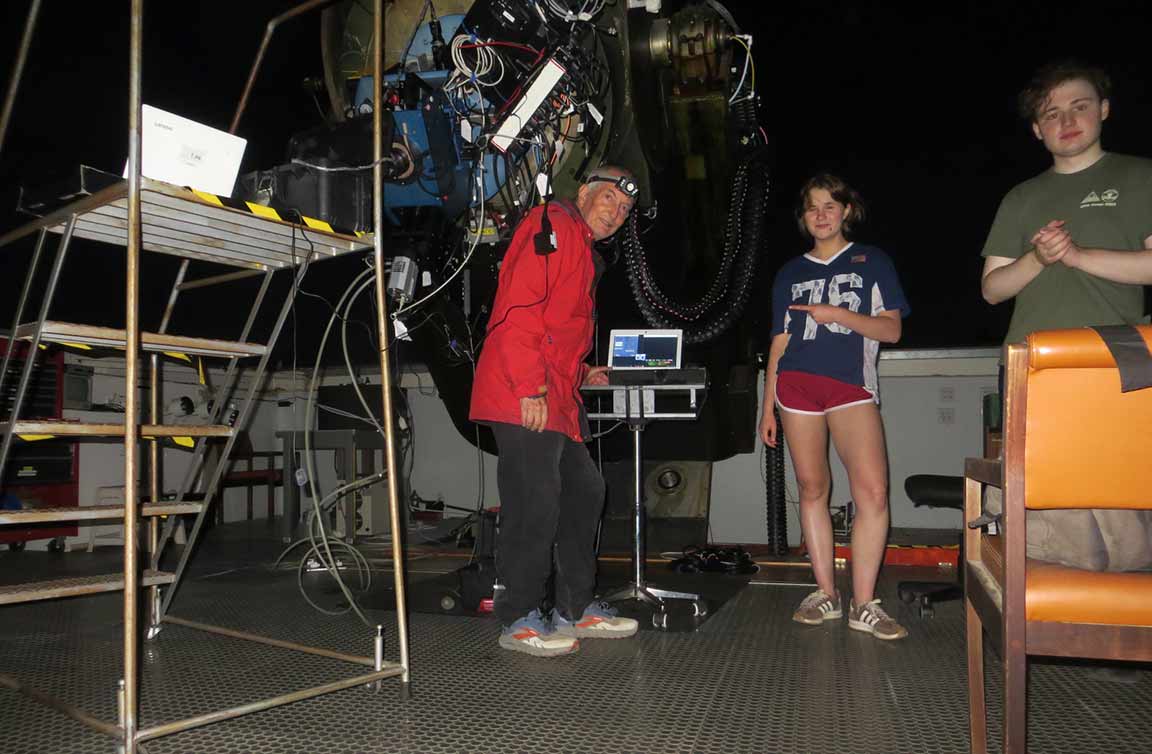 |
Flat fielding done. I'd brought the OccBox 4 previously used by Jordan (my student assistant this past Spring). Testing, I decided the OccBox 4 had a better Watec video camera than I'd been using, and so I swapped for it. Now my old Watec is in OccBox 4 and I've got the newer Watec which has much less column and row noise. I used this newer quieter Watec for tonight on the 36" scope. |
Now the time consuming process of taking my charts made for a different telescope and ID'ing the star field and the target. This is an art and a skill of pattern recognition by eye. |
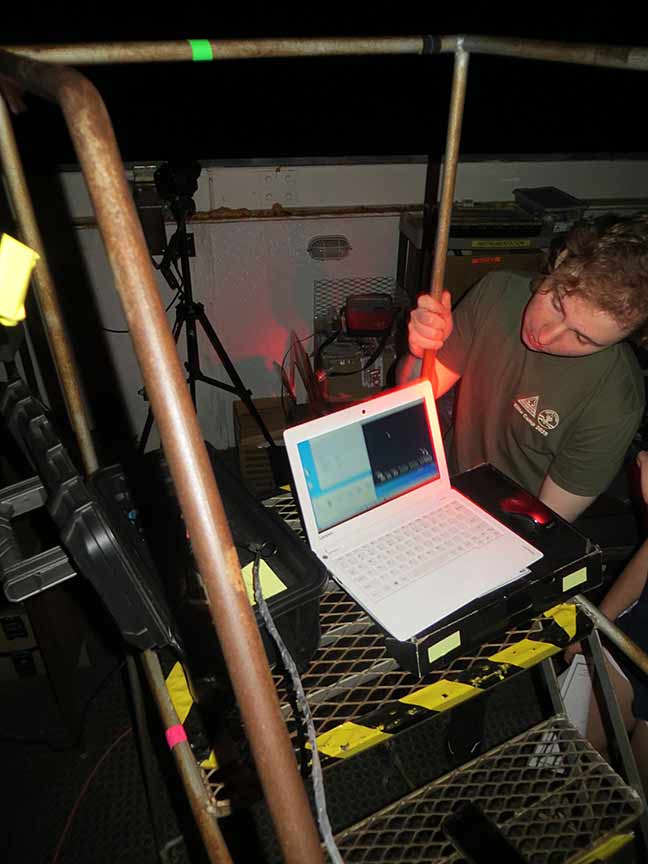 |
Twilight ends after 9pm and the occultation is at 11:01pm, so we had to be efficient. |
Now I really wanted to reduce the long f/10 36" focal length to get more star photons per pixel on the chip. I'd brought the f/3.3 reducer but it turned out we needed less backfocus than the scope could provide, for this. Discovered only after we tried about every adapter we could find. |
In the end, we had to settle for the native f/10 focal length. The adapter we had on at the time of that realization, is so time consuming to swap out, the we didn't have time to do that, and it wasn't a clean mate to my 2" to 1.25" adapter made for the Celestron. We had to MacGyver it! Duct tape to the rescue. |
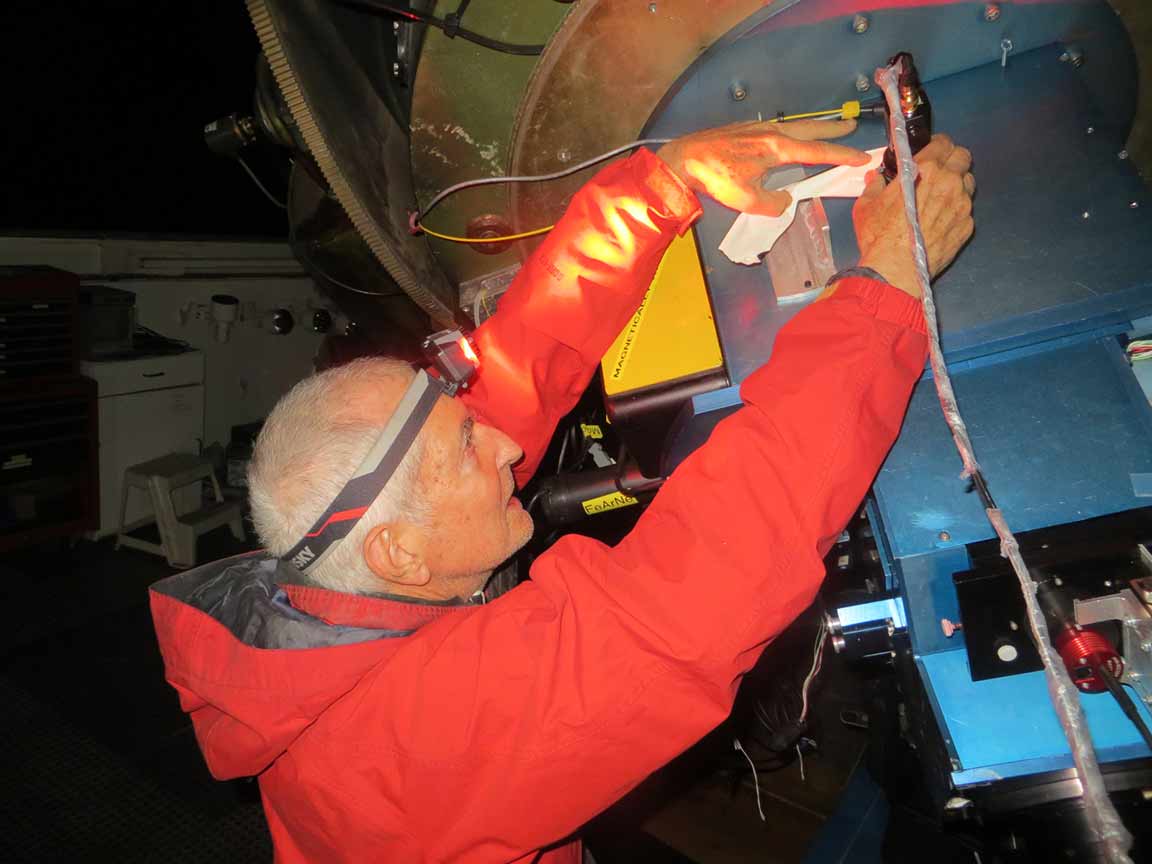 |
All's well - we got the data! Afteward, I tried one more idea - using the 0.5x nosepiece focal reducer... mounted on the next slide |
But the coma on the imaging was horrific. HORRIFIC. Not usable. We'll have to re-engineer things to get optimal focal reduction for next time. |
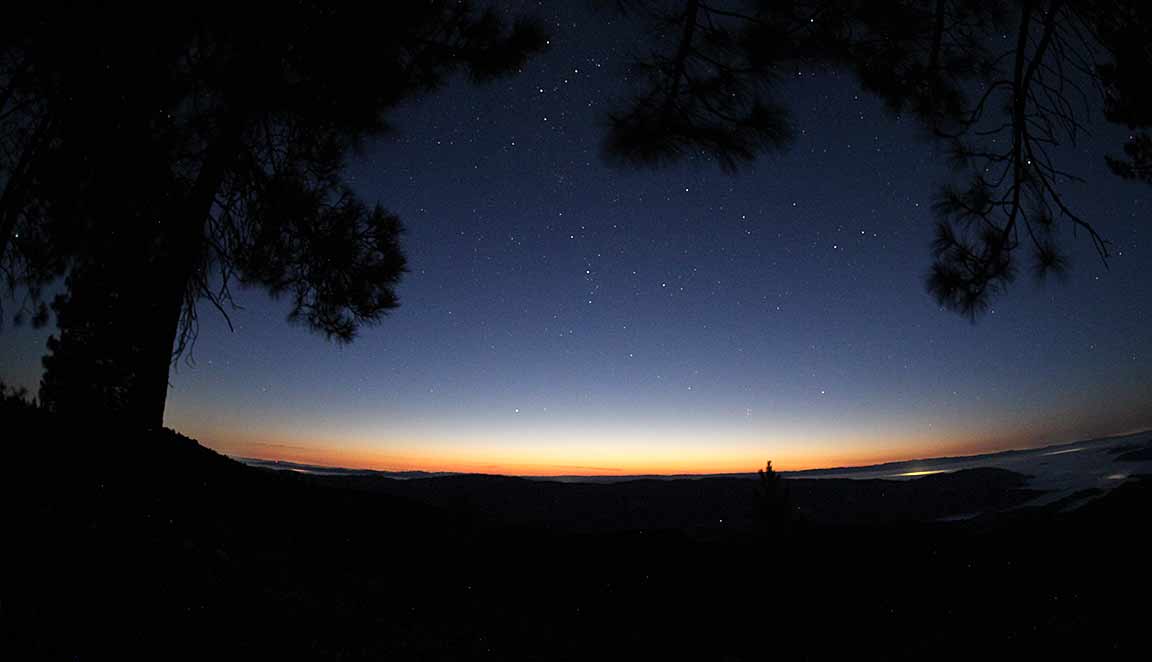
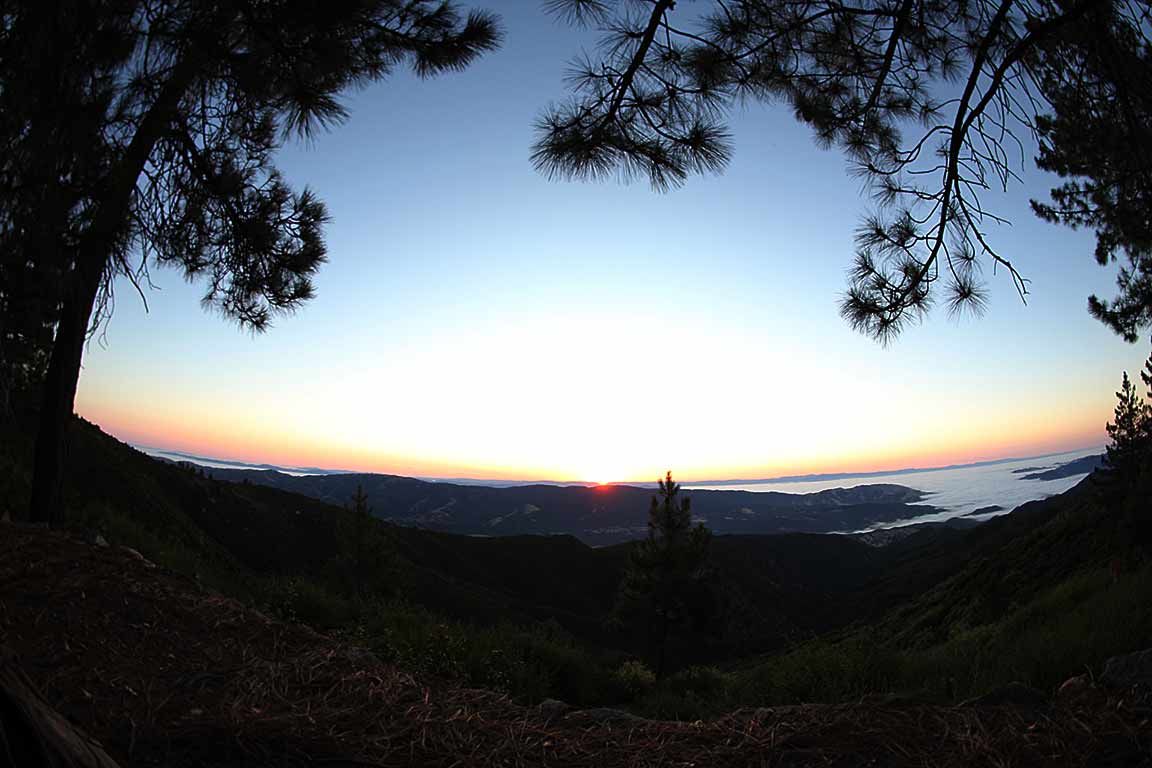
Then, I took it all down, and set up my sleeping back on the overlook and slept till sunrise |
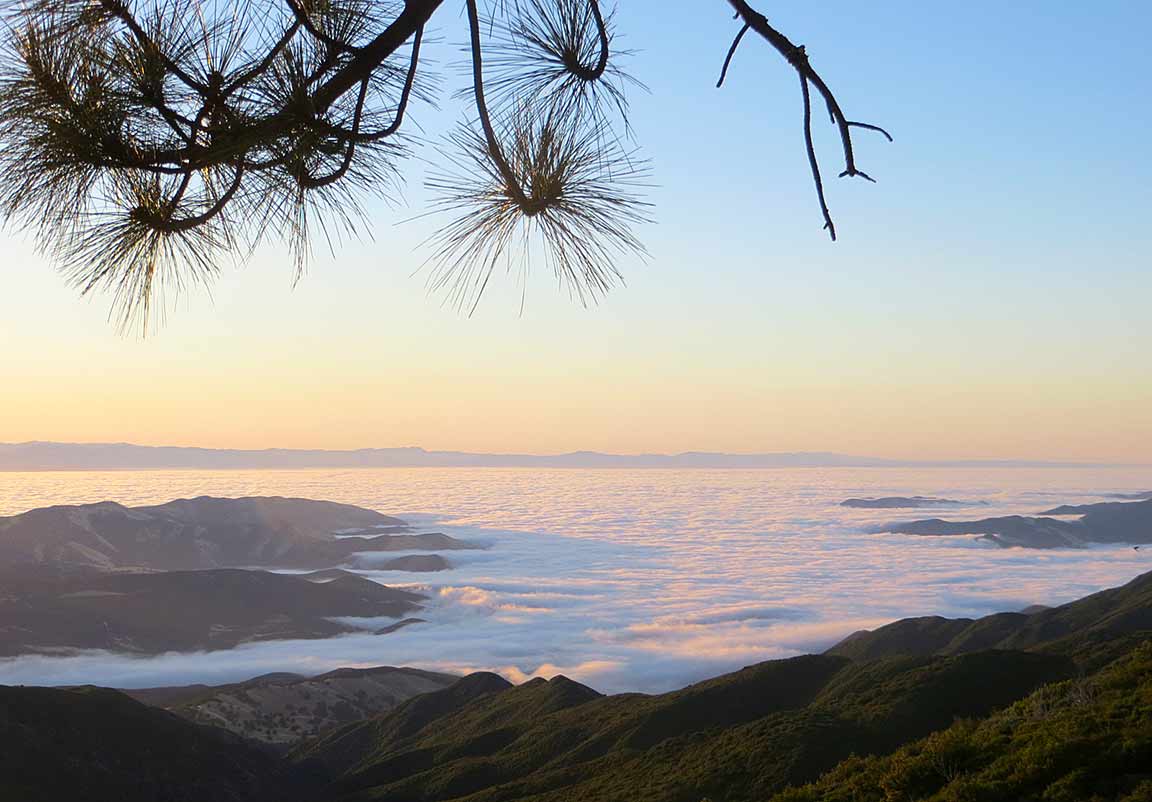
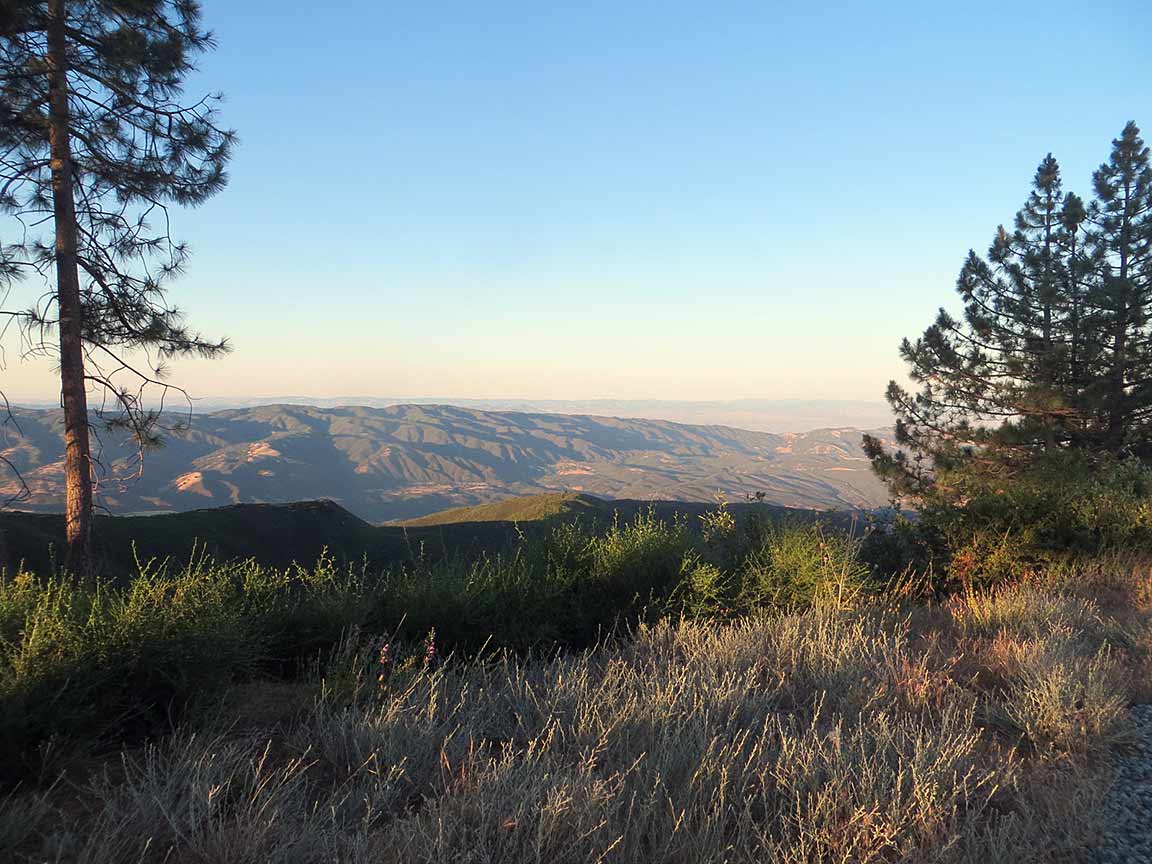
Looking down into Salinas Valley and nearby Arroyo Seco canyon |
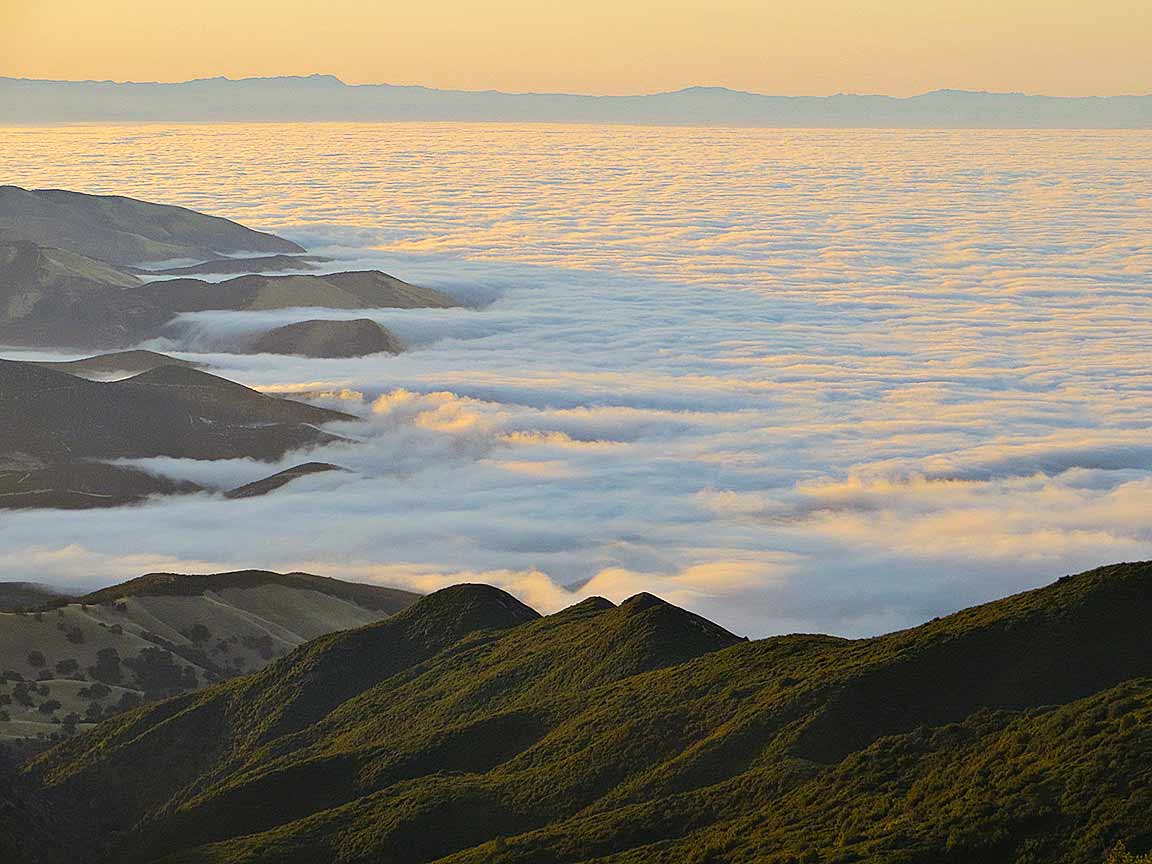 |
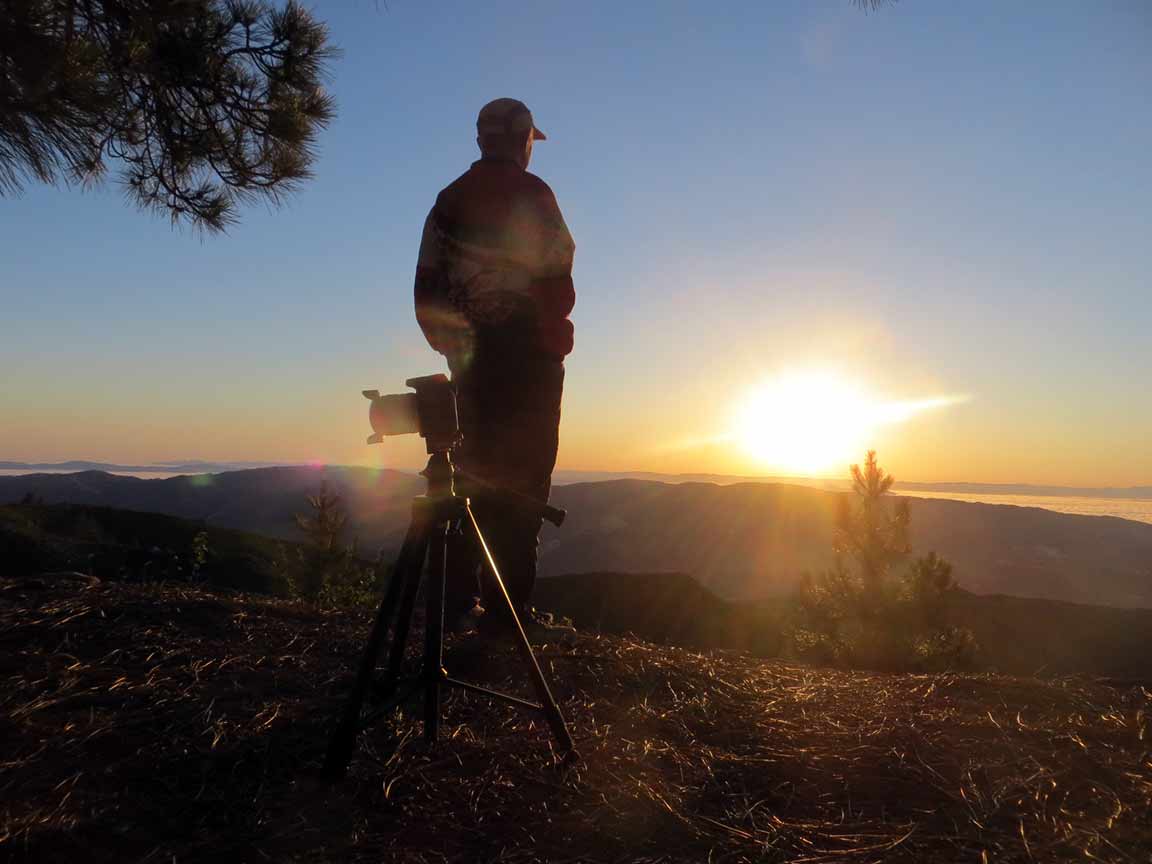
It's a beautiful spot. I'd MUCH rather camp outside than indoors in one of the sleeping areas. But then, I'm OK with waking up at dawn. |
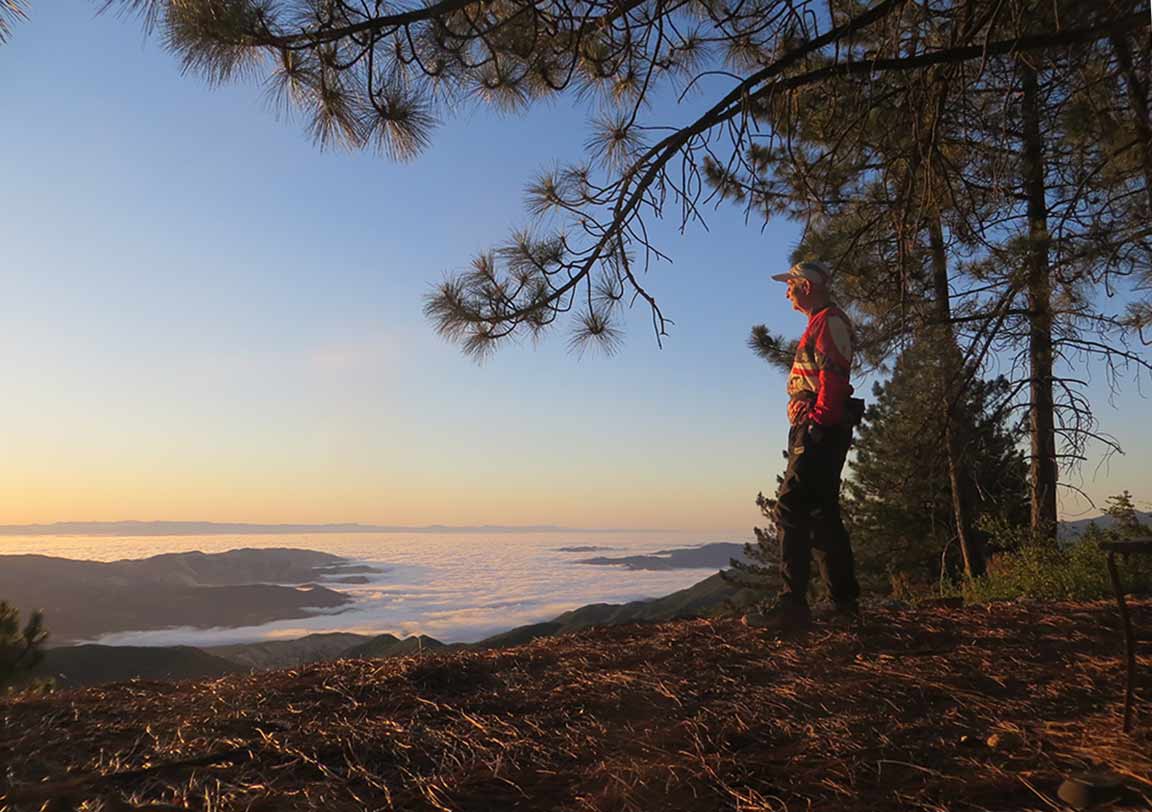 |
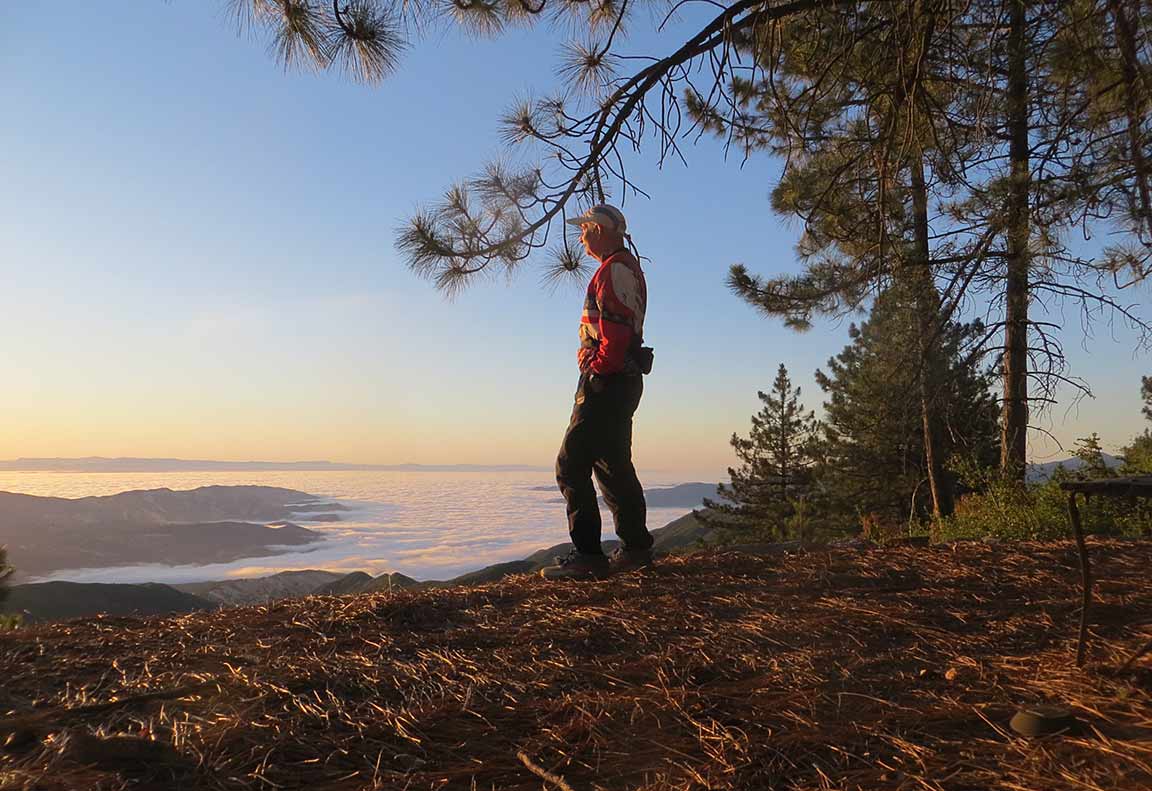 |
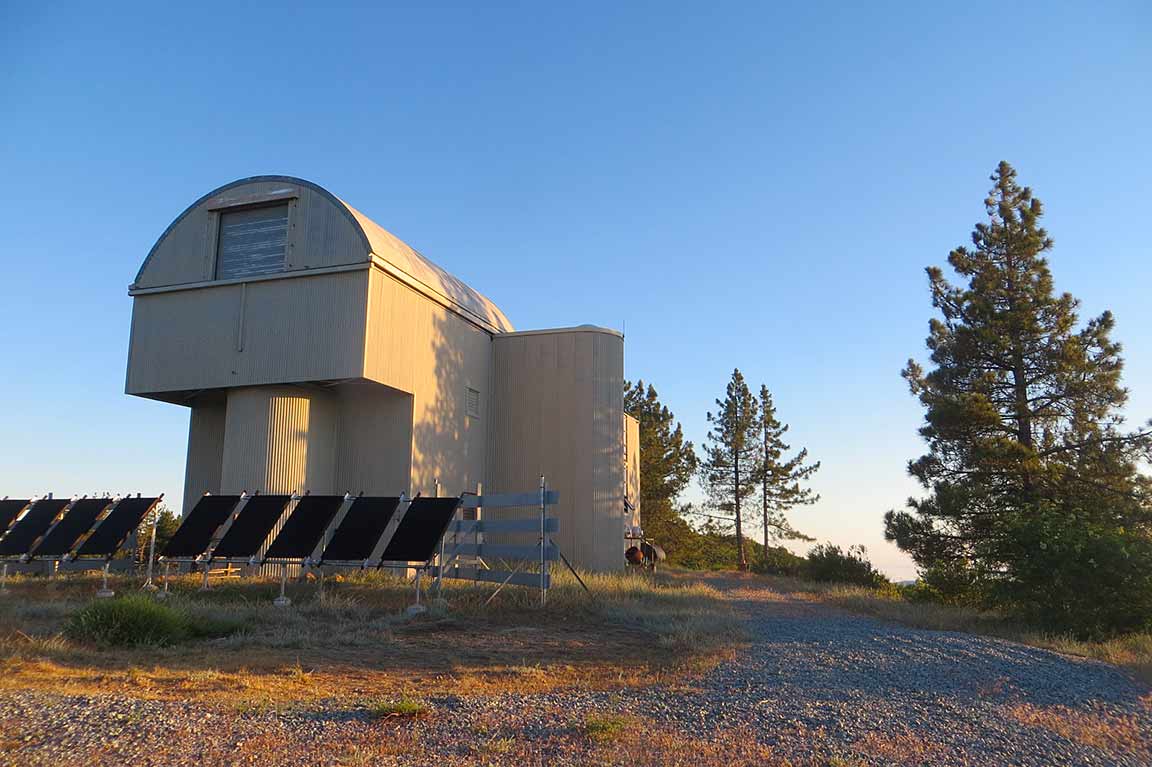
Morning light on MIRA OOS. The massive concrete pier supporting the telescope is obvious behind some of the solar panels. |
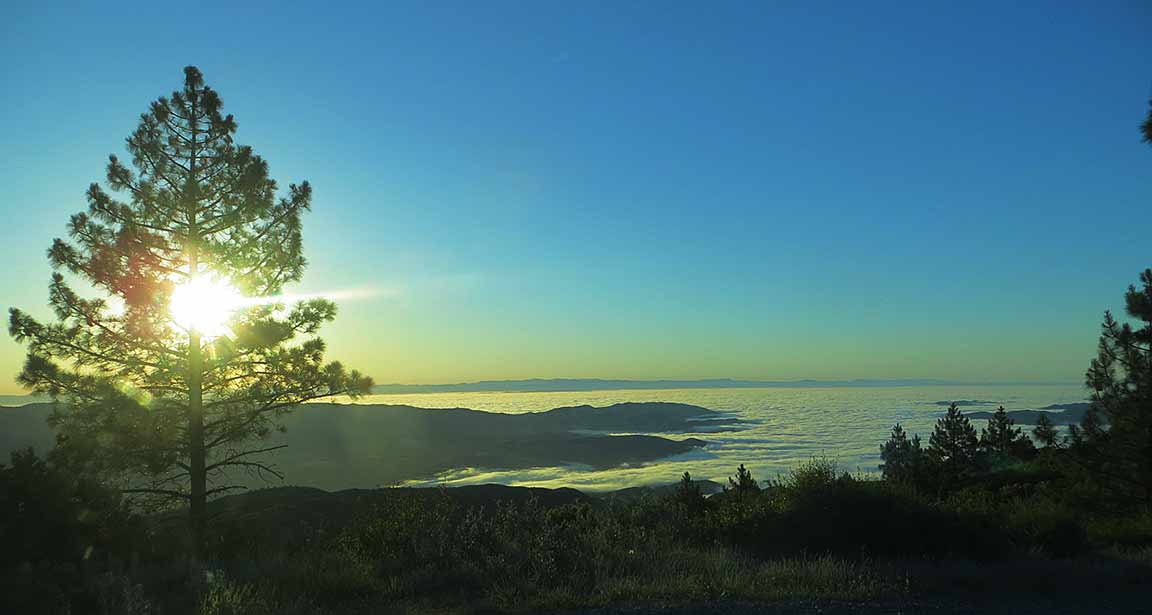 |
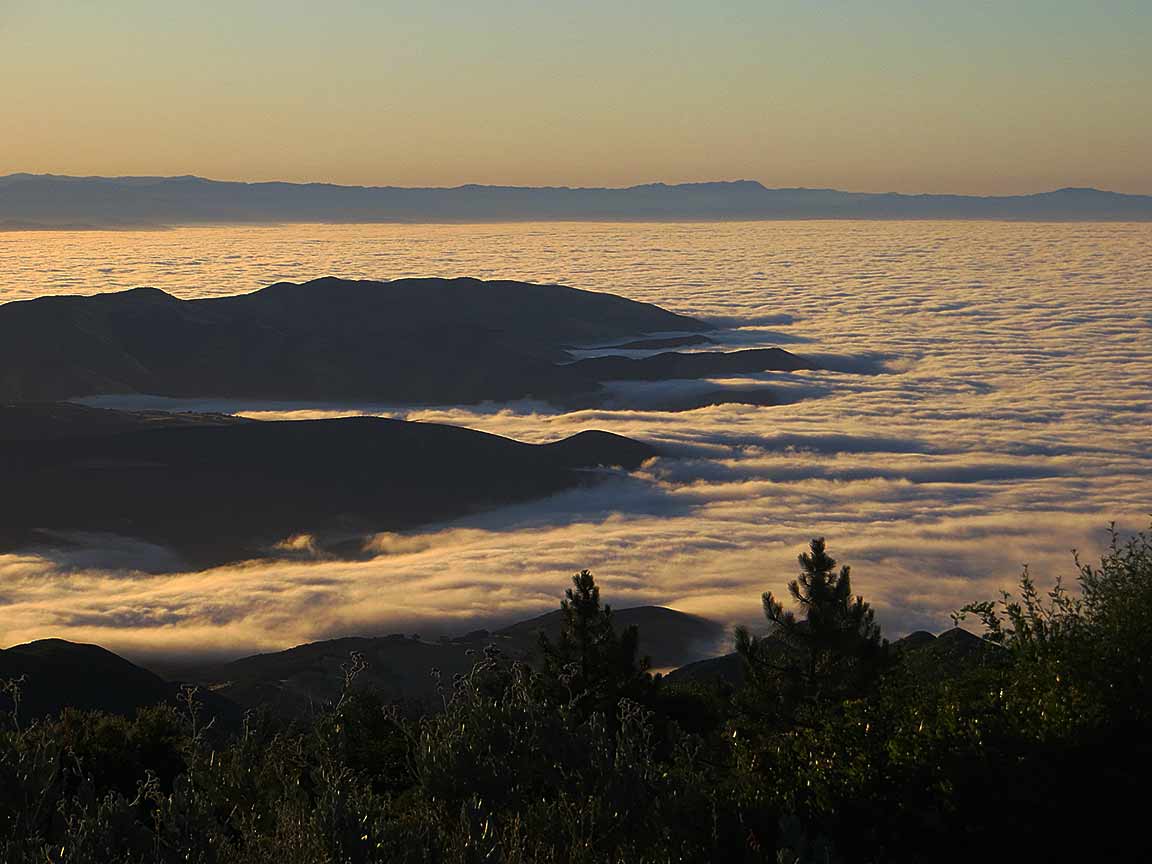 |
 |
 |
 |
 |
 |
 |
 |
 |
 |
 |
 |
 |
 |
 |
 |
 |
 |
 |
 |