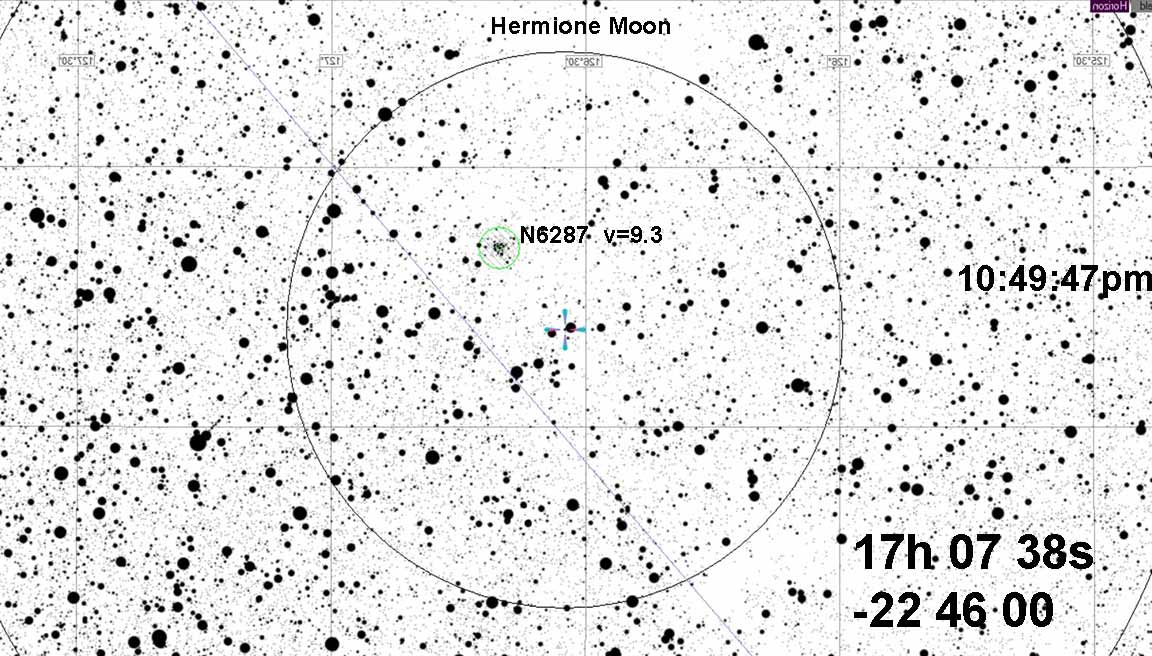
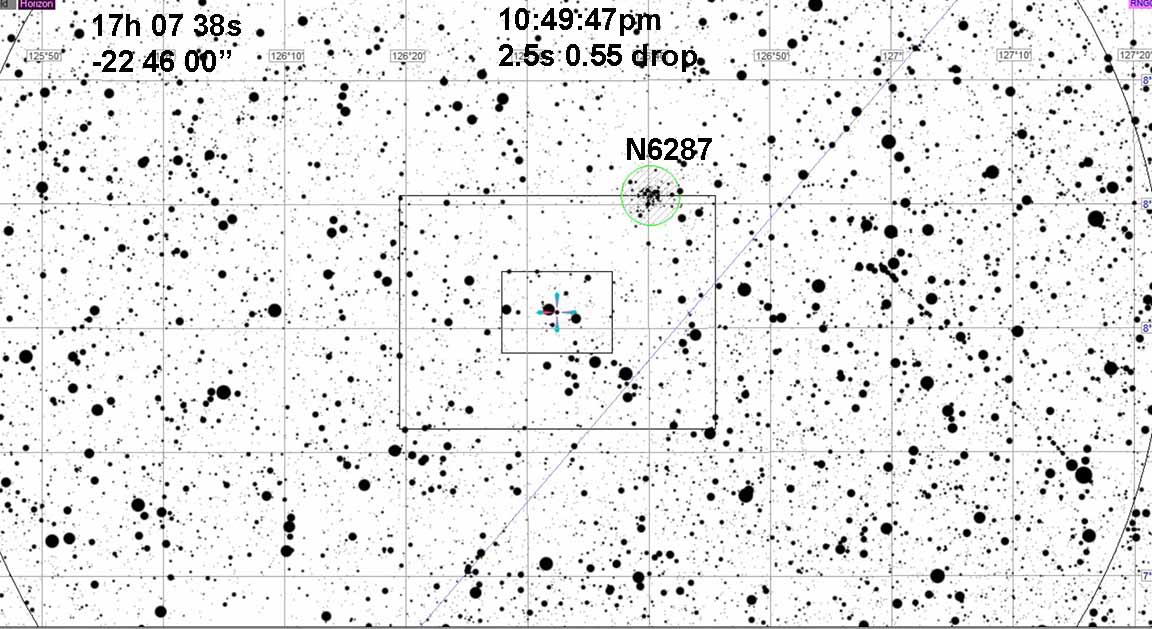
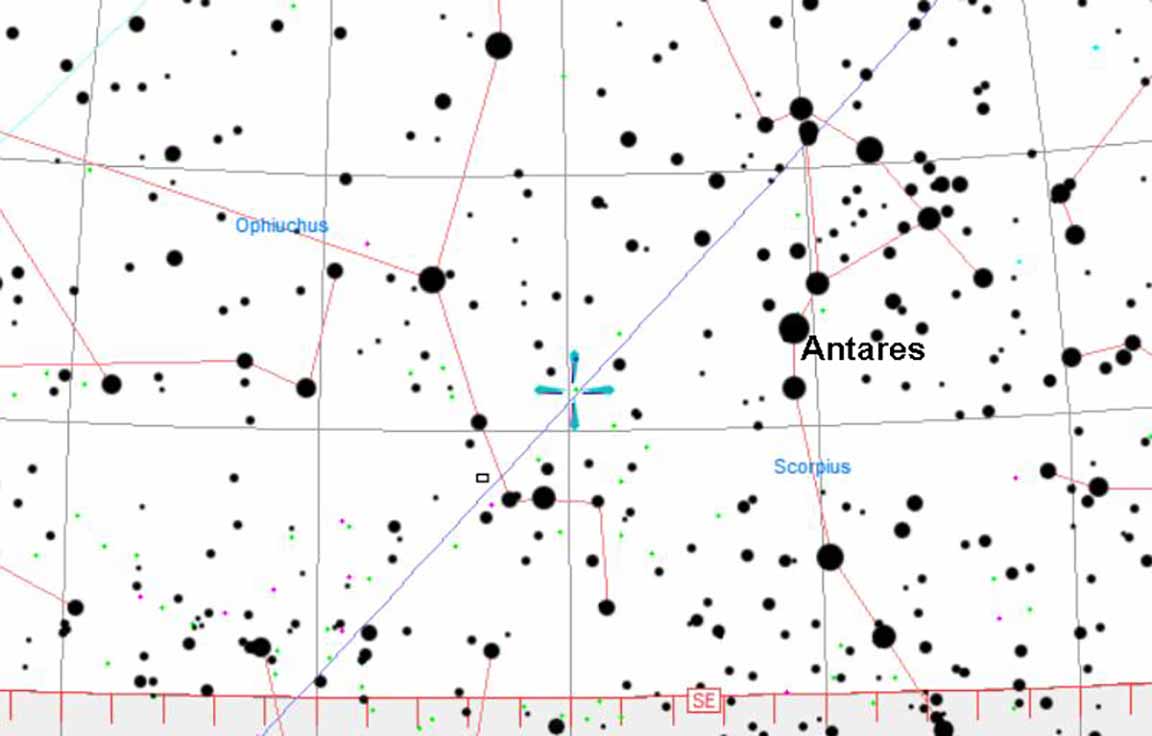
The target is 10 degrees left of Antares, and 1.5 degrees lower.
This will be able to refine the orbit of this moon, so it is of higher value than a typical occultation. Orbit refinement helps in the mass determinations of this double object. The wide path goes through San Luis Obispo and SE into Carrizo Plain and Arizona. RUWE =0.95 which is a good star position. This moon's orbit uncertainty gives an estimated odds for us of a positive only about 40%. 11 other observers have signed up for this event, so even a miss will give valuable astrometry data.
The target star is W=13.1, combined magnitude in OWc is given as 11.44 and a drop of V=0.55, which says Hermione is 12.0. The shallow drop means we should be prepared to not just detect the combined object, but get good counts, enough to be able to see a 13.2 star at alt=13 disappear completely. Probably 8x is the right value to try, but use your judgement.
The altitude of the event at Santa Margarita is only 13 degrees in the Southeast. This means the target will look 0.8 mag dimmer in V compared to being at a good 55 degrees typical altitude for our event choices. So it won't look like 11.4 but instead more like 12.2. But with a duration of 2.4s, it should still be easy to get at 8x or 16x.
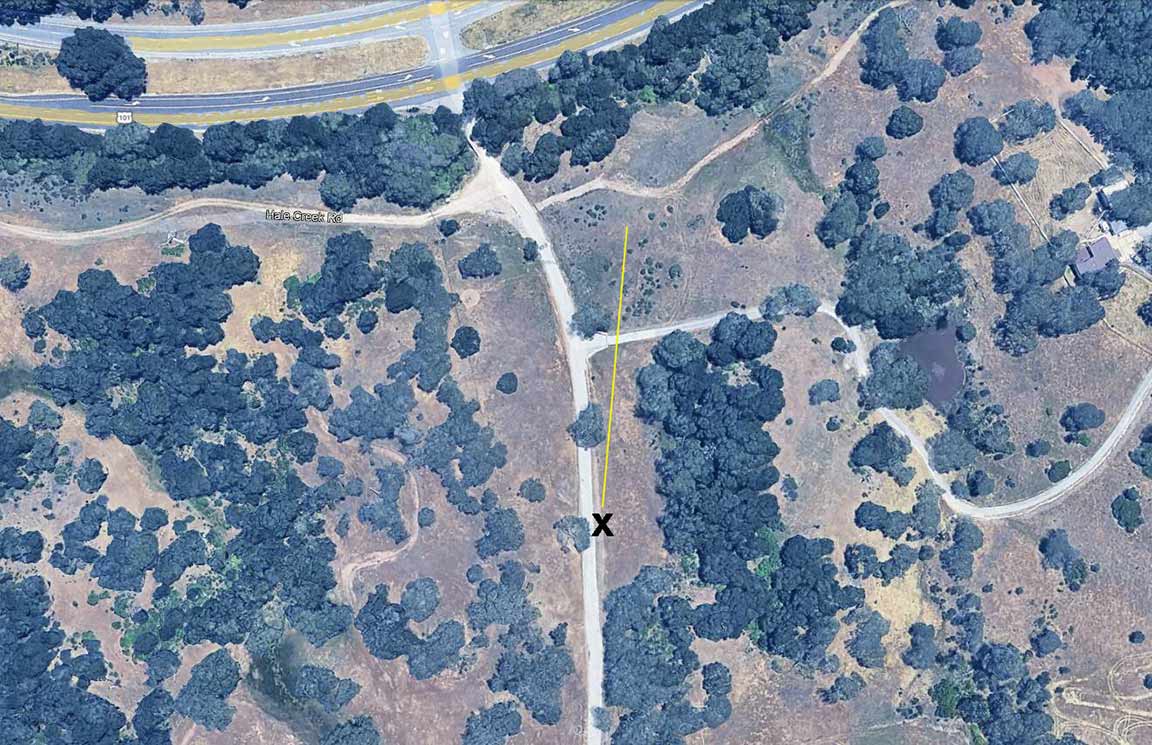
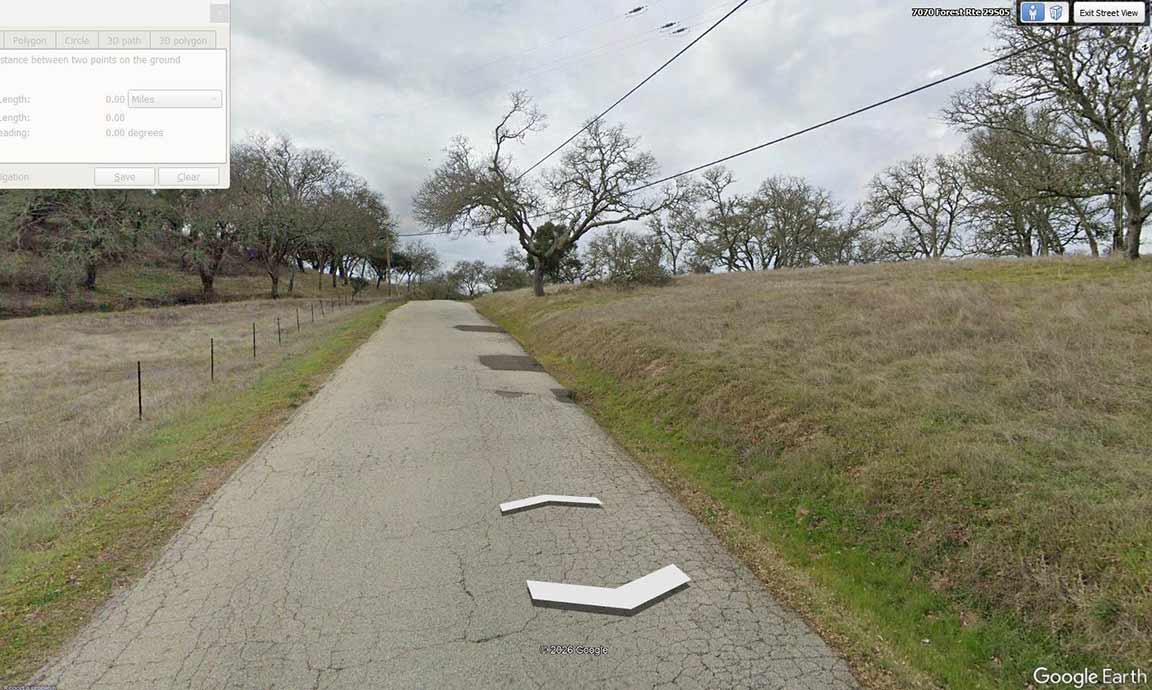
Low horizons are essential; making a choice for site difficult. The horizon towards the target is 8.0 degrees above the distant ridge, from Tassajara Creek from the X. opposite the split tree. However, the northern Horizons ephemeris is more likely the better one, which will require we pick up and move from our Dogo Osen site on Tassajara Creek Rd and go north. Site selection was difficult... see the changes below. We settled on two sites off Neal Spr. Road east of Templeton. Close enough to Tassajara Creek to get there in time for re-setup, but deep enough into the norther path to be decent odds of success, and not step on other's chords.
Alt=13 in Santa Margarita, Az=129 in Santa Cruz in Ophiuchus
|
|
|
|
The target is 10 degrees left of Antares, and 1.5 degrees lower. |
Ignore the images below assuming we'd do Hermione-1 from Tassajara Creek or Santa Margarita. This assumed the southern older path which I'm now assuming is less accurate than the May 2026 Horizons ephemeris which centers over Paso Robles, but includes east of Templeton.
My site, on Tassajara Creek Rd |
I should set up right across from that split tree up ahead, on the left (south) side of the road. Looks like a low traffic road, I may be a bit slopping onto the roadway. I hope that is OK. |
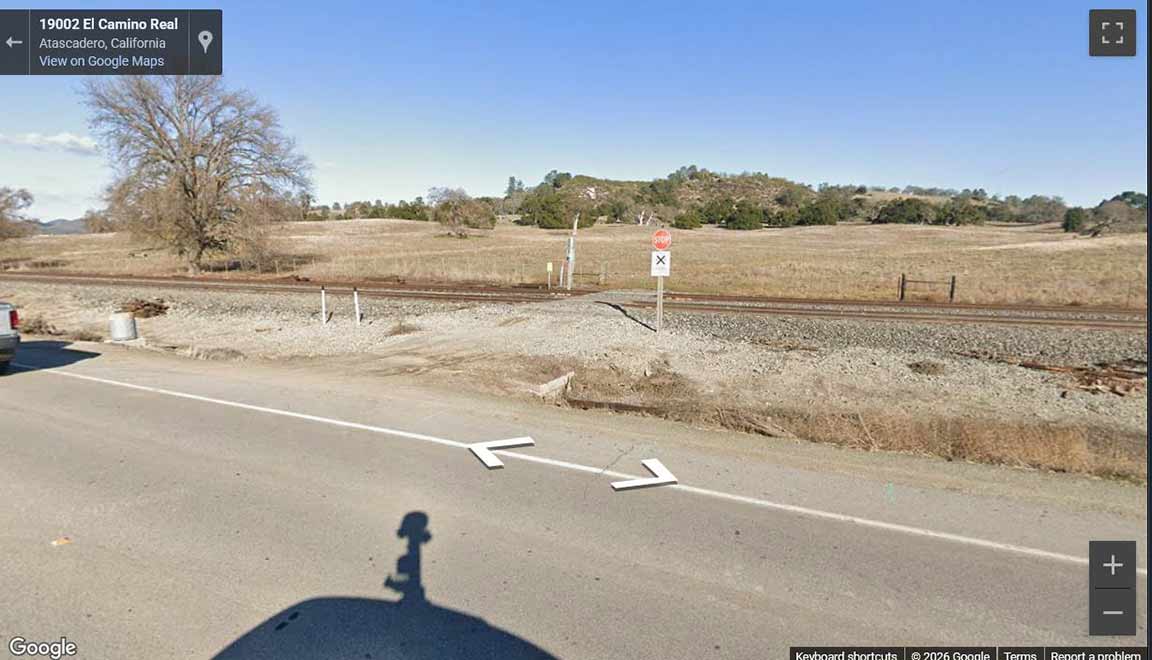
Railroad crossing site, Kirk's station. GE Streetview |
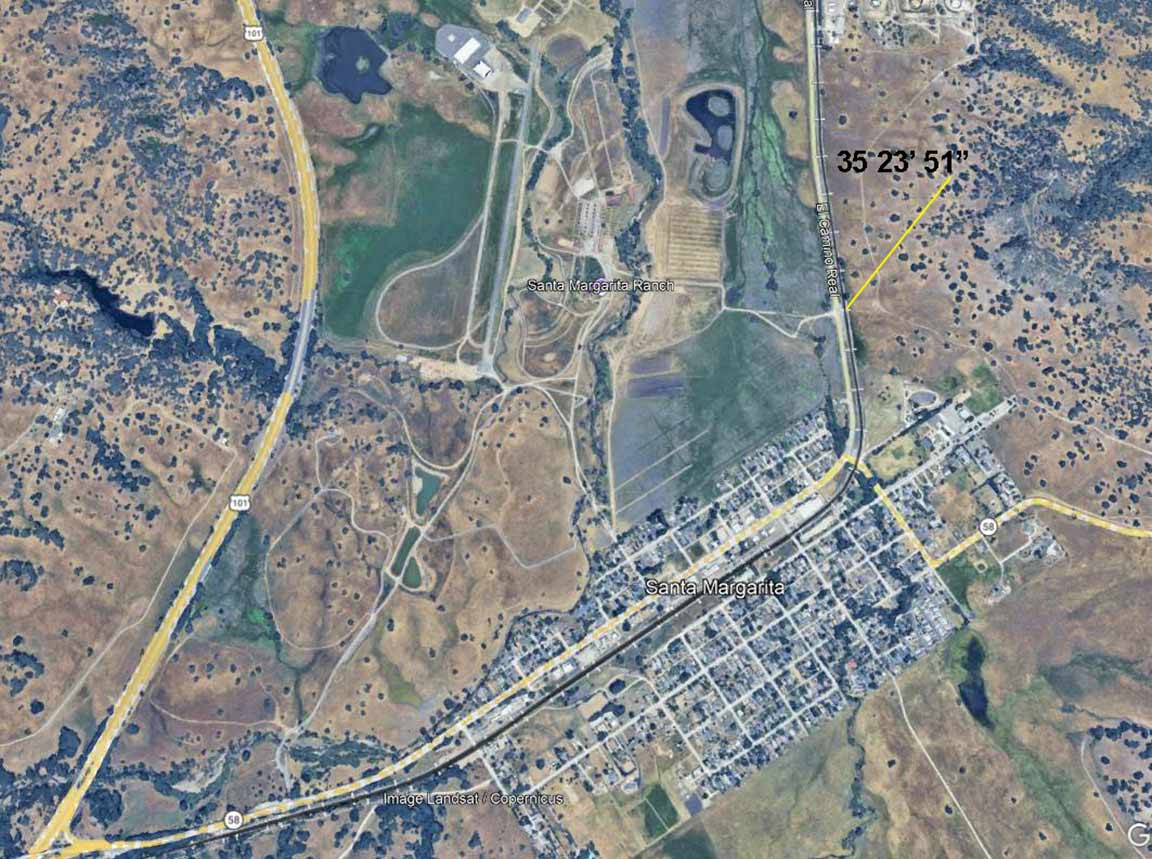
Kirk's site GE, with latitude to aim for |
KB Santa Margarita Railroad site: Lat=35 23 51". BUT, this assumes the older and probably less reliable predictions
Final Plan - Set up off Neal Spr Rd east of Templeton. This is south of the centerline but still well within the Horizon latest path, and can be accessed with enough time after Dogo Osen. Kirk will be at a dirt inlet off Vaquero Rd, just a quarter mile west of its intersection with Neal Spr Rd, and I continue NE up Neal Spring till it angles due east and use a wide spot near a drive entrance to a farm. Both of us are looking over flat vacant land to the target. We're not that far apart, but still usefully far apart. Best I can do for trying to get both asteroid events.
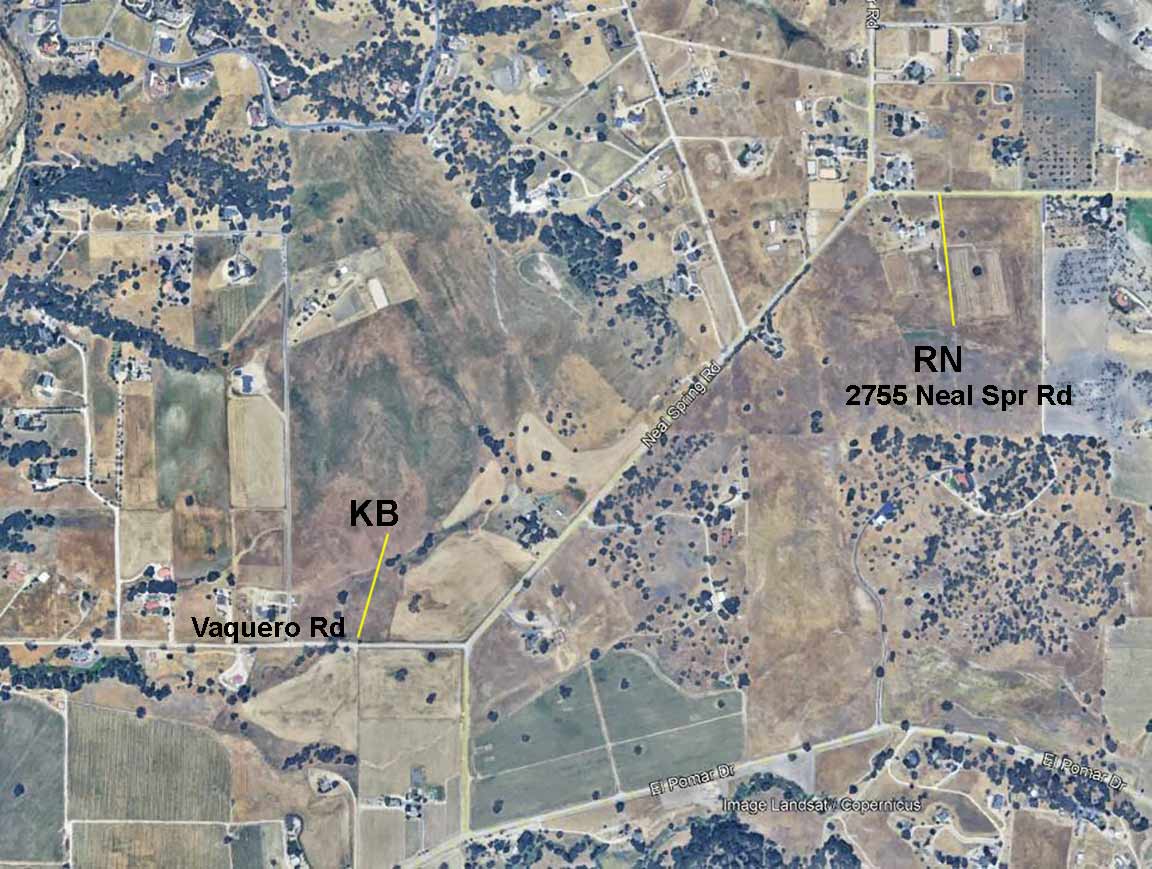 |
Directions from south; get off 101 at Templeton offramp, stay on it over the Salinas River, it then turns into El Pomas Rd and goes north on the east side of the river, then finally does a big turn right, and stay on it until left on Neal Spring Rd, then a ~half mile till Vaquero Rd, turn left onto Vaquero for a few hundred yards to Kirk's site. Then get back on Neal Spring and stay on it doing diagonal NE till it angles right (due east) and look for my site.
By interpolating along the OWc path, I find that Kirk and I were at predicted event center time of 5:49:40.33 UT for the May 13 (default) ephemeris. And for the southern path (Mar 21 ephemeris) the predicted time for Kirk and I was 5:49:46.0 UT.
I set up 72 ft east of the driveway center to the ranch specified on the map, on the south side of Neal Spr rd, 25 ft south of the road edge. I recorded both on the camcorder w/ sound, and with the Lenovo. Used 8x. Skies were clear, no wind. I did have one car drive by during the dark frame video but the scope was aimed opposite and well capped. About a 20s dark video right after the main event. I did not do a dust blowoff or BPC before this event. There was two obvious bright pixels on the videos, which have been there on recent events. I saw no other bright pixels. It should correct with BPC easily but will do that later. Temperature about 58F.
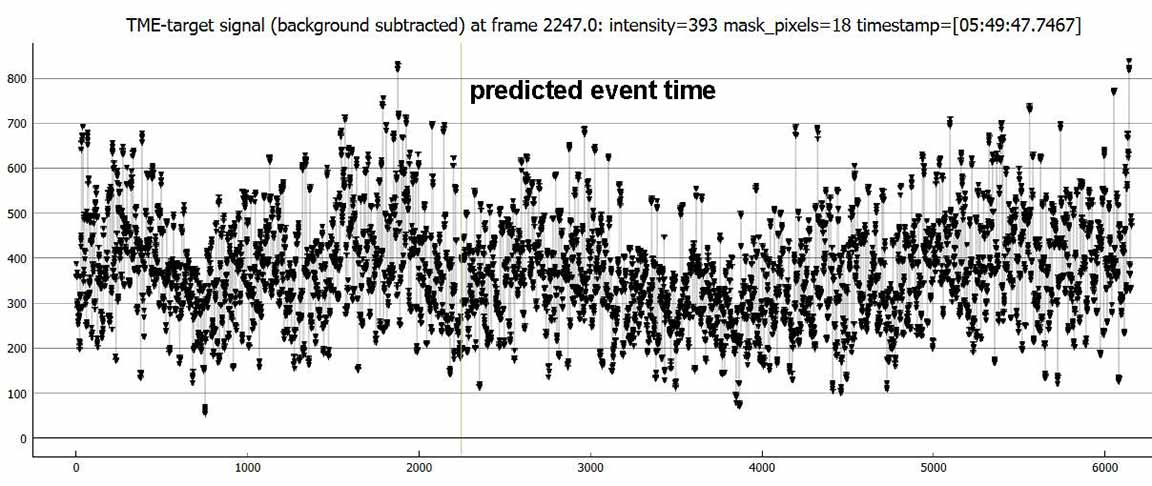
I did not notice an obvious occultation, but did notice visually a double dip at the predicted time, of maybe a second? But I expected a stronger dip than I saw and so I wasn't confident it was real. The double dip is detectable in the data below, but the first dip is too close to being pure noise to consider. The second dip is more interesting, and at the predicted moment more precisely.
First Analysis:
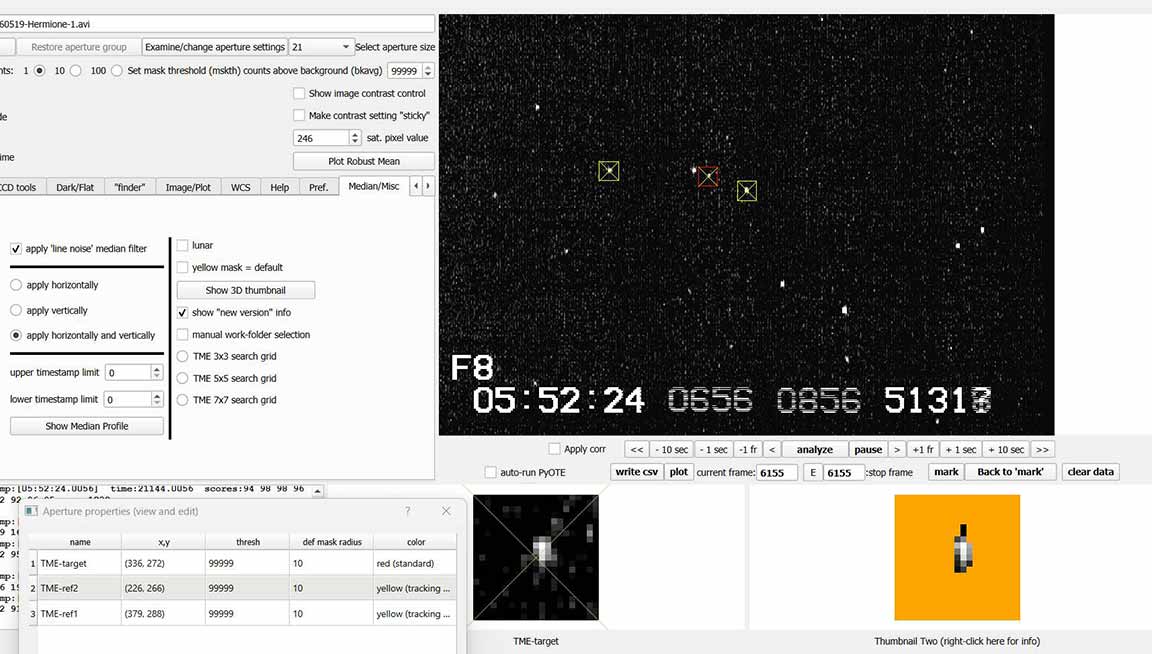
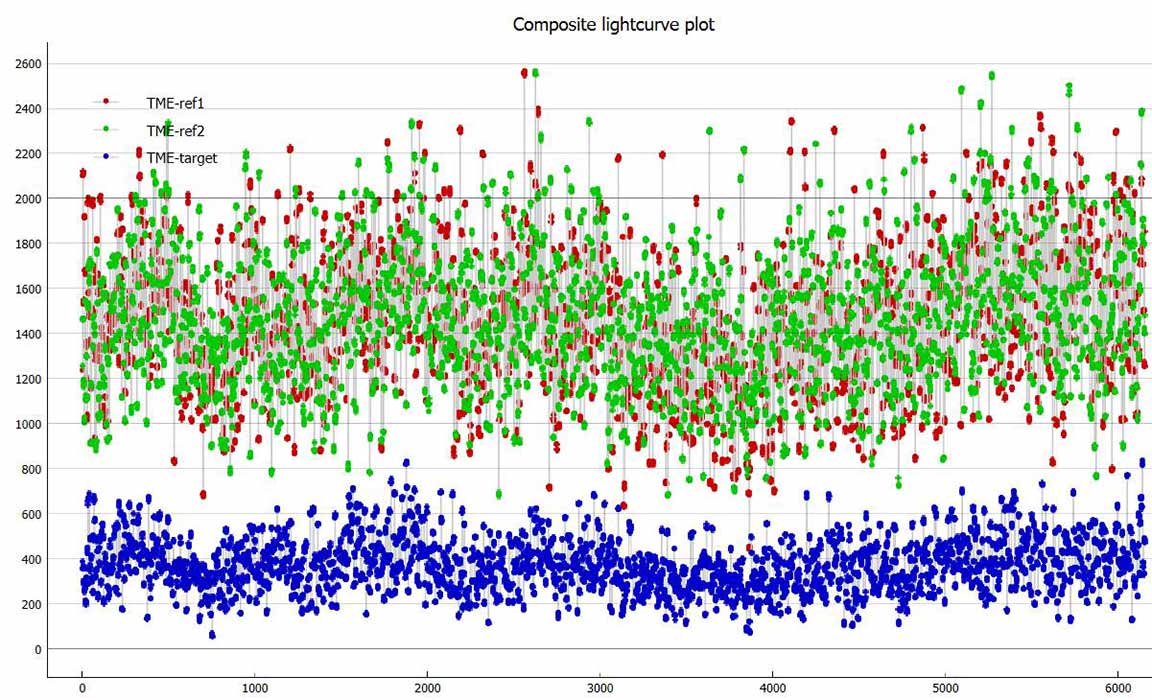
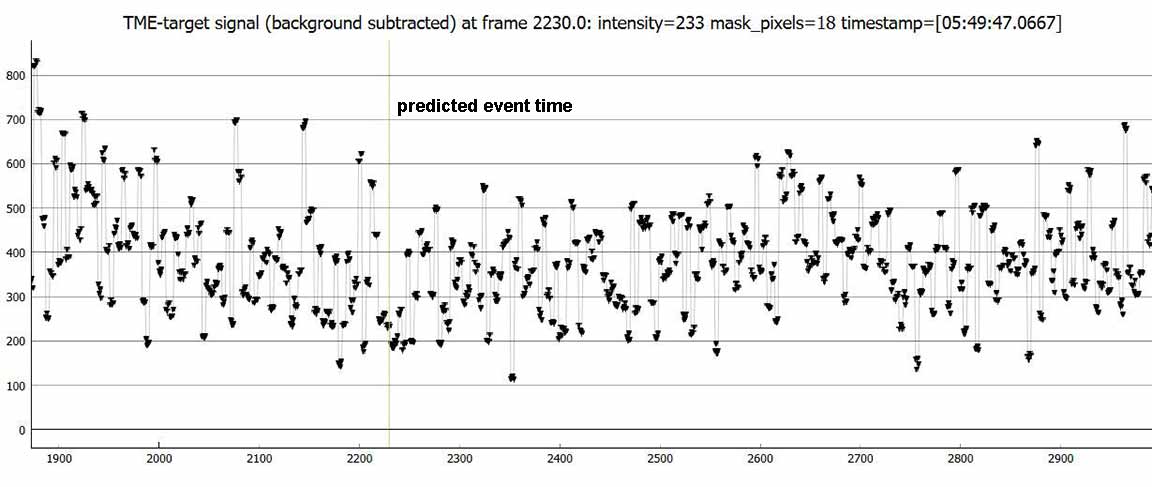
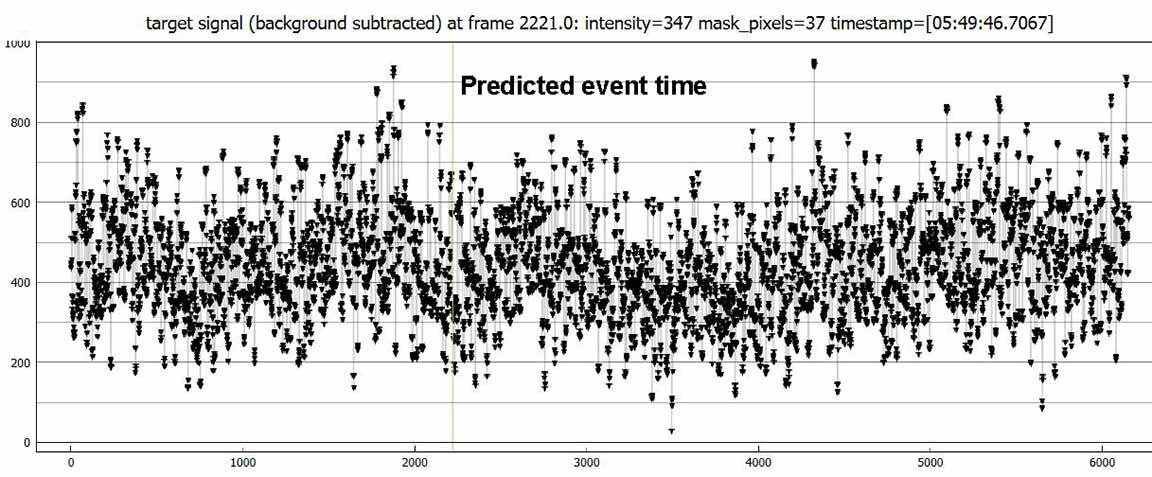
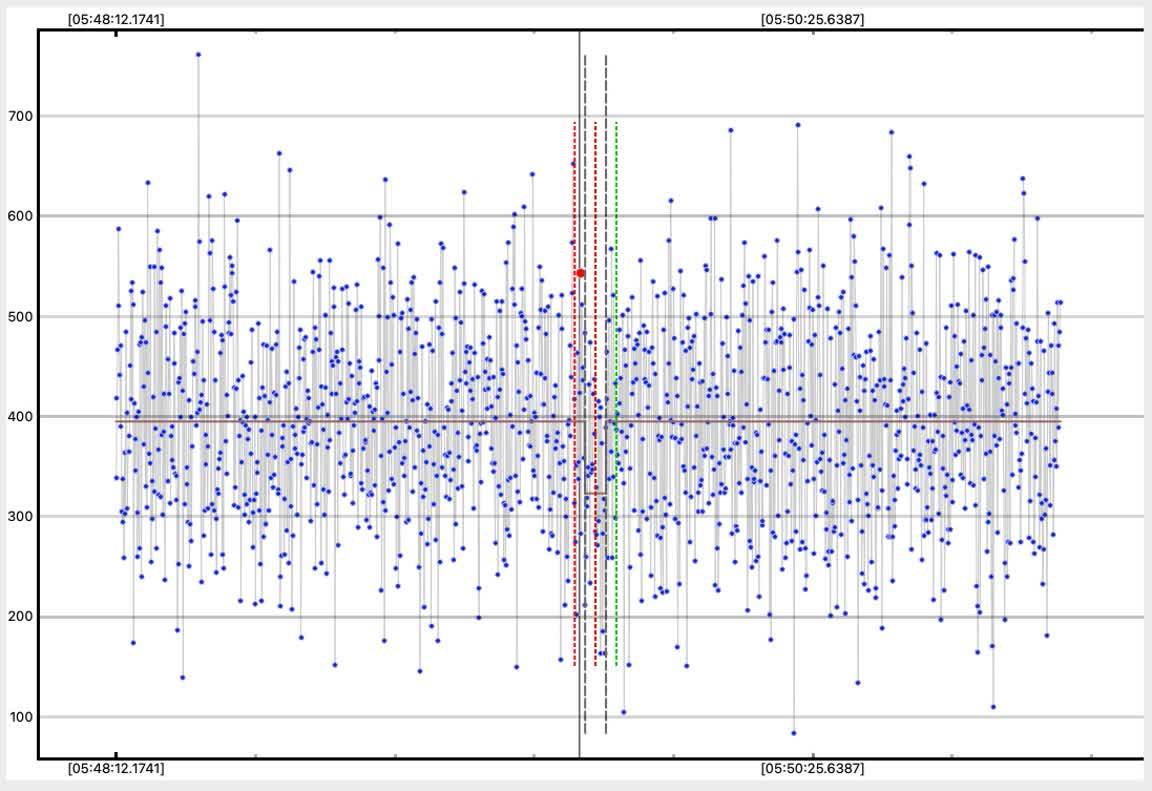
Using a TME aperture mask, using a 111 frame Fourier Finder. Median filtering both horizontal and vertical. Marginally perhaps this TME analysis gives the cleanest signal among the 3 analyses; a dip of 0.54 magnitudes for 1.1s at the predicted time.
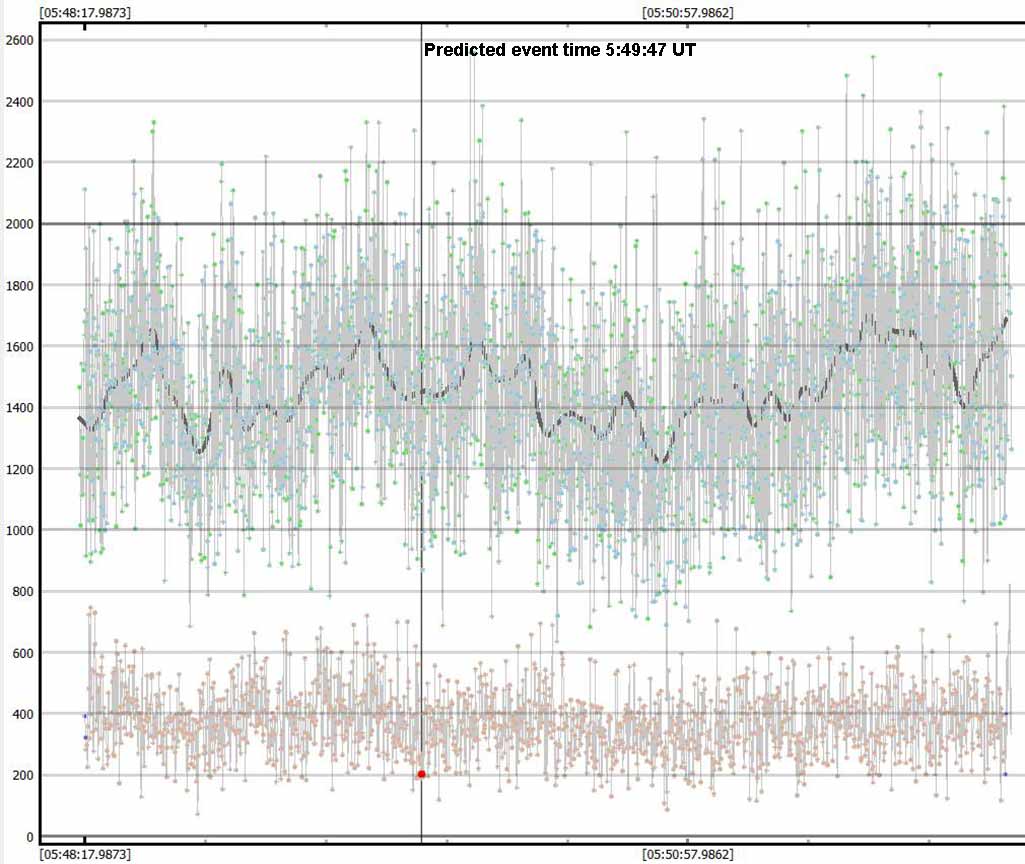
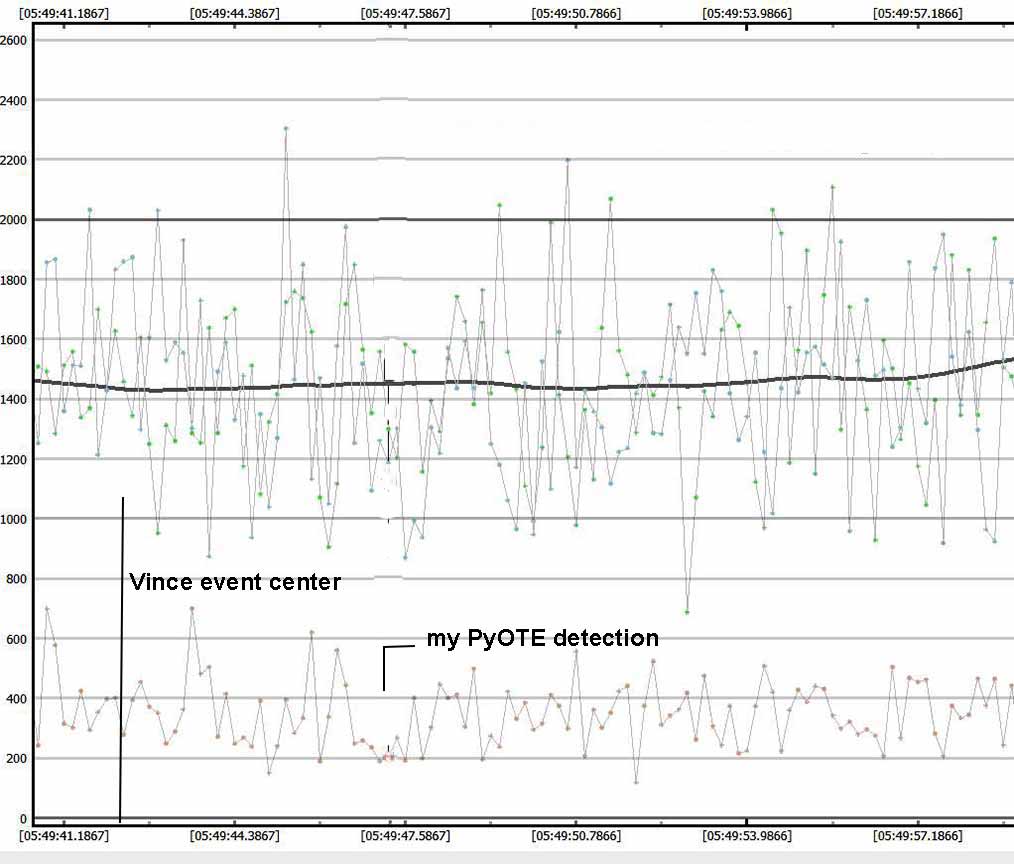
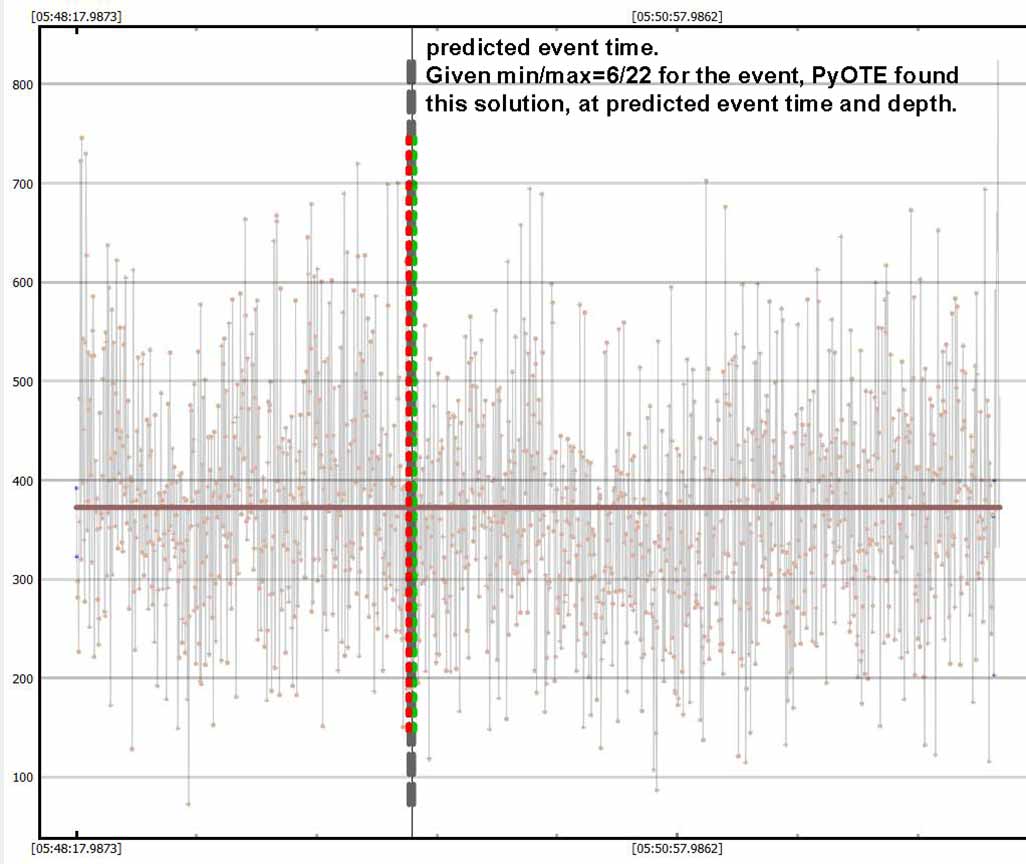
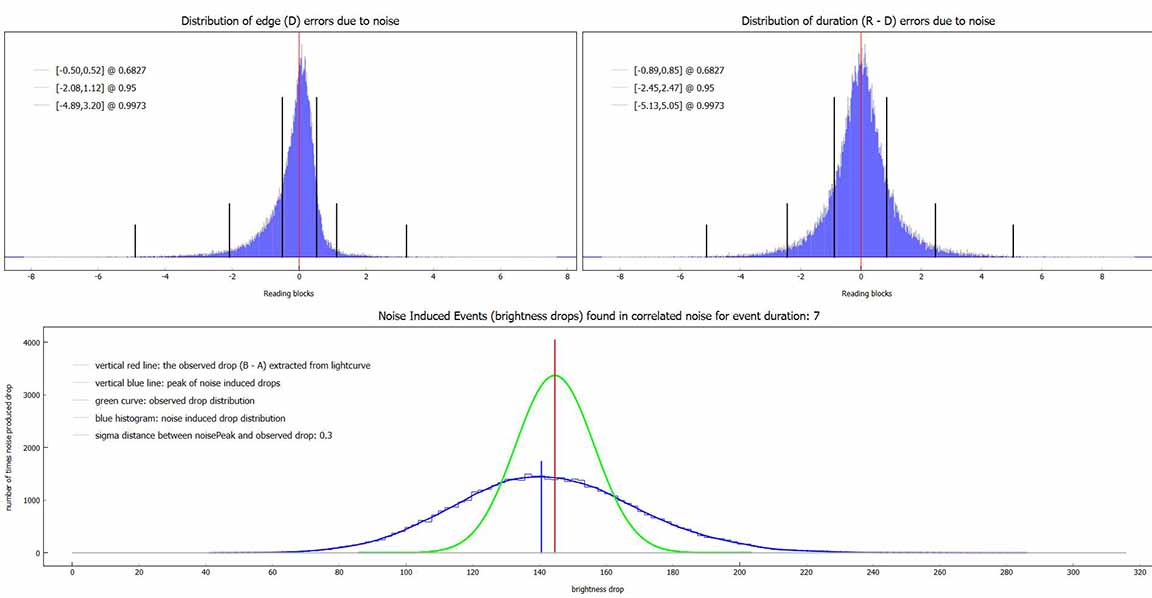
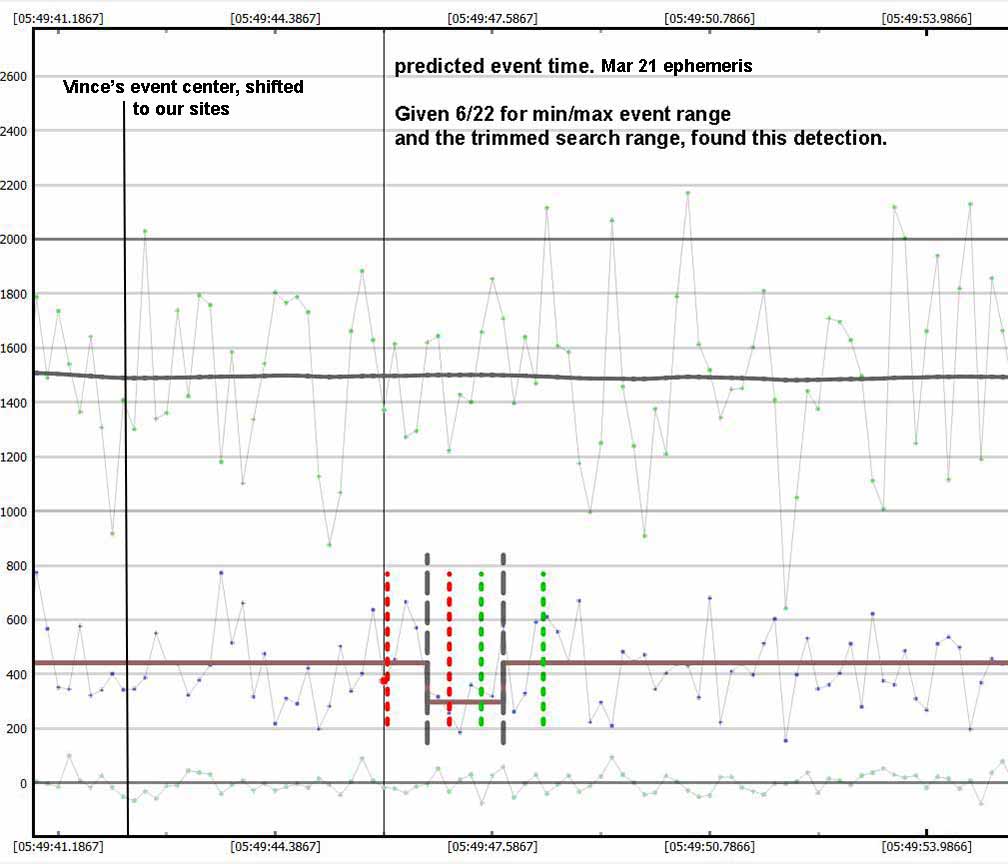
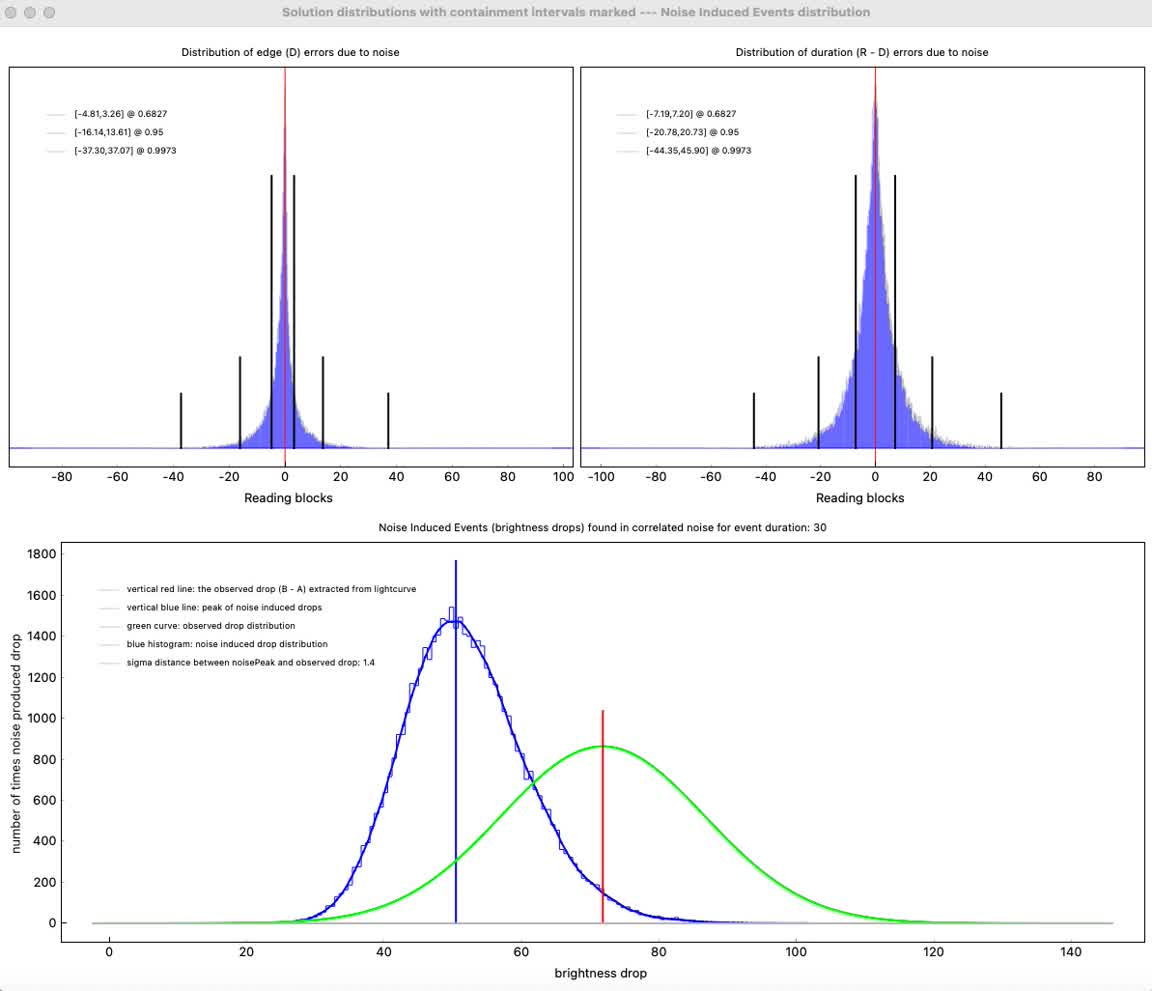
PyOTE Analysis: PyOTE finds the event, using the entire light curve and min/max points = 6/22. NIE test is not very good though; only 0.3 sigma. If my time is consistent with Kirk's and especially with Vince's, it may be good enough to pass the review. The nominal center is 5:49:47.1 UT, which is 1.1s after the nominal (Mar 21 ephemeris) predicted UT time for our location.
magDrop report: percentDrop: 38.8 magDrop: 0.534 +/- 0.119 (0.95 ci)
DNR: 1.32
D time: [05:49:46.6267]
D: 0.6800 containment intervals: {+/- 0.0830} seconds
D: 0.9500 containment intervals: {+/- 0.3329} seconds
D: 0.9973 containment intervals: {+/- 0.7826} seconds
R time: [05:49:47.7467]
R: 0.6800 containment intervals: {+/- 0.0830} seconds
R: 0.9500 containment intervals: {+/- 0.3329} seconds
R: 0.9973 containment intervals: {+/- 0.7826} seconds
Duration (R - D): 1.1200 seconds
Duration: 0.6800 containment intervals: {+/- 0.1393} seconds
Duration: 0.9500 containment intervals: {+/- 0.3936} seconds
Duration: 0.9973 containment intervals: {+/- 0.8145} seconds
 |
 |
 |
 |
 |
 |
 |
 |
 |
Second Analysis:
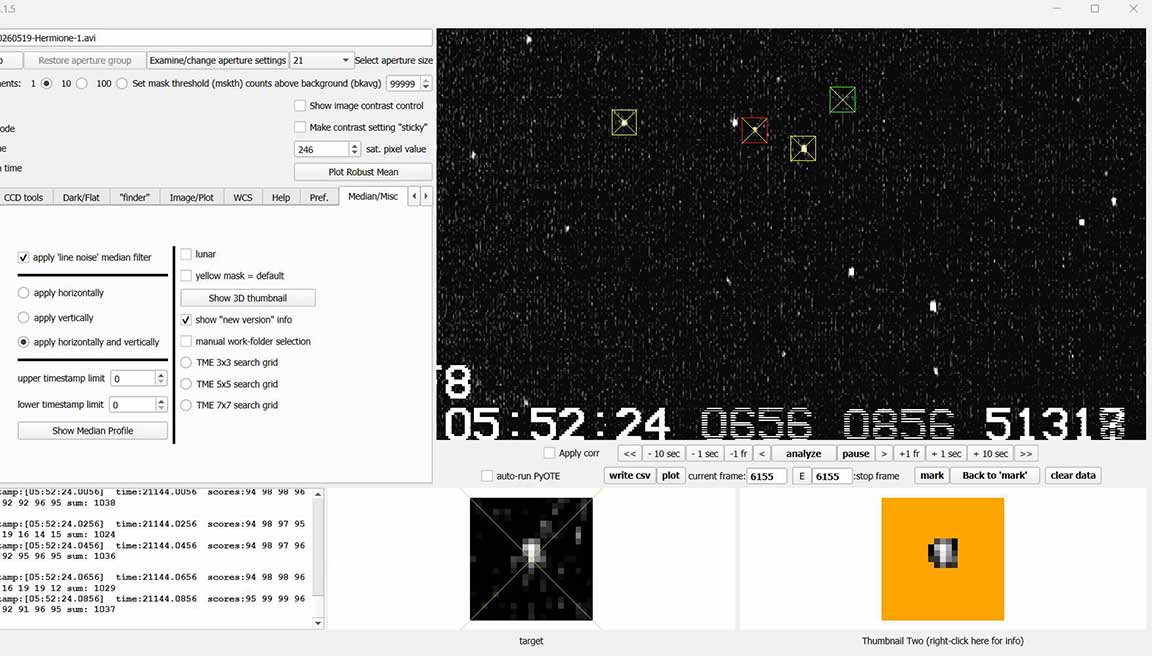
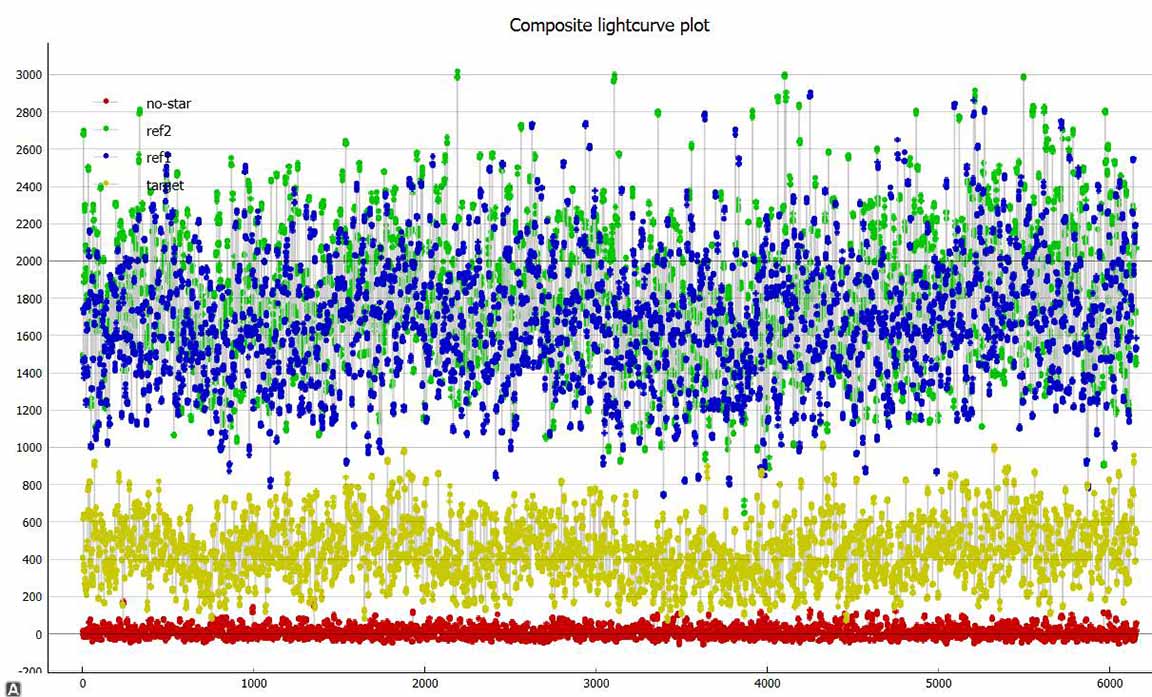
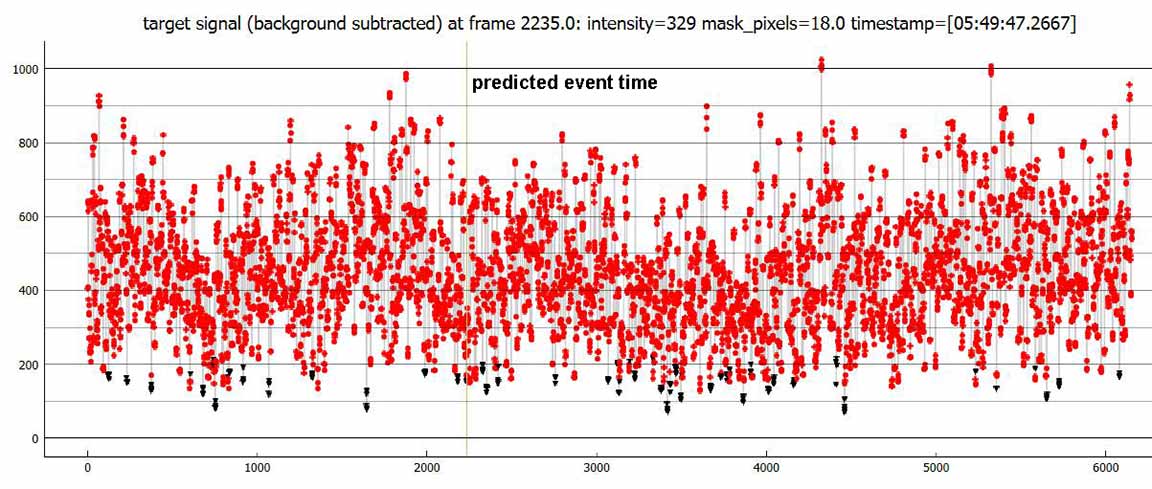
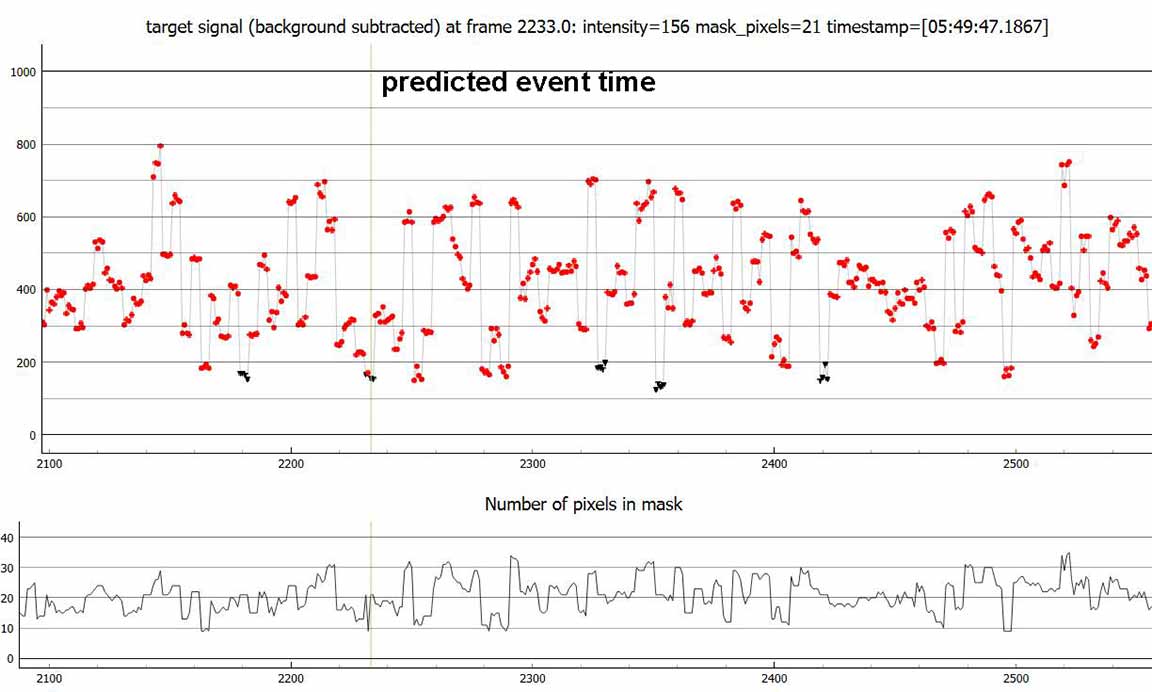
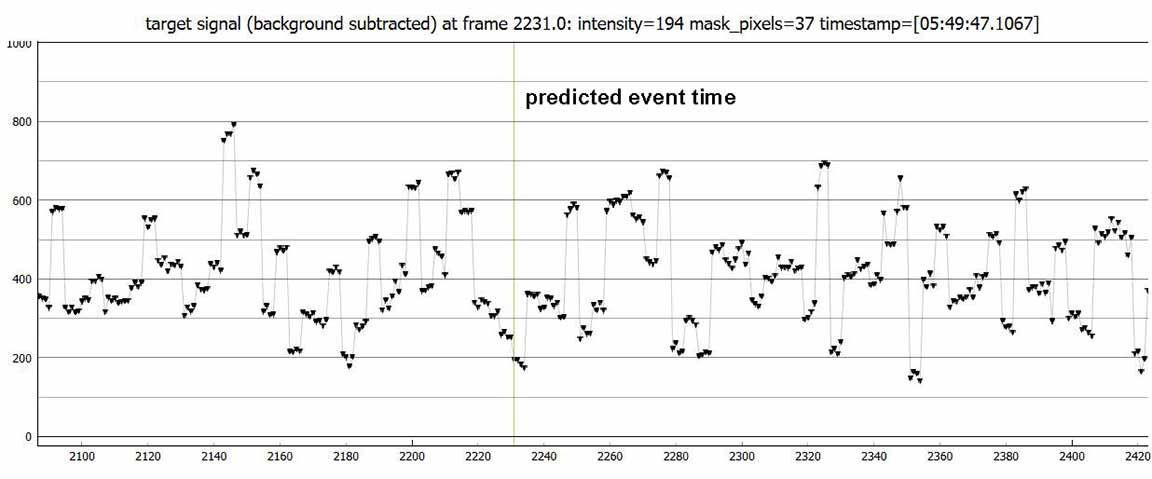
Using PyMovie's Dynamic mask. Applied median filtering both horizontal and vertical. In the raw data, I see a 0.56 mag drop at the predicted time, for 1.1 seconds. Very noisy, though.
This data was rather noisier, and no event detections could be found. I present only the raw data below and ignore the PyOTE noise.
 |
 |
 |
 |
Third analysis:
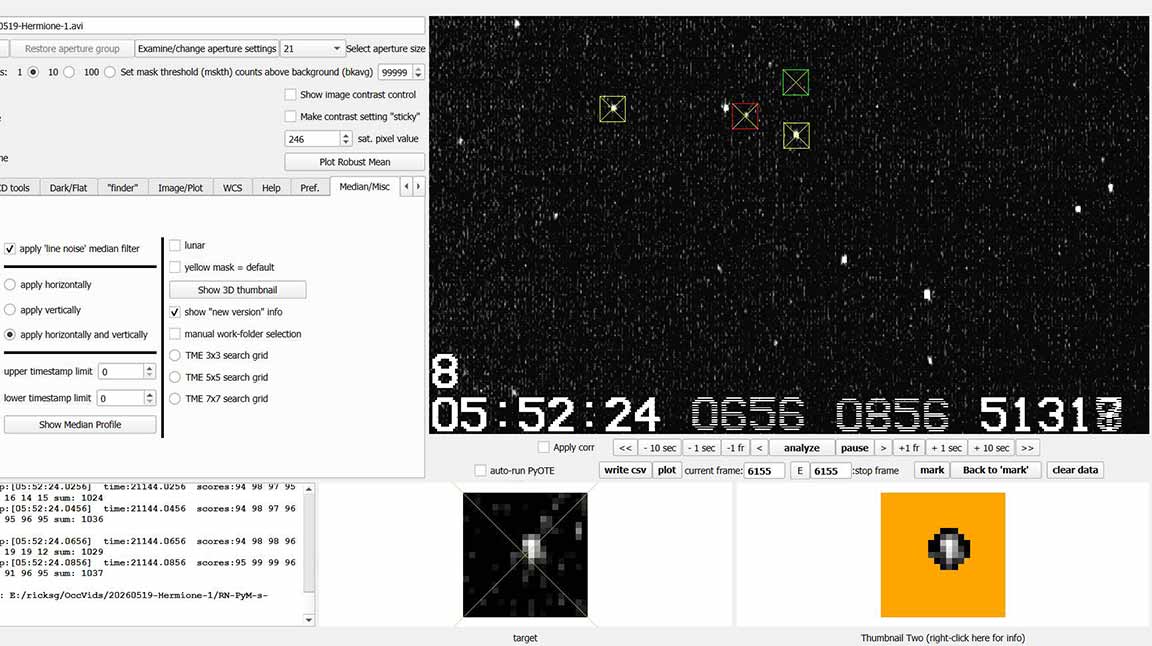
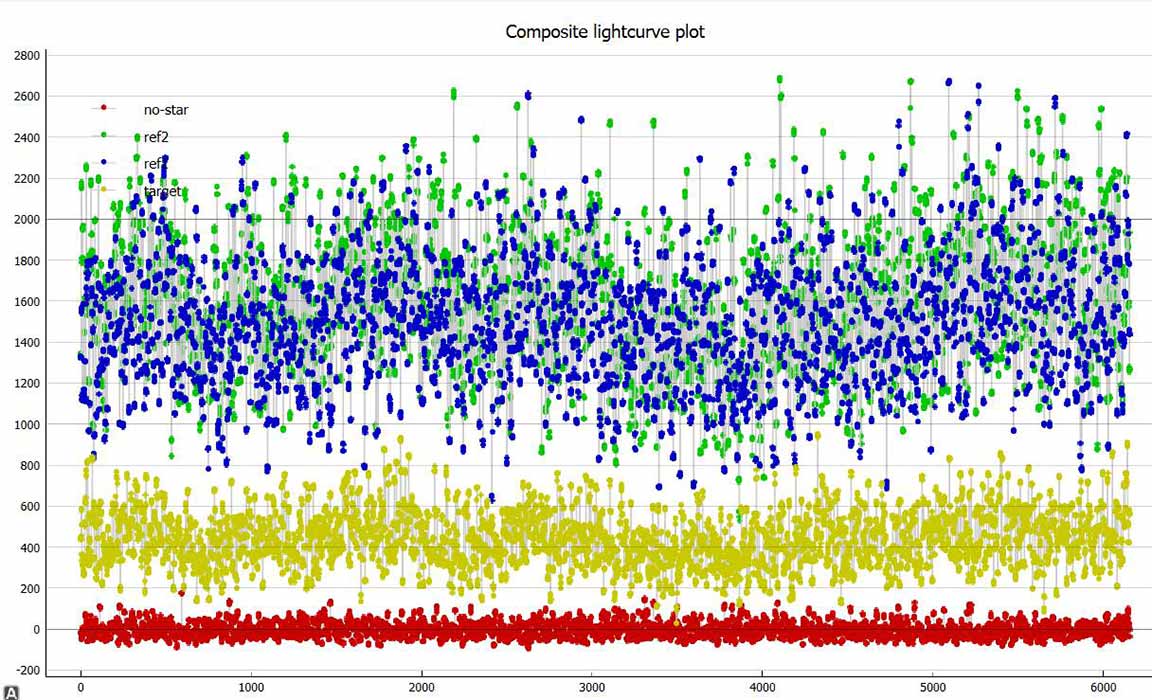
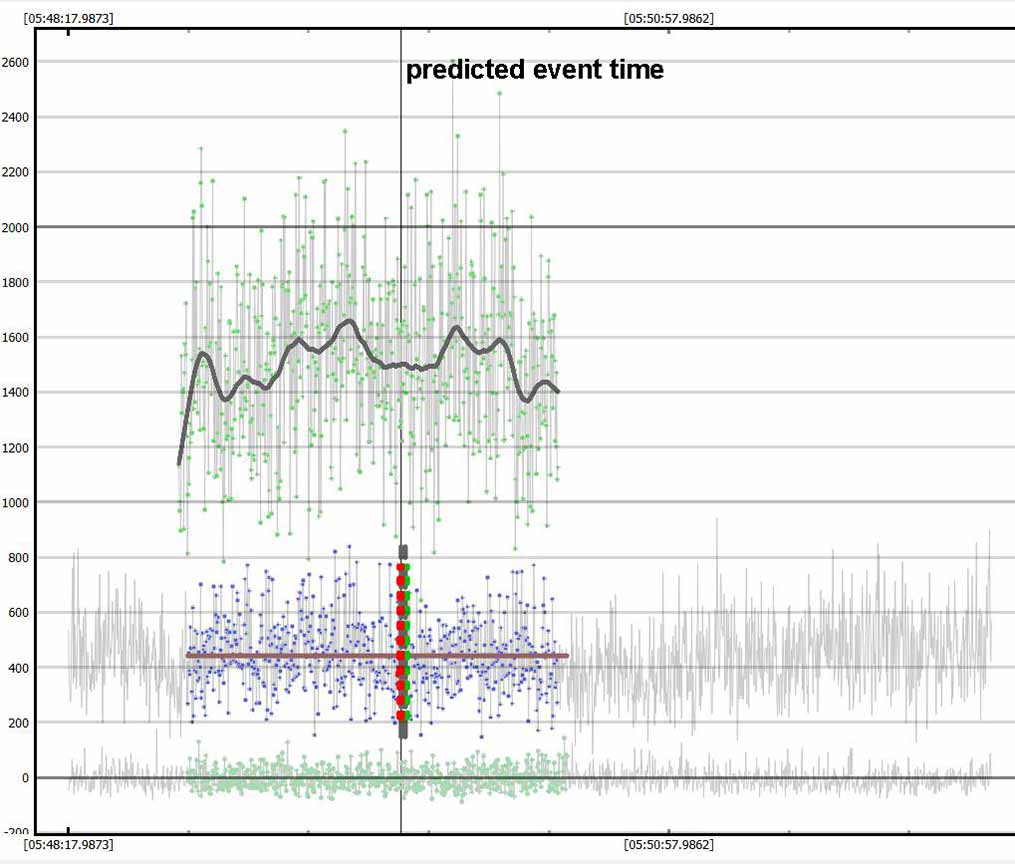
Using static circular mask 3.2px. I used 3.2px instead of my default 2.4px because the raw data spilled over the 2.4px too often, vertically. The TME mask was a better fit to the shape of the pixel cloud. And again, median filtering horizontal and vertical. Visually on the raw data, I see a ~0.55 mag drop for 1 second at the predicted time. PyOTE finds the same drop as in the TME analysis, after trimming out very low NIE sigma false detections. The resulting event's NIE detection is a bit better than for the TME analysis, but not much; The depth is marginally lower, only 0.43 magnitudes.
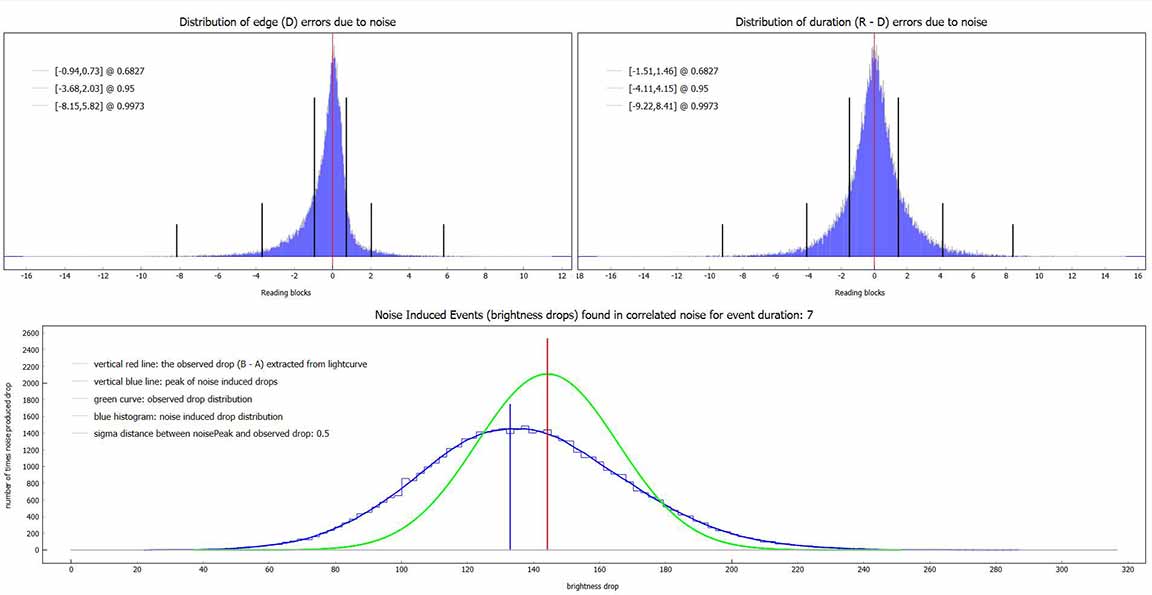
NIE test sigma=0.5
magDrop report: percentDrop: 32.6 magDrop: 0.429 +/- 0.166 (0.95 ci)
DNR: 1.18
D time: [05:49:46.6267]
D: 0.6800 containment intervals: {+/- 0.1510} seconds
D: 0.9500 containment intervals: {+/- 0.5890} seconds
D: 0.9973 containment intervals: {+/- 1.3034} seconds
R time: [05:49:47.7467]
R: 0.6800 containment intervals: {+/- 0.1510} seconds
R: 0.9500 containment intervals: {+/- 0.5890} seconds
R: 0.9973 containment intervals: {+/- 1.3034} seconds
Duration (R - D): 1.1200 seconds
Duration: 0.6800 containment intervals: {+/- 0.2376} seconds
Duration: 0.9500 containment intervals: {+/- 0.6606} seconds
Duration: 0.9973 containment intervals: {+/- 1.4103} seconds
 |
 |
 |
 |
 |
 |
 |
Observed from Vaquero Rd at a ranchland access point. Got a short event found by Pyote, at the predicted time.
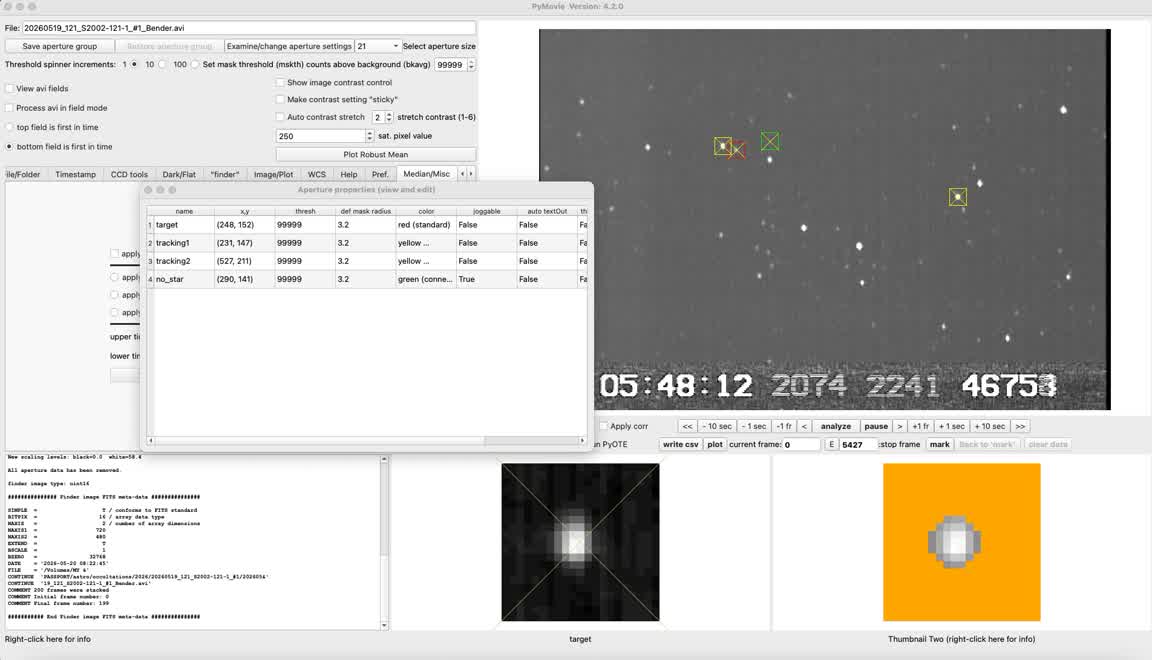
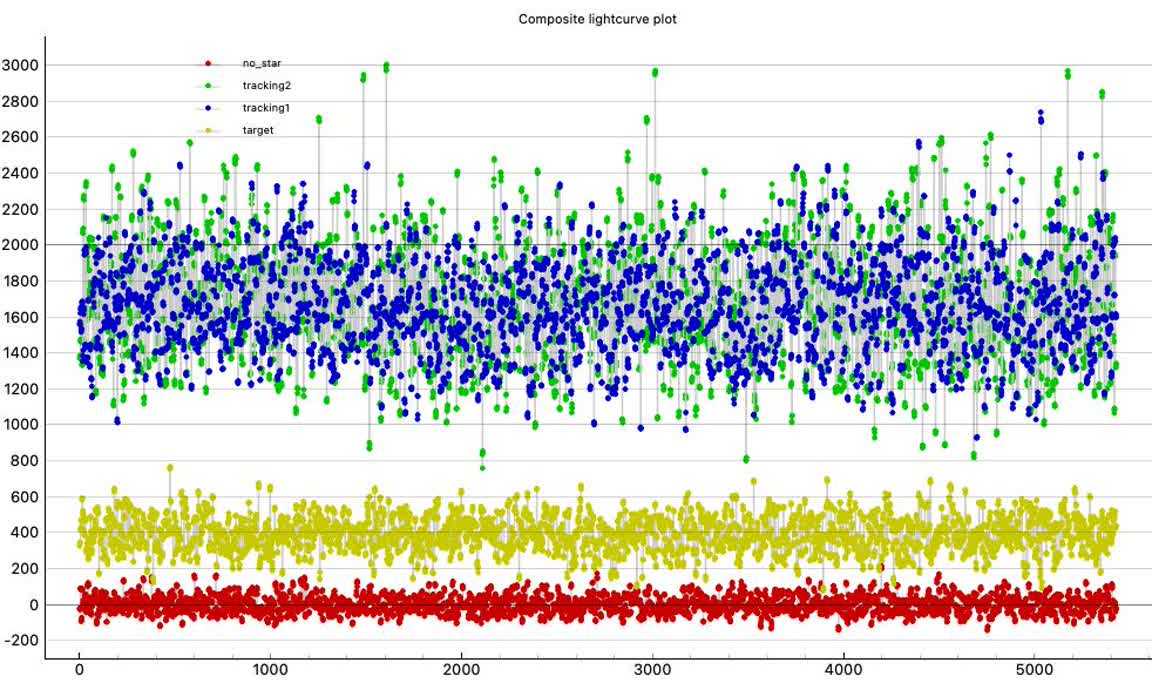
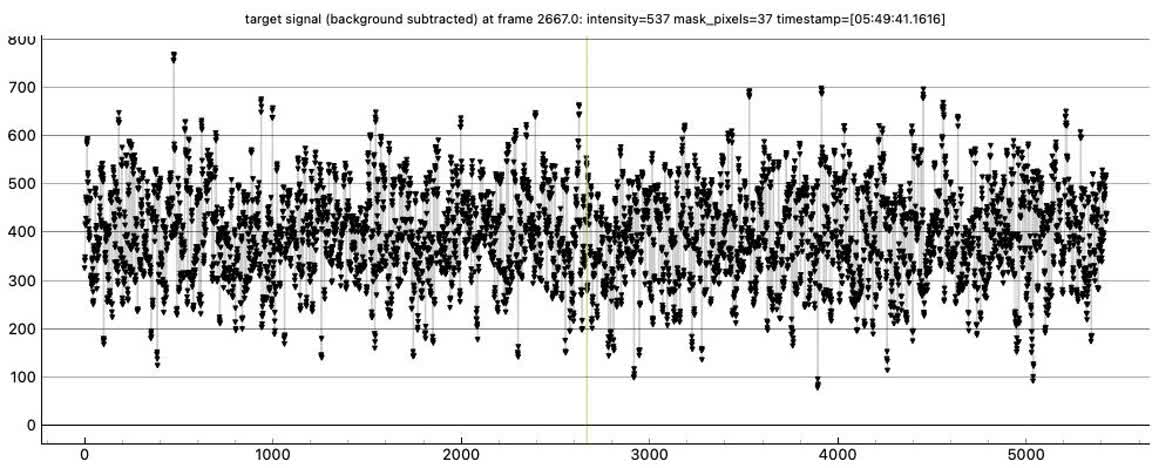
PyOTE found an event in my recording for (121) S2002-121-1 #1 (moon of Hermione) from Templeton, at 8x integration. The event is near the predicted time, which was 5:49:41 UT for my location from the Horizons prediction. However, PyOTE gave a low NIE sigma distance of 1.4, and a drop of 0.2m, smaller than predicted 0.5m. The target curve is noisy, but well above background. It gave a duration of 4 seconds, longer than predicted 2.54s max, but error bars are large, +/- 2.8 sec. for 0.95 containment interval. I gave PyOTE a min/max to automatically find the event, I didn't set D and R manually. The PyOTE detectability tool reported that with my data an event of 1.6s would likely be detectable. I tried a nest of mask sizes in PyMovie and size 3.2 gave the best results. I found that not normalizing on a reference star gave a little better NIE sigma, 1.4 vs. 1.2, and a little better DNR and containment intervals. The D and R times were exactly the same though, normalized or not normalized. Given the low NIE sigma, I'll probably file it as unsure, but I'll see what you get first.
magDrop report: percentDrop: 18.2 magDrop: 0.218 +/- 0.101 (0.95 ci)
DNR: 0.73
D time: [05:49:41.9957]
D: 0.6800 containment intervals: {+/- 0.5385} seconds
D: 0.9500 containment intervals: {+/- 1.9856} seconds
D: 0.9973 containment intervals: {+/- 4.9631} seconds
R time: [05:49:45.9997]
R: 0.6800 containment intervals: {+/- 0.5385} seconds
R: 0.9500 containment intervals: {+/- 1.9856} seconds
R: 0.9973 containment intervals: {+/- 4.9631} seconds
Duration (R - D): 4.0040 seconds
Duration: 0.6800 containment intervals: {+/- 0.9600} seconds
Duration: 0.9500 containment intervals: {+/- 2.7698} seconds
Duration: 0.9973 containment intervals: {+/- 6.0224} seconds
 |
 |
 |
 |
 |
 |
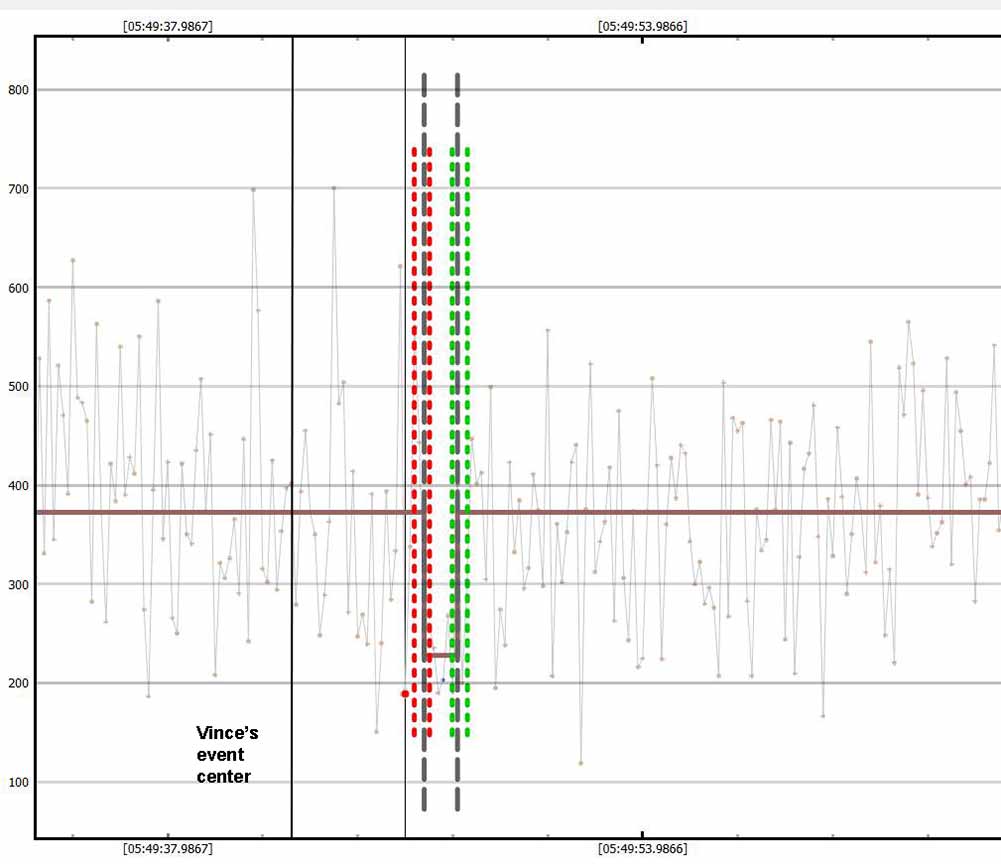
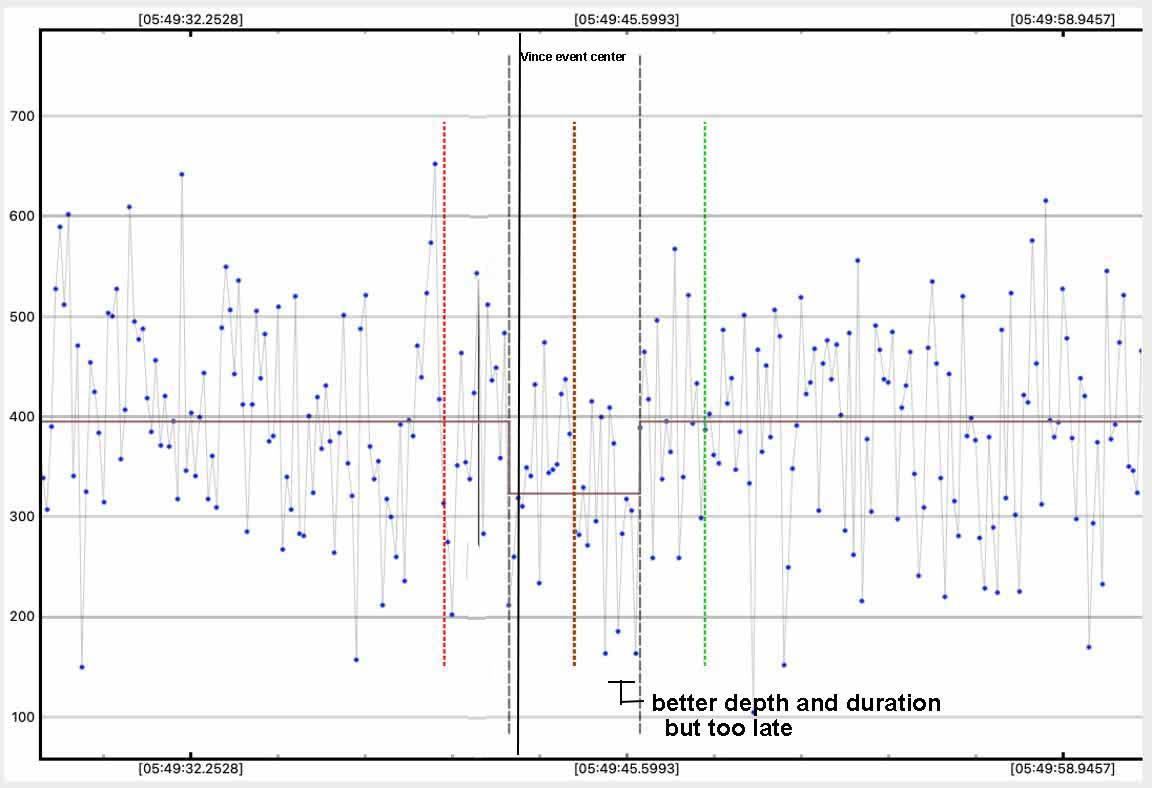
By putting down new sites incrementally, I could see where the integer seconds clicked over, and thus interpolate where Vince's icon center time prediction was, to a ~1/10th second. This allowed me to show that our noisy detections must be noise; they did not line up with Vince's solid event. See below |
I had already used the Mar 21 ephemeris prediction as my reference simply because it agreed better with my and Kirk's event detections. No other reason than that.
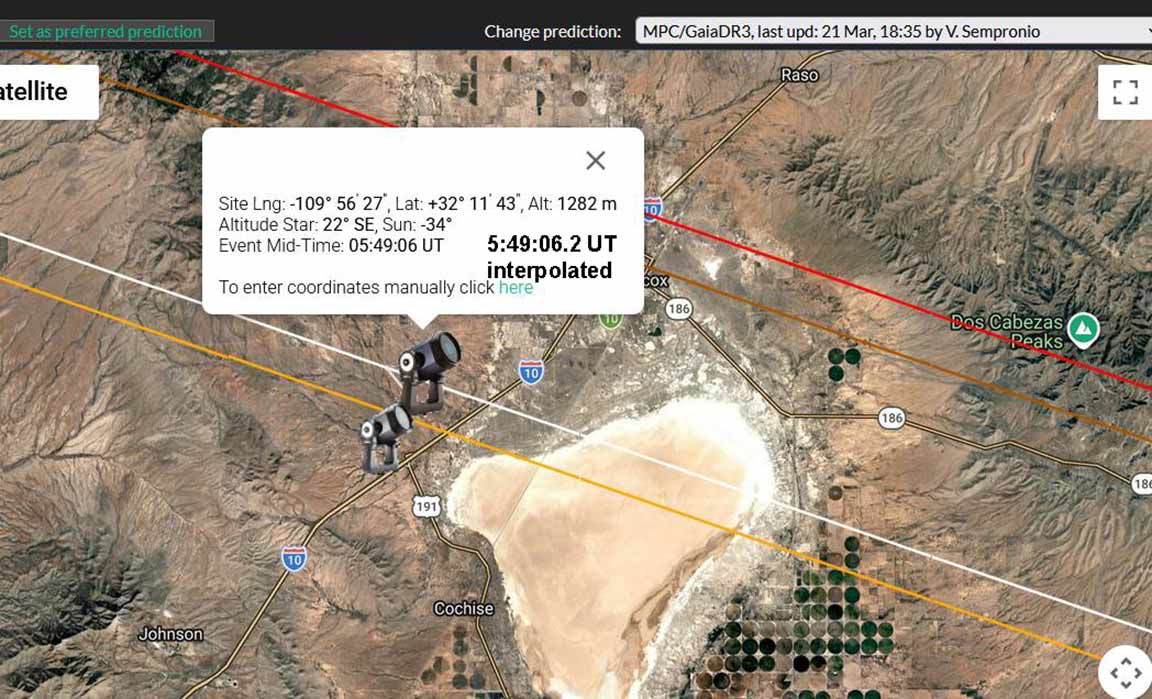
Vince's predicted UT time (May 13 ephemeris) was 5:49:01 UT (rounded) and his site icon on the OWc map says his UT prediction was 5:49:06.2 for the Mar 21 ephemeris. His observed UT times: D = 06:49:02.07 and R=06:49:02.777. So his center time was 5:49:02.42. That is 3.8s early vs the Mar 21 ephemeris.
Relative to the Mar 21 ephemeris ...
Vince 5:49:02.42 UT which is 3.8s early vs predicted 5:49:06.2
RN: 5:49:47.1 UT = 1.1s later than predicted 5:49:46.0
KB: 5:49:45.1 UT = 0.9s earlier than predicted 5:49:46.0 UT, given my belief that his actual event was not as shown above by PyOTE but instead the much shorter dip within his 4s dip.
Kirk and I should look for any suspicious dip at Vince's event corresponding to our location; i.e. at 6:49:42.2 UT = Vince's event center translated to our California sites. At these spots on our light curves, there are no suspiciou dips.
I can only conclude that our and Kirk's timings are inconsistent with each other, and inconsistent with Vince's too. That says we both had misses or non-detections. I suggest we file our reports as "MISS" and "UNSURE" since our data is too noisy to be sure.
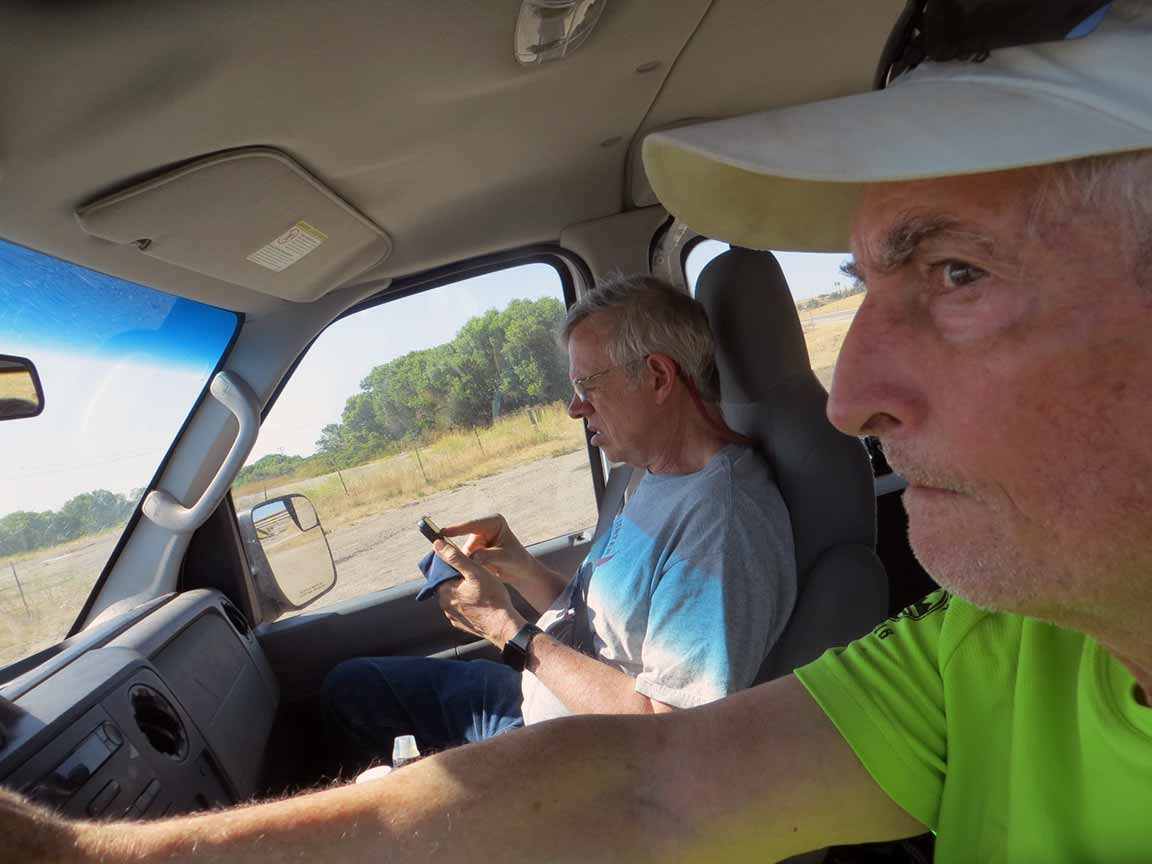
Van driving down the Salinas Valley: Kirk's on navigation. I'm paying close attention to the road. |
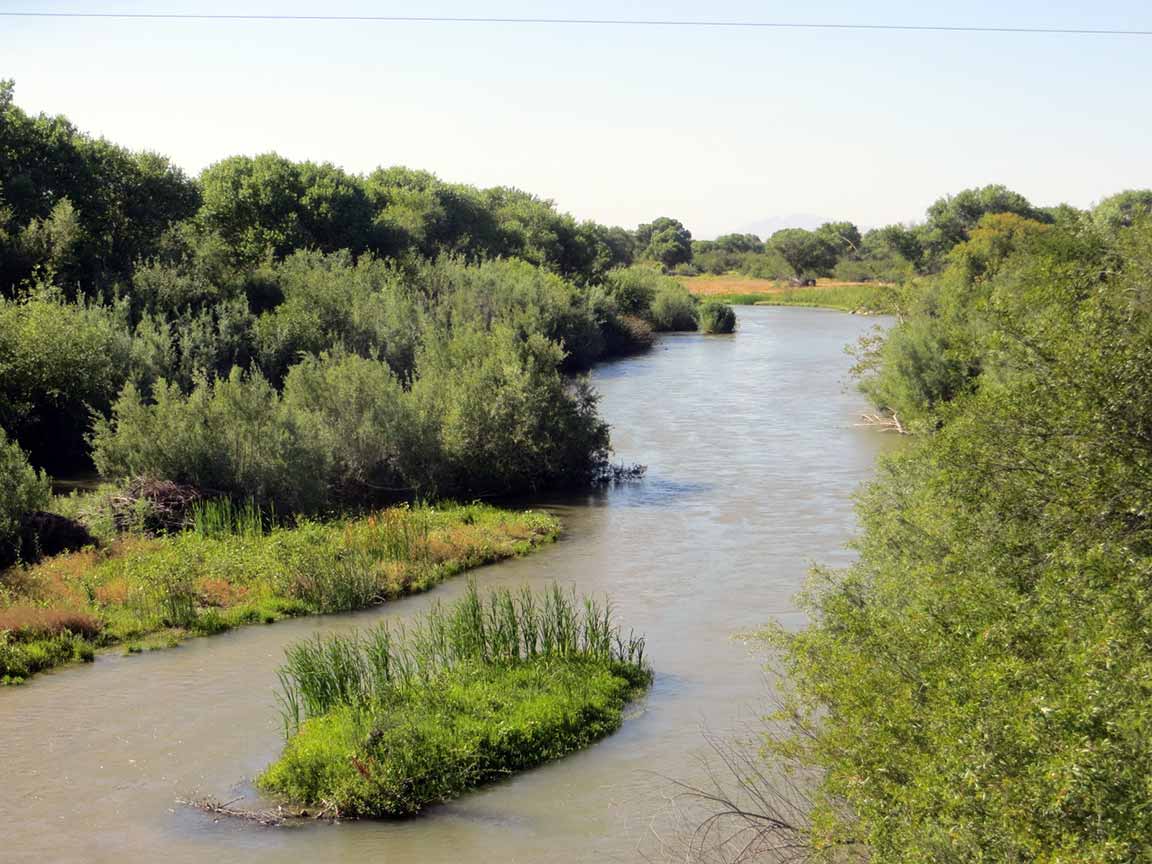
At San Lucas, we pulled off and did a thorough search for the right Subway Sandwich shop to patronize later, and check out the Salinas River |
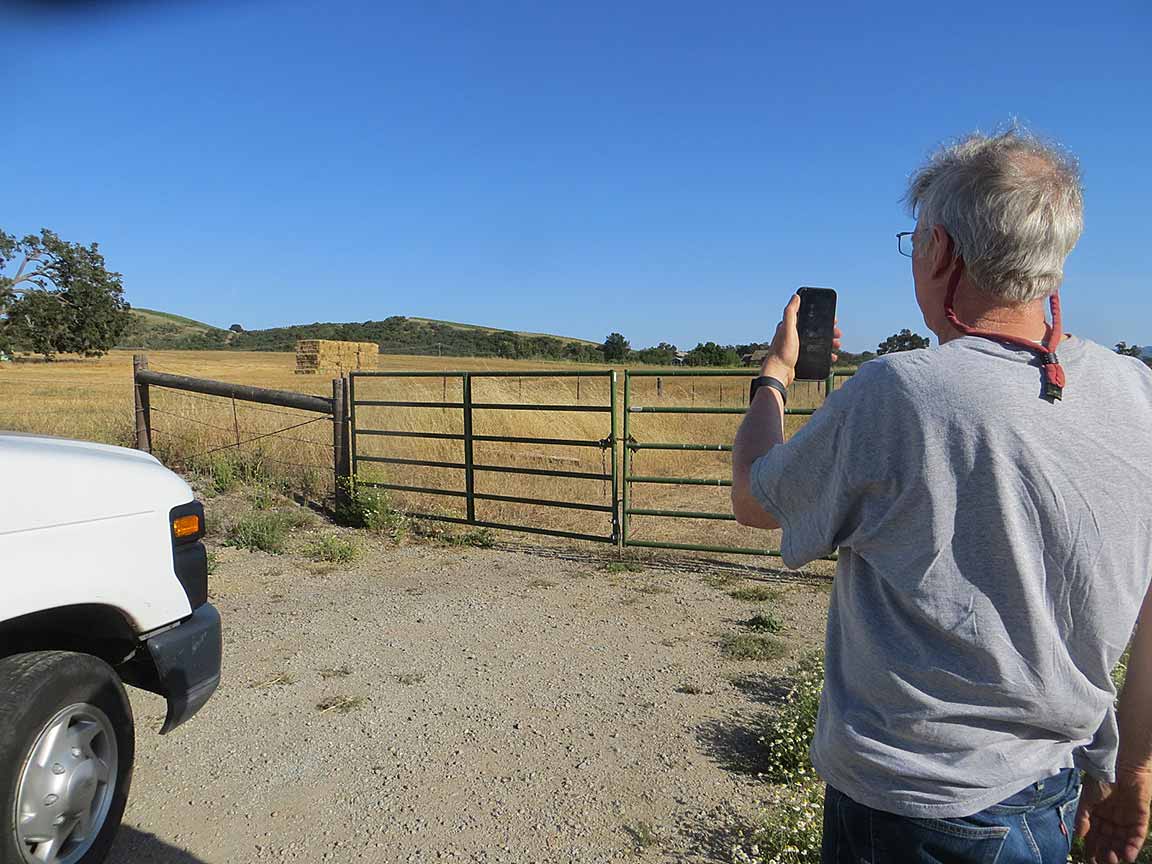
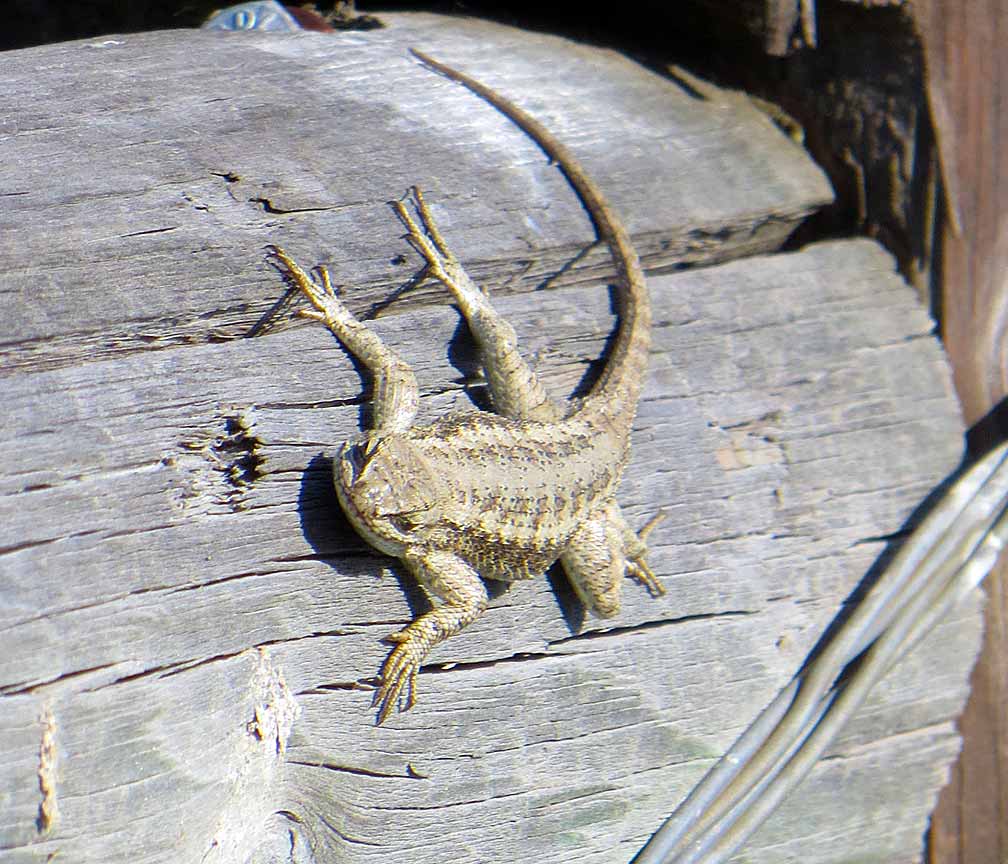
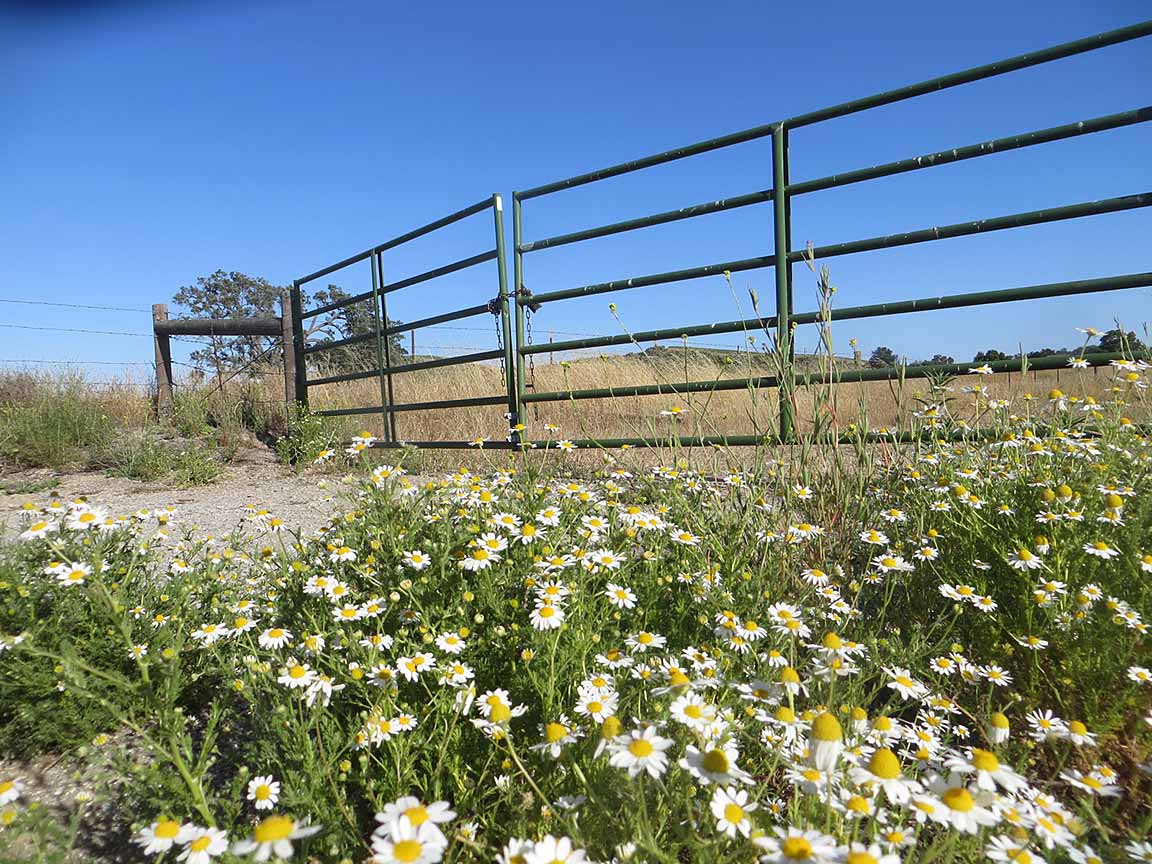
We'd left early so we could scout my and Kirk's chosen Google Earth sites and verify the horizon was low enough for the 13 degrees altitude of Hermione. A local resident of Kirk's grazing land entrance... |
 |
 |
Kirk's checking the azimuth of the target star, forward at the time of the event. |
It was still pretty windy, as the Salinas Valley in Spring can be. I'm seeing if my wind breaker can provide enough of a "Batman Maneuver" to block the wind from my scope. |
Kirk's sweatshirt was better. No worries - I have a much bigger jacket that will work if needed. We hoped the wind would die down by dark. That was the prediction from the guy at the Subway Shop in Atascadero. |
 |
 |
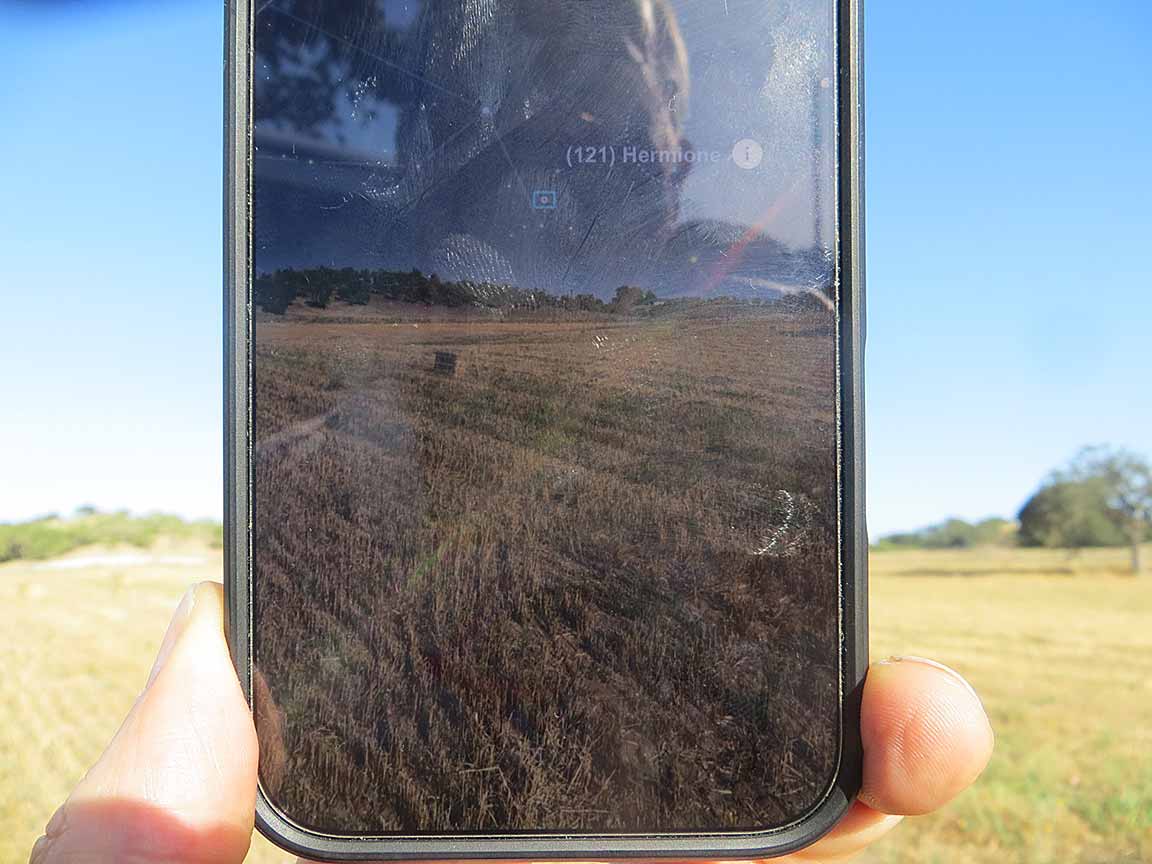
Kirk's app "Sky Safari Pro" can plot any asteroid at any chosen time, and show you the horizon at that time. Great feature; verifying his site was good, as I'd thought from Google Earth data. |
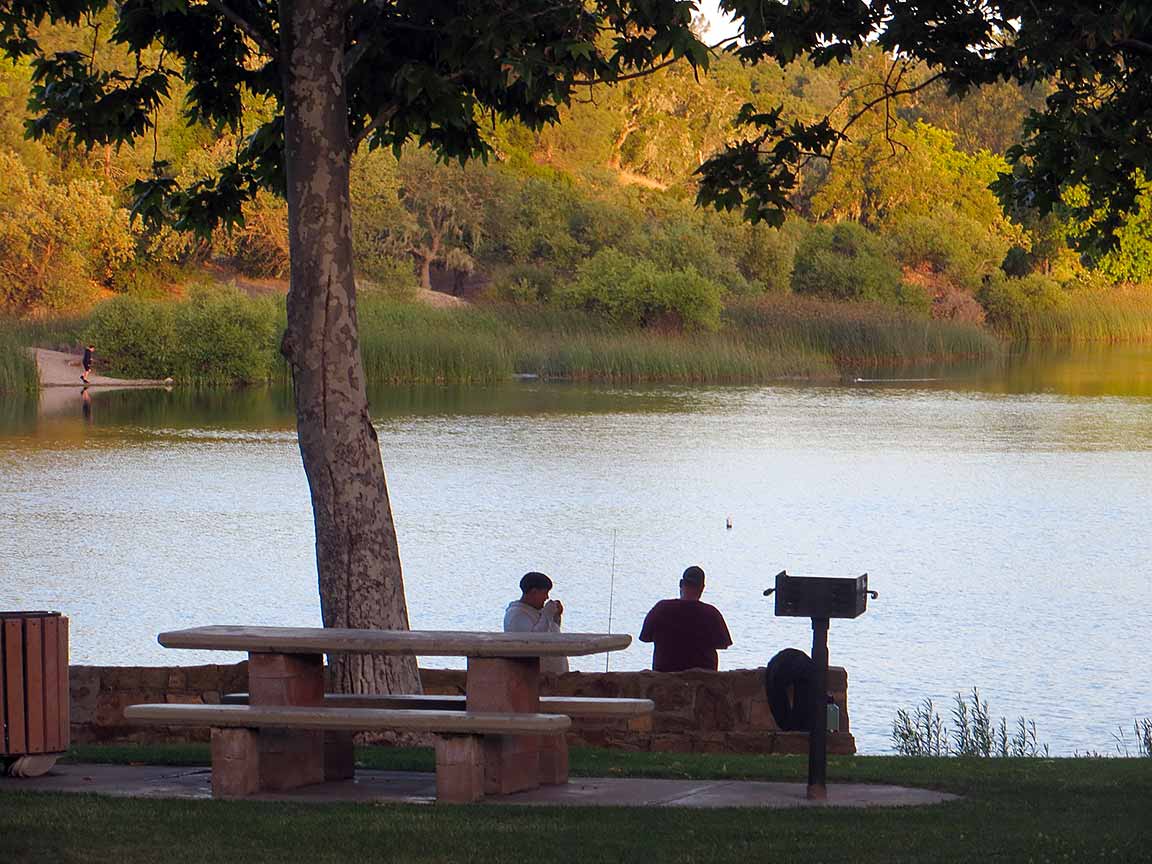
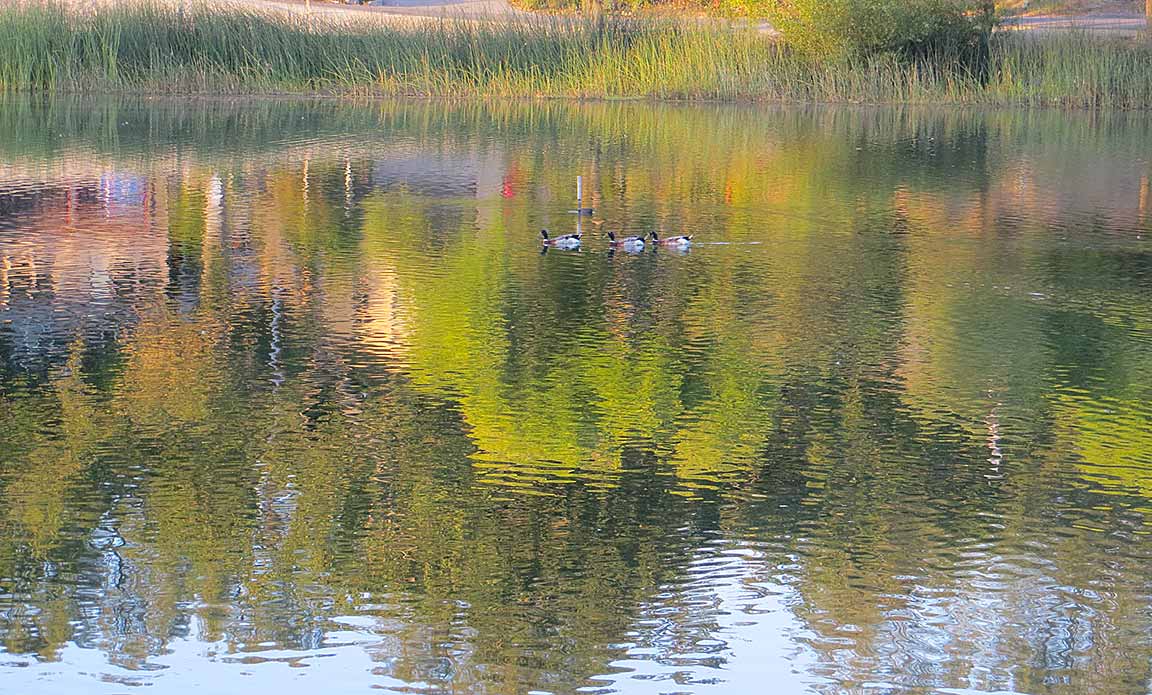
After our "foot long"'s from Subway, we drove to Lake Atascadero before heading to our first asteroid shadow site. The lake was beautiful at sunset. I even got in a 1 mile run around the lake... |
 |
 |
 |
 |
 |
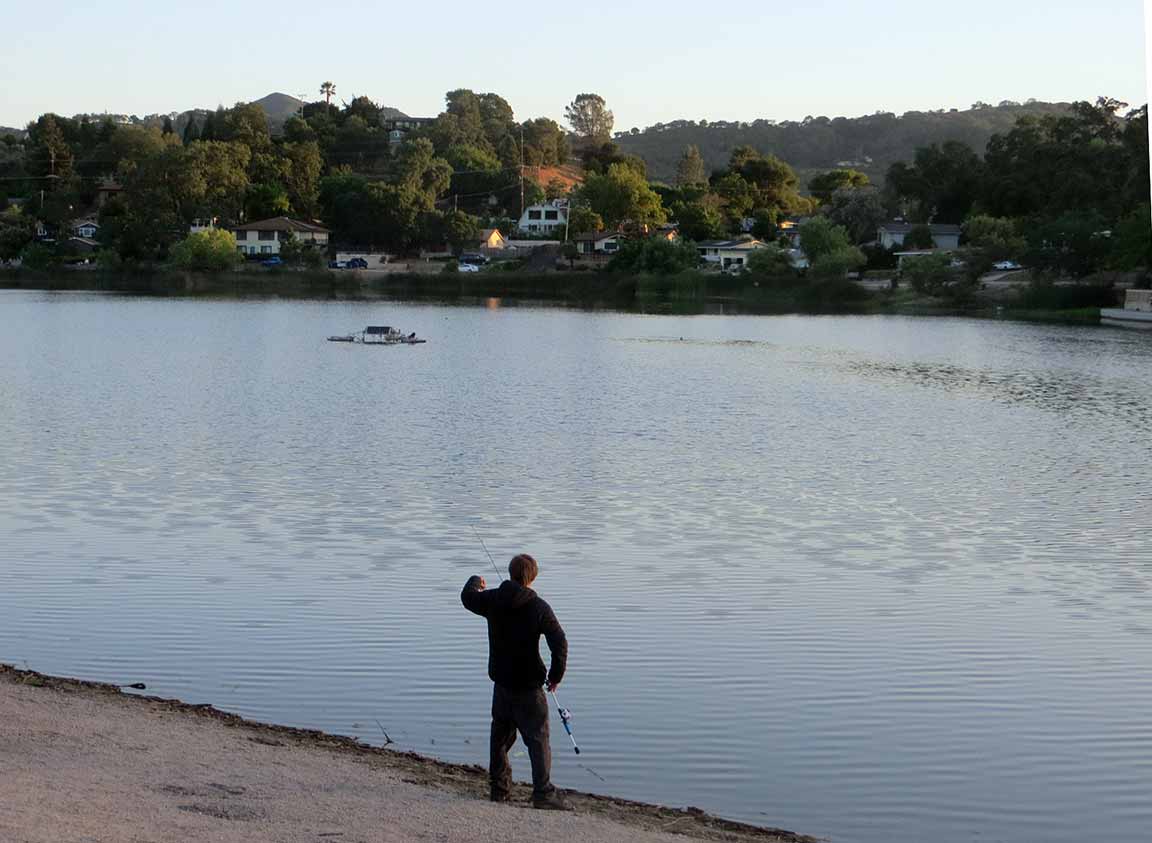 |
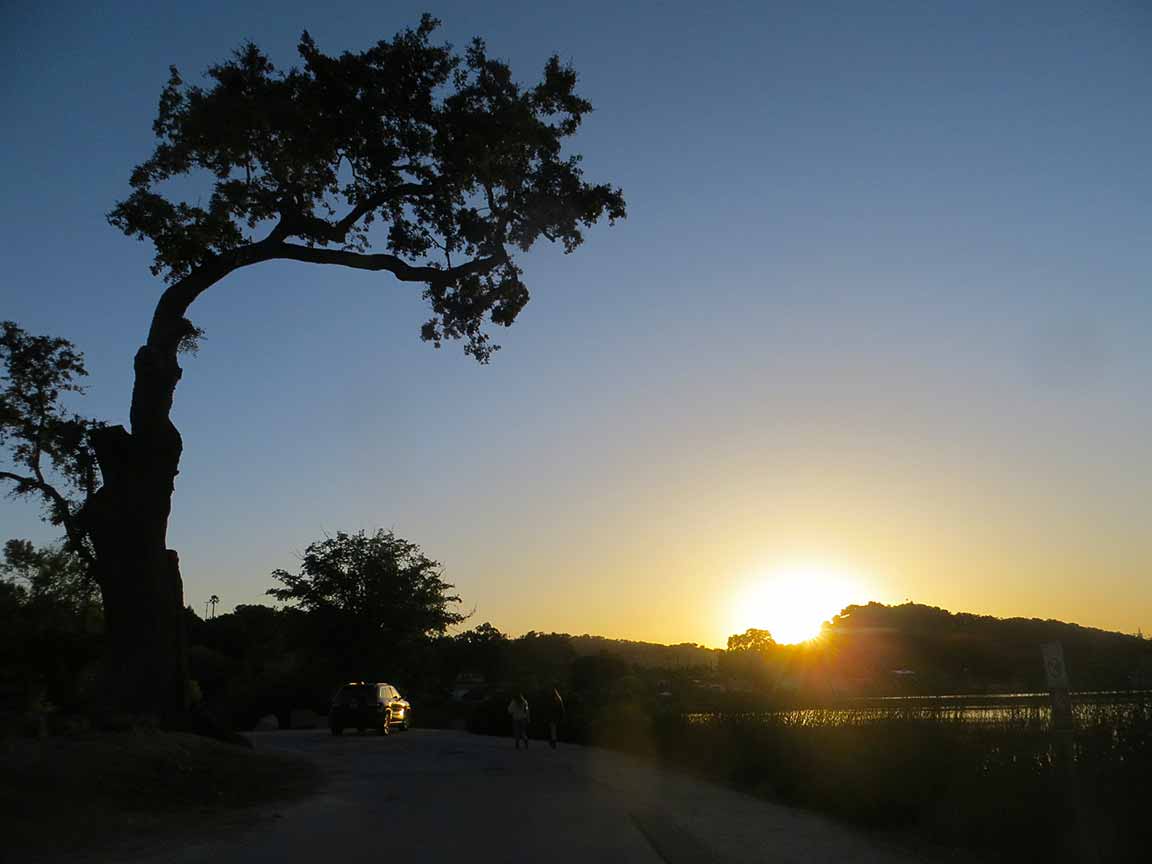 |
 |
 |
At the far end of the lake, there was a Par course, which I paused at to get in a little variety to my workout. |
 |
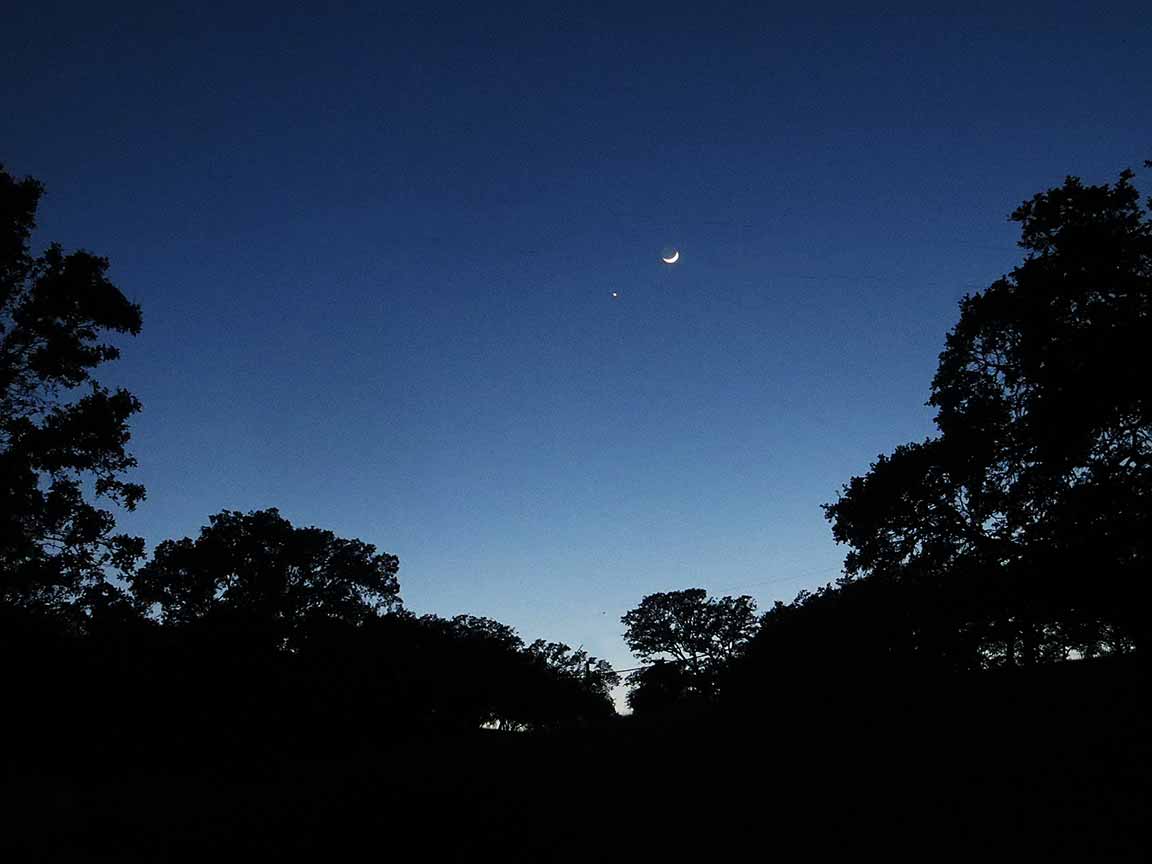
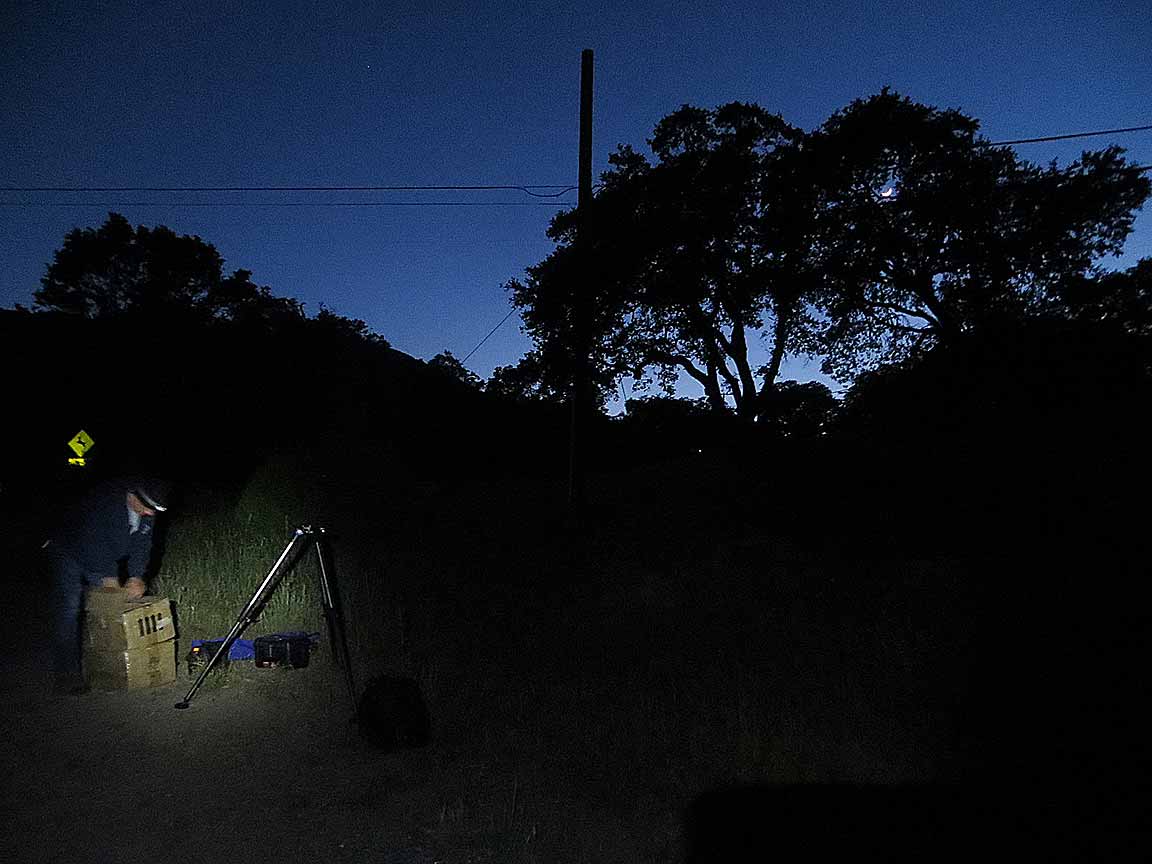
Now at Kirk's site for the Dogo Onsen asteroid occultation site, on Tassajara Creek Rd. The crescent moon was making a close conjunction with Venus tonight. Beautiful! |
 |
 |
 |
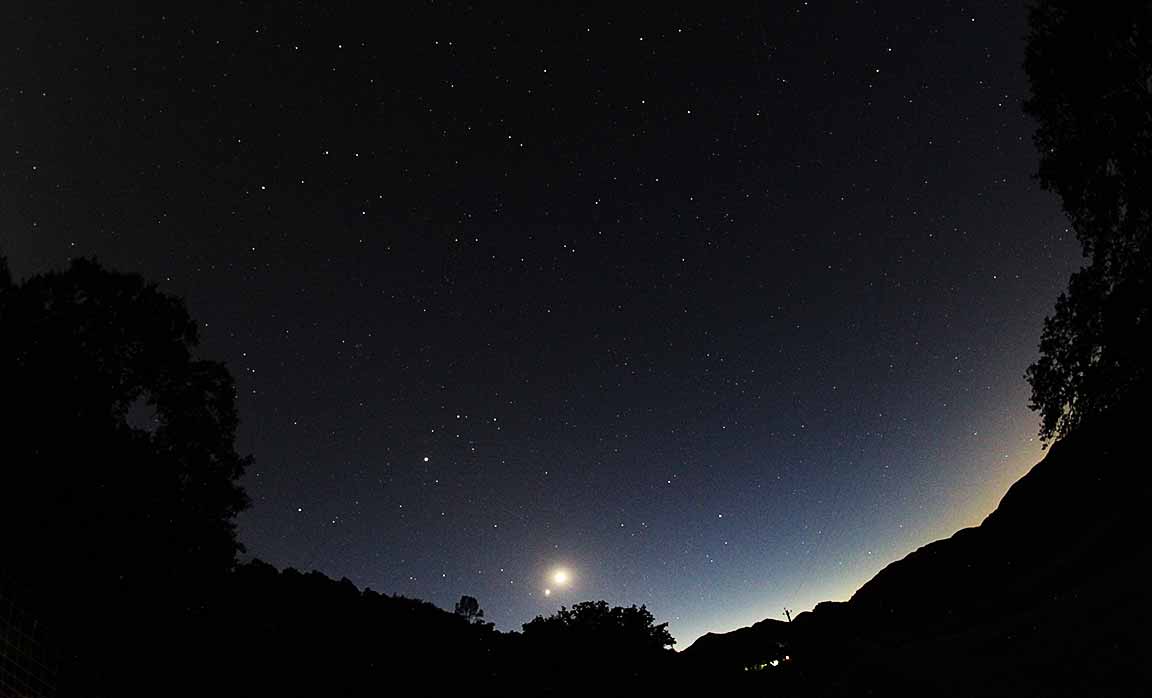
A half mile up the road, was my site. A fisheye lens view of the late twilight site. |
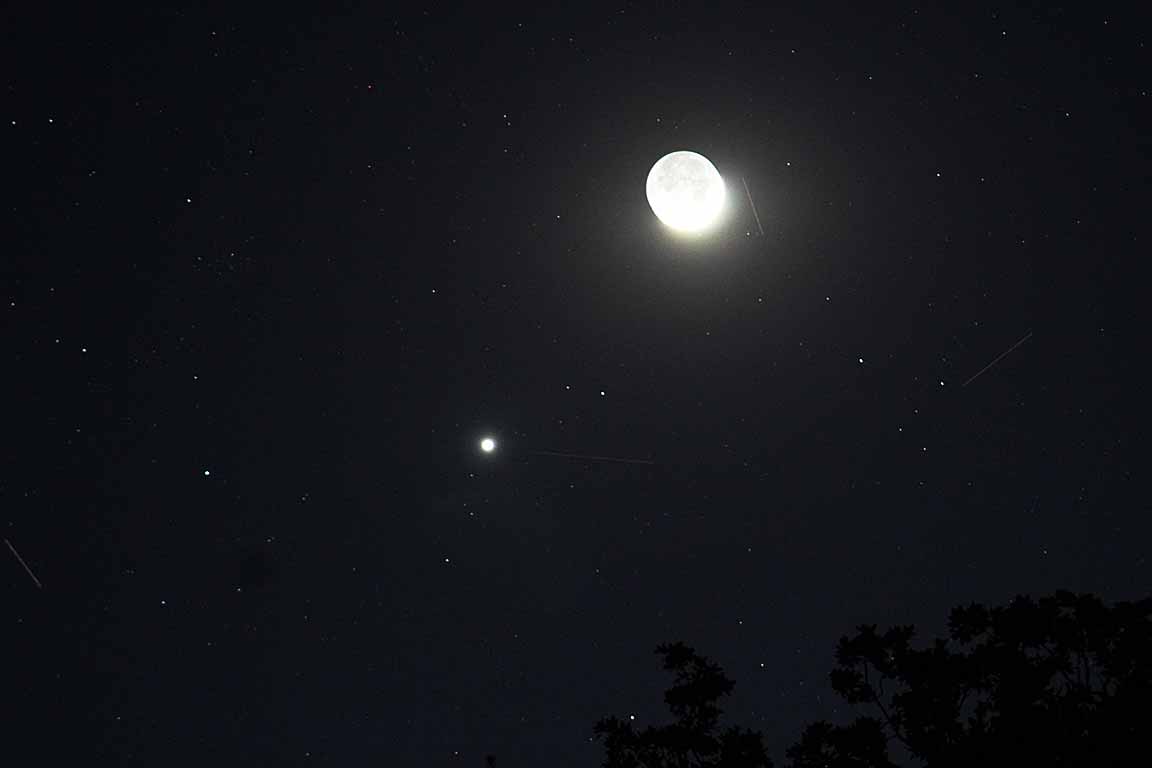
Zoom lens on Venus and the Moon. |
At my site for Dogo Onsen |
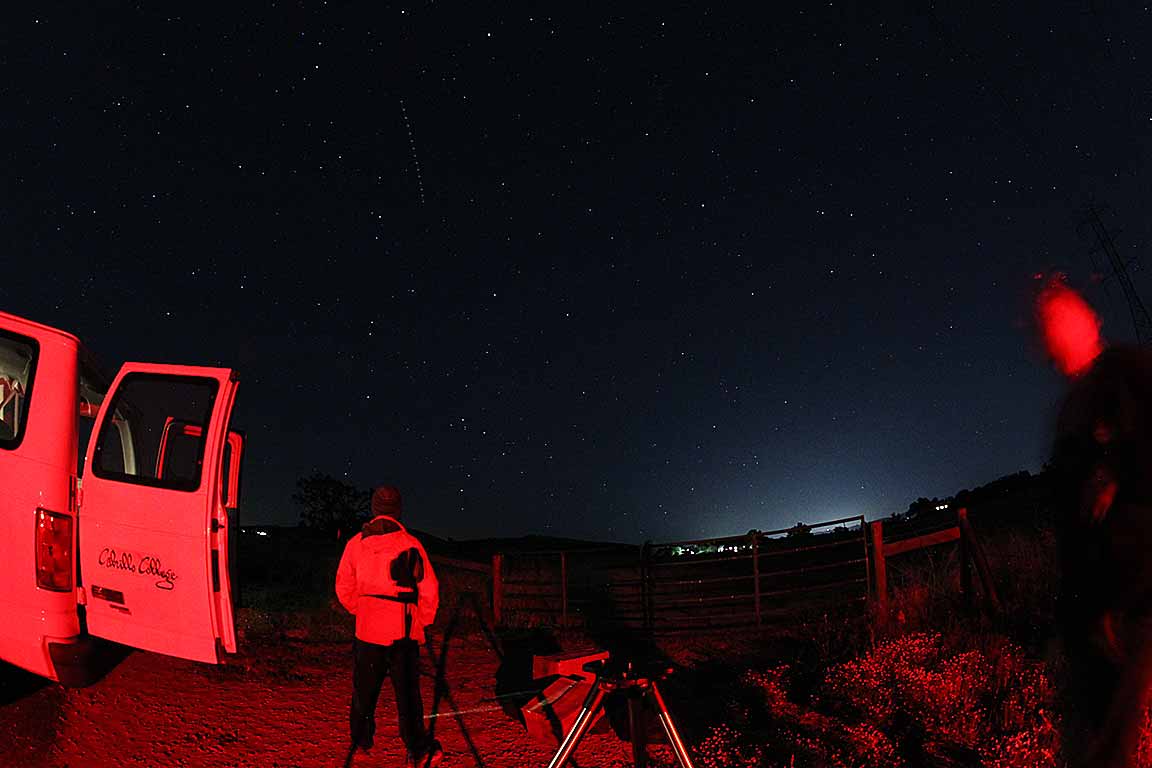
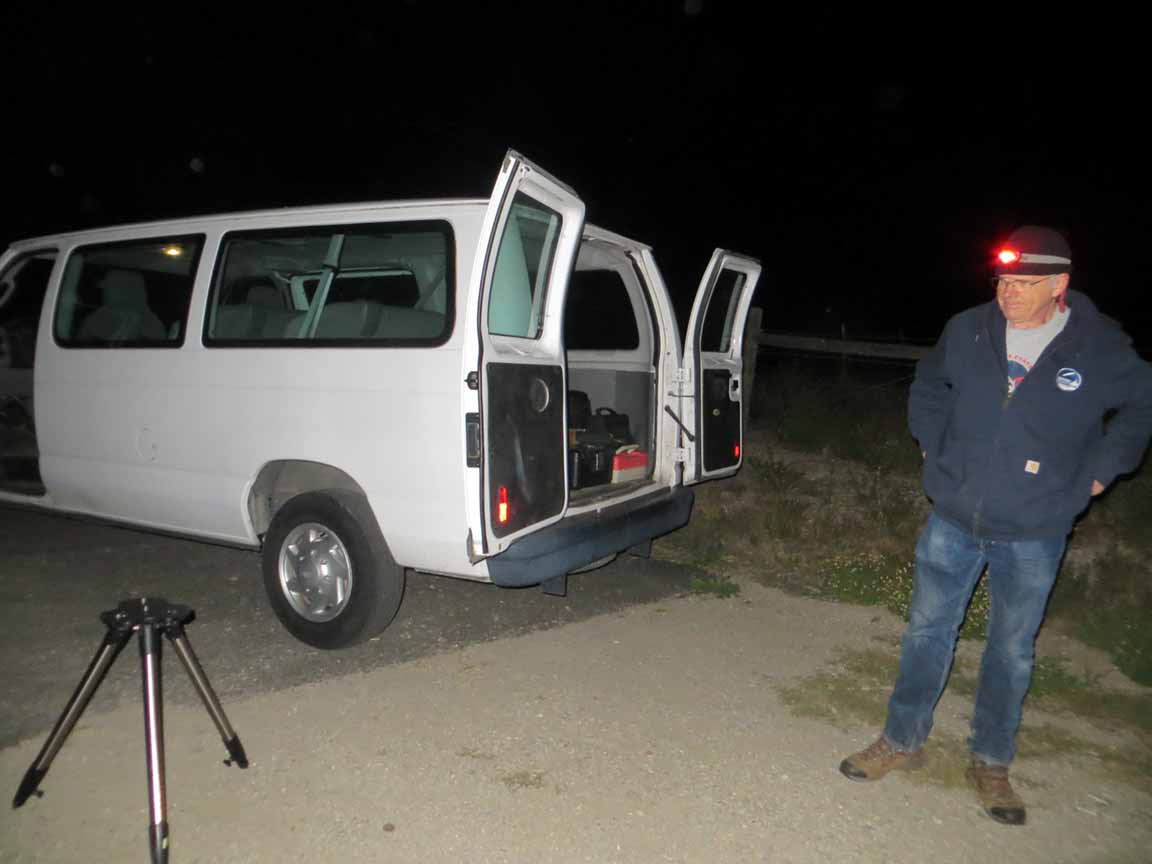
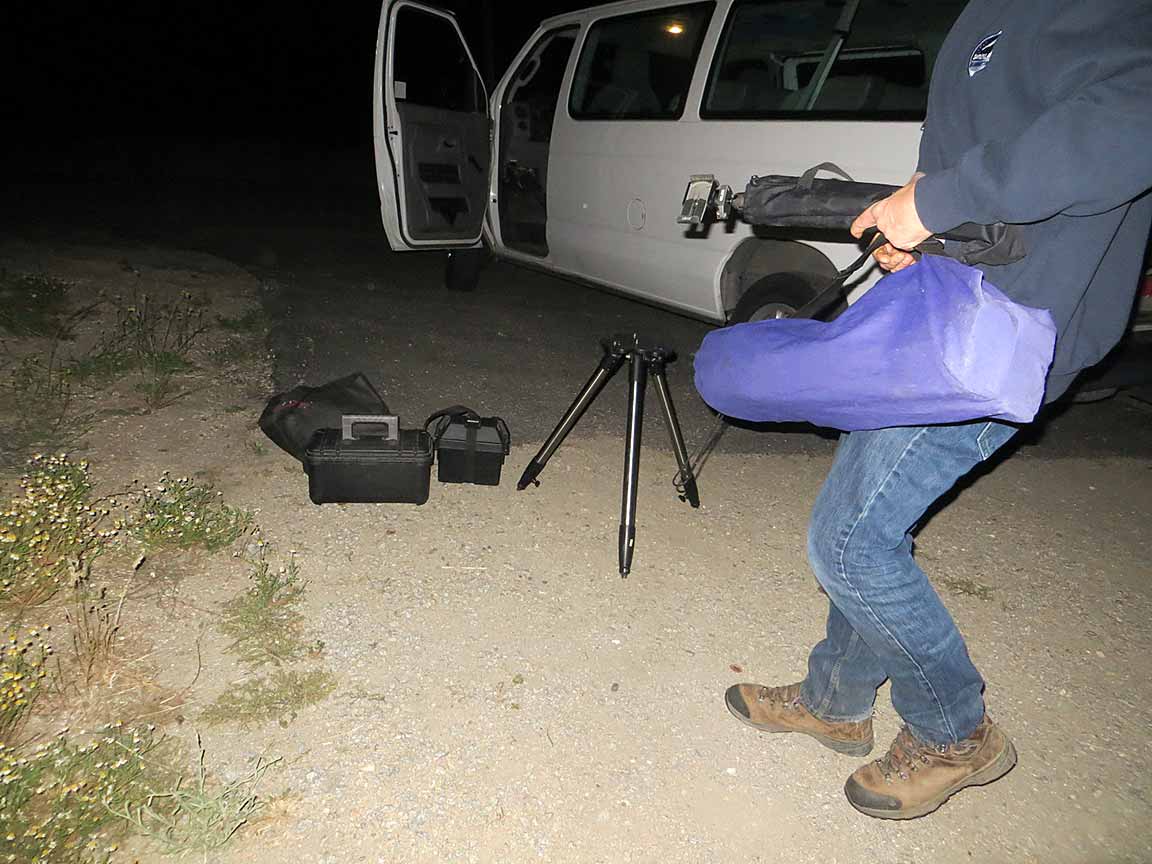
After the event, a quick pack up, toss everything in the van, and drive north to Templeton for the Hermione Moon occultation. Here, at Kirk's site, looking off towards the event direction |
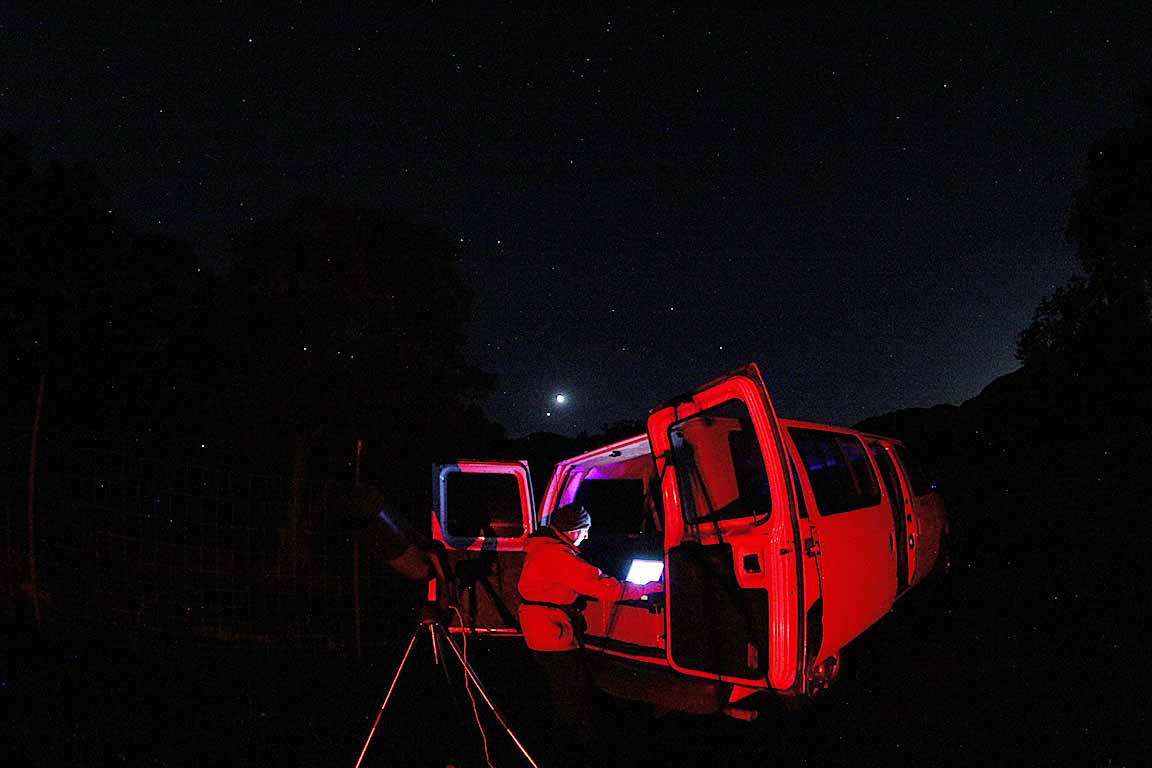
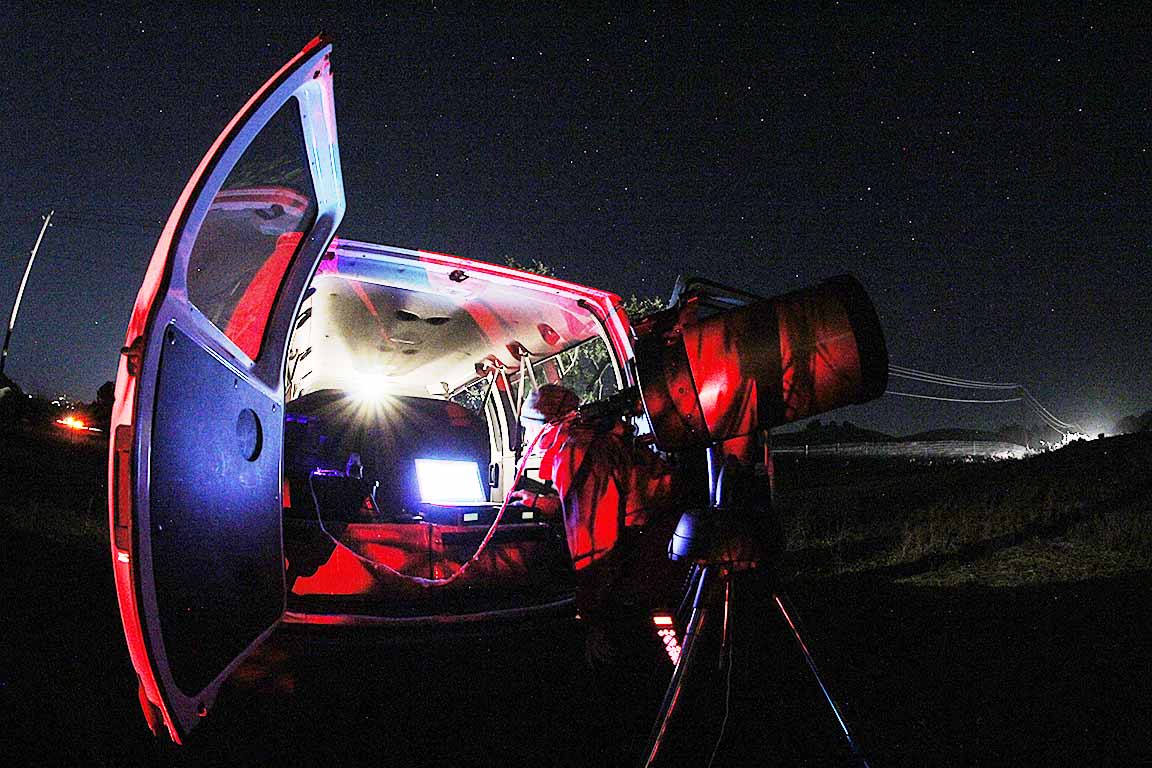
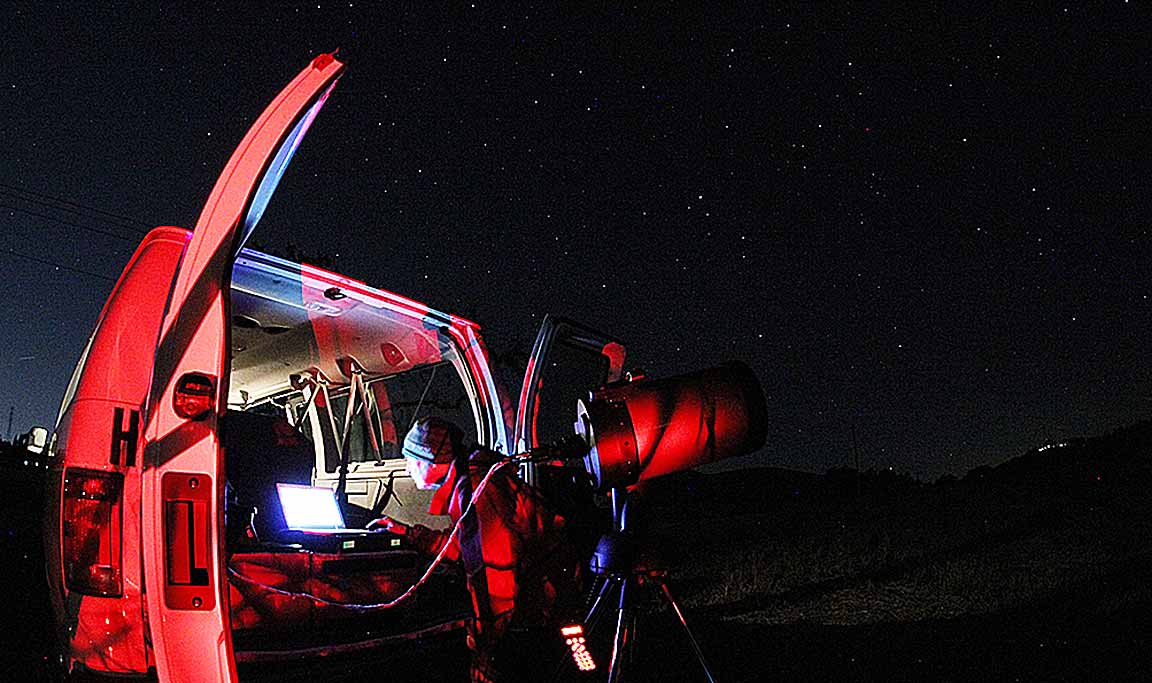
At my Hermione Site about a mile or so north of from Kirk's site. Monitoring the laptop screen. Seeing was variable at this low altitude of 13 degrees. Got on target pretty easily. |
 |
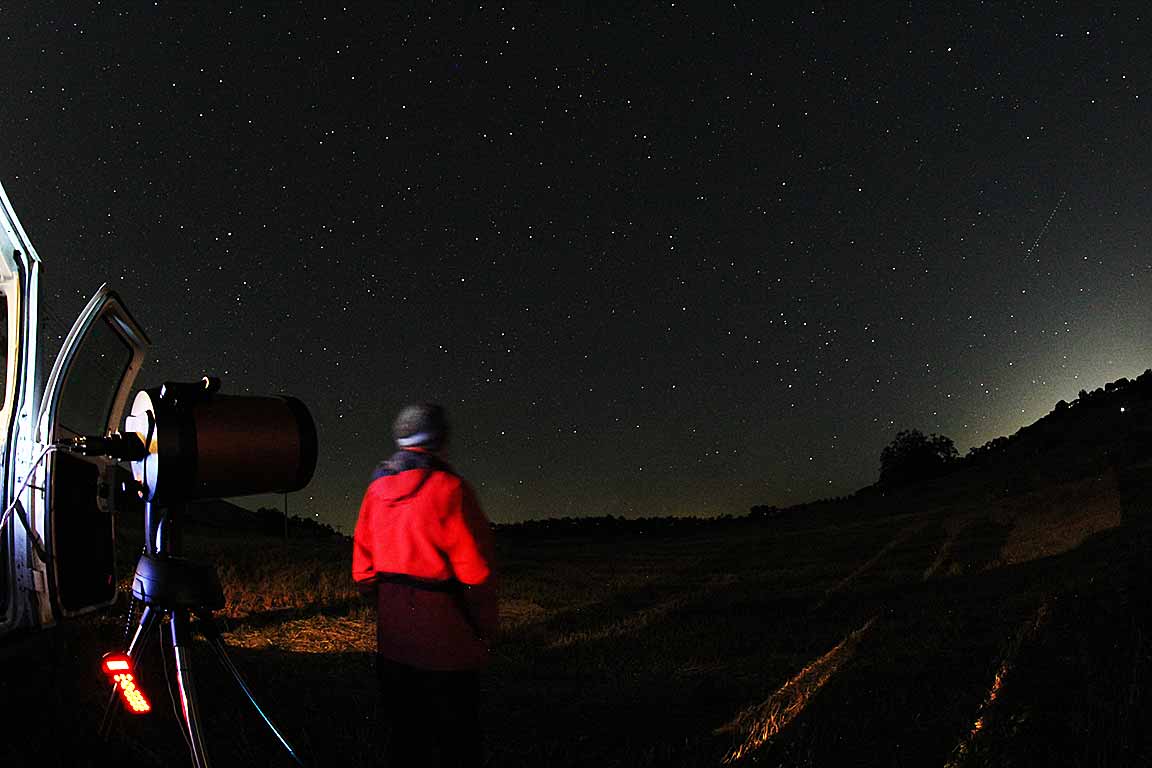
A last shot after the successful recording, of Sagittarius rising. |
Cleaning bugs off the windshield before the long drive back to Santa Cruz. I got to sleep at 2:30am back in Santa Cruz, after dropping off the van and Kirk. |