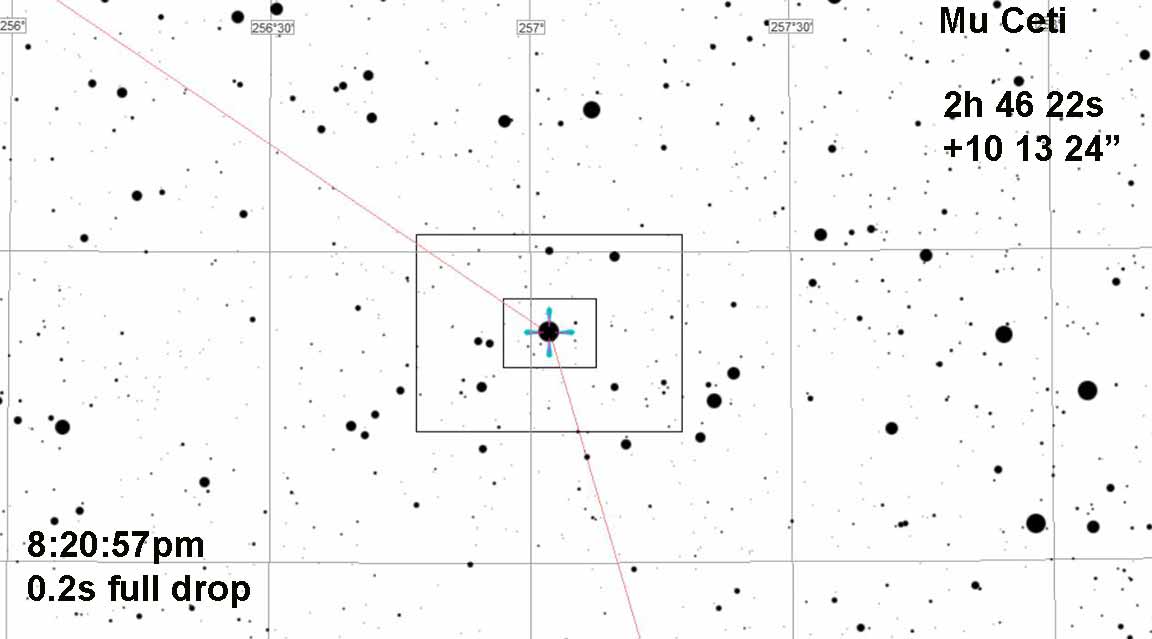
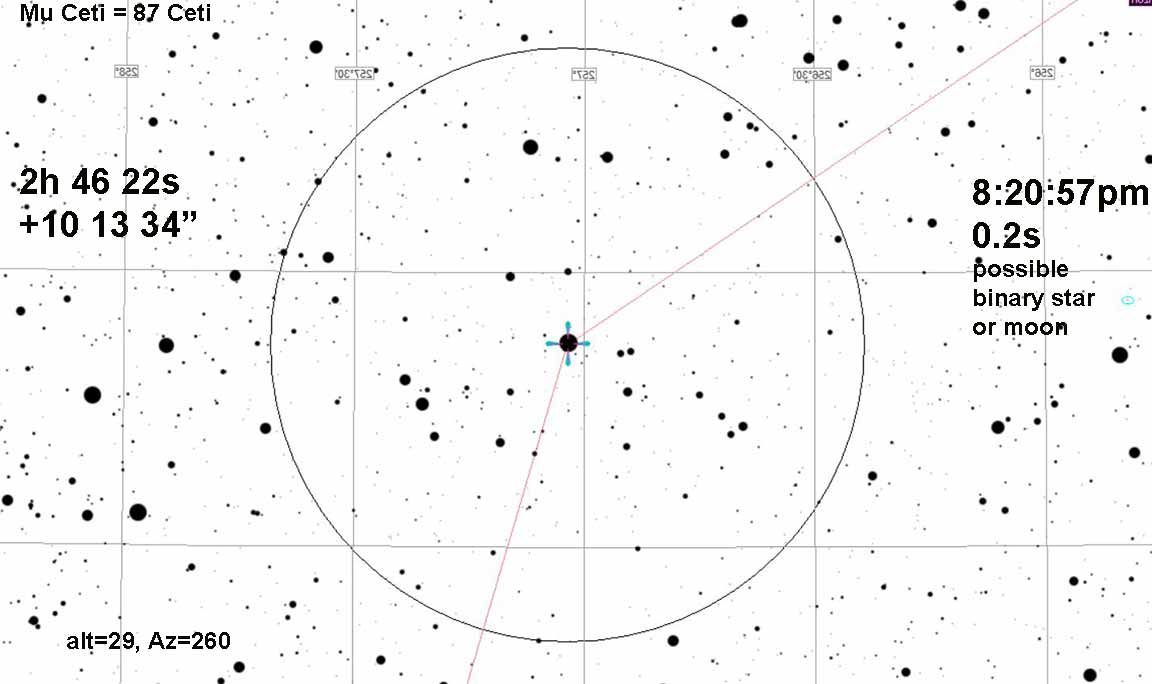
This is the brightest occultation possibility I've yet seen for me to try, and it's local!
The problem is - the rank is not great. I'm not sure why. The RUWE is 1.30 which is OK. Not perfect, but not bad either. 1.20 is the upper limit for "good star astrometry", so 1.30 is "OK" but not bad or awful. The pink limits on the star path however suggest the possibility of a miss is substantial, even on the centerline. It's good that we're spread out. We'll have to go in with those expectations. But it could be a spectacular wink out. I'm planning on recording not just on the Lenovo, but also on the camcorder so I can record audio as well. It might be a good one to post on our YouTube channel.
Diameter effects:
OWc lists the target star as 0.80 mas and the asteroid at 4.0 mas. So, the target star is 20% of the diameter of the asteroid. This means that a graze is not that unlikely, in which you'll get a drop and rise and maybe not a complete disappearance. The whole event is only 0.20s, so it's imperative to get valuable data that you expose at 1x integrations and reduce in "field mode" in PyMovie. At 1x, you'll get 10 integrations inside the maximal occultation, for getting a feel for things.
I've just read the Wikipedia article kindly linked by Kirk Bender. This star is more interesting than I thought. It's got one definite companion, and two others possible. The spectroscopic companion has a magnitude of 7.8, which is still bright enough to be easy to see in our 1x setups. So, do go to 1x but don't go too crazy with lowering the gain I am guessing, or else you may not detect the fainter companions. I'm going to 'double record', on my camcorder as well as the Lenovo computer and I can reduce each recording separately to see if there's differences. I'll adjust my gain down, but I still want the star to look good and bright on my monitor, for the secondary star(s) effects.
|
|
Mu Ceti is a spectroscopic binary. These systems have binarity inferred from variations in their spectral lines, which shift from redder to bluer (gravitational redshift) across the orbit. It has also been resolved by speckle interferometry. The energy output is dominated by the main star, which is 25 times brighter than the companion.[a] They share a highly eccentric orbit, are viewed orbiting nearly edge-on, and take 34 years to complete an orbit.[3]
The main component (apparent magnitude 4.30) has an spectral class A9IIIp,[4] suggesting it is a late-type giant star and is chemically peculiar. Its physical properties, however, do not support this evolutionary stage and the peculiar class, Mu Ceti is instead in the late main sequence, about to become a subgiant. This star is 67% more massive than the Sun and two times larger. Its effective temperature is 7380 Kelvin,[3] giving it the white hue typical of late A/early F stars.[12] It has been suspected to be a δ Scuti variable,[13] and found to be of constant brightness by some studies,[14][15] but a more recent analysis with the Transiting Exoplanet Survey Satellite confirm this star is a Gamma Doradus variable.[3]
The secondary (apparent magnitude 7.80) is a K0.5V star, indicating it is a dwarf star cooler than the Sun. Mu Ceti B has an effective temperature of 5,250 K and has a mass and radius measuring 80% solar units.[3] Its effective temperature give it an orange hue typical of K-type stars.[12]
Three companions were all discovered during occultations of Mu Ceti by the Moon. An orbit was derived for the brightest with a period of 1,202 days.[16] Later studies have failed to find any evidence of these companions.[17]
Jordan and I met at Los Gordos and planned our strategy, a neighbor stations set at Sand Dollar Rd and the lane just north of that, off San Andreas Rd. Skies were clear with a small amount of light scattered cirrus which did not seem to affect observations.
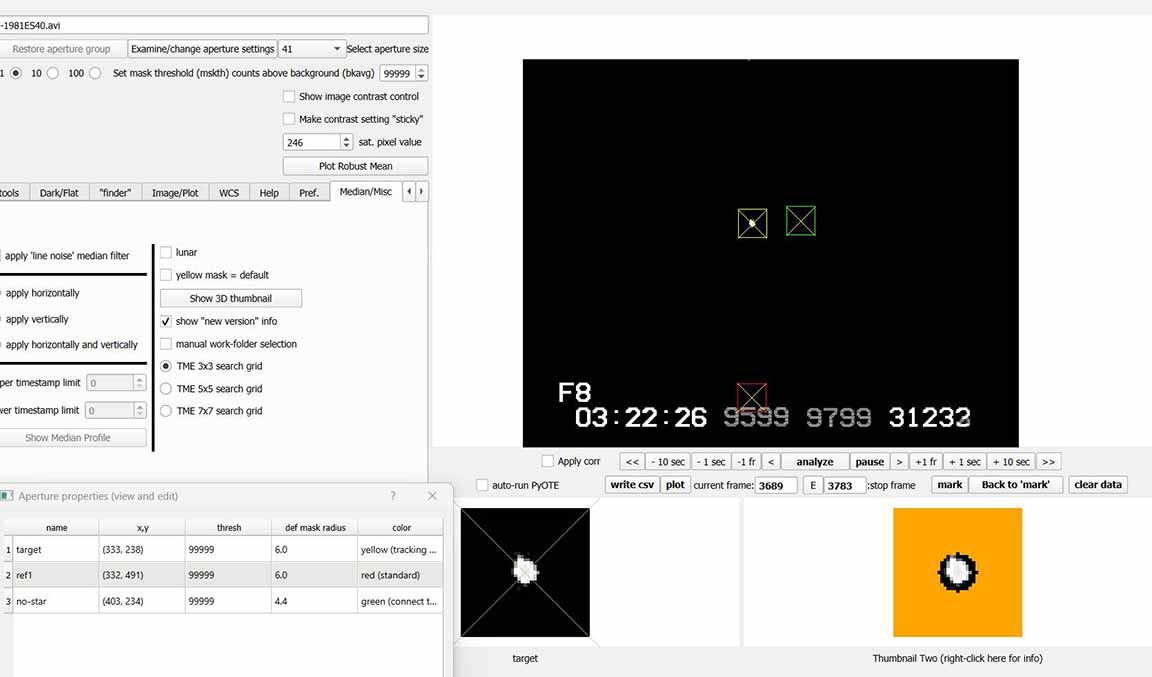
I helped set up Jordan, then went to my site and set up in a hurry. I set up on Sand Dollar Rd up about .1 mile up from the intersection with San Andreas Rd. Gain lowered from 41 down to 30, defocused enough to blend rows, 1x setting.Got a recording on both the camcorder with sound and the computer w/o audio. No event was obvious, but will await reductions to decide.
long: 121 51 04.04
lat 36 55 31.23
elev 46m
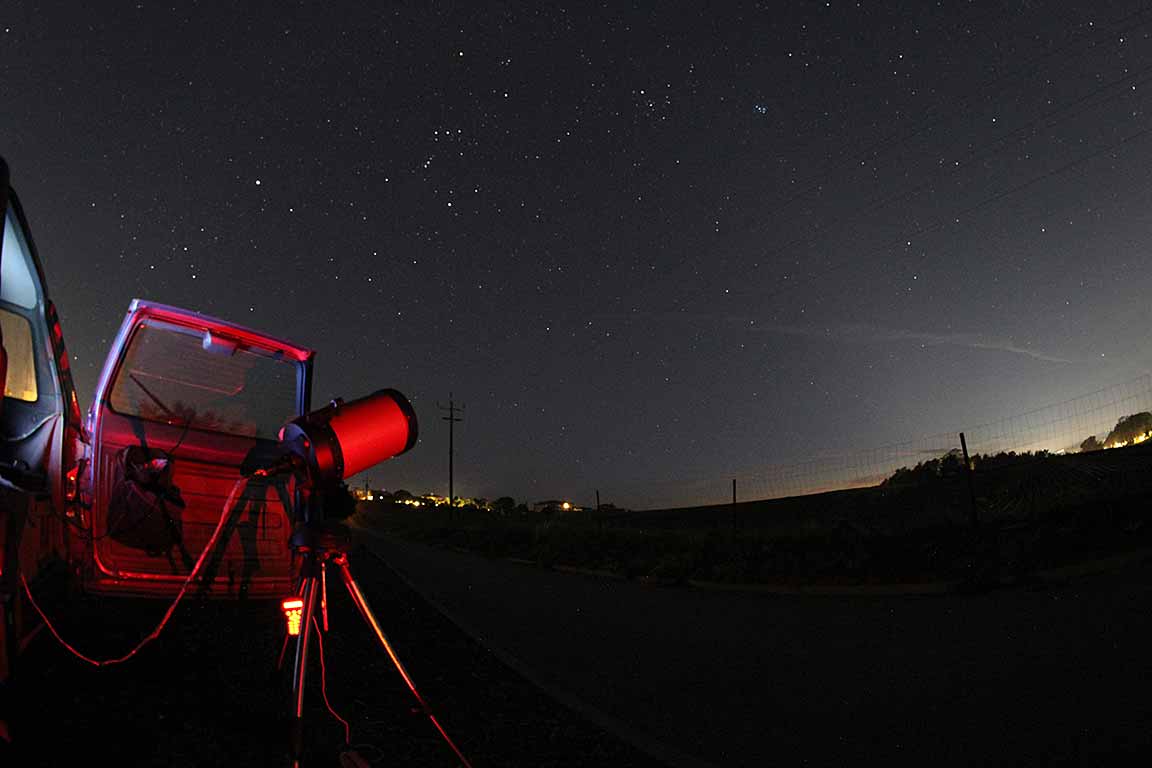 |
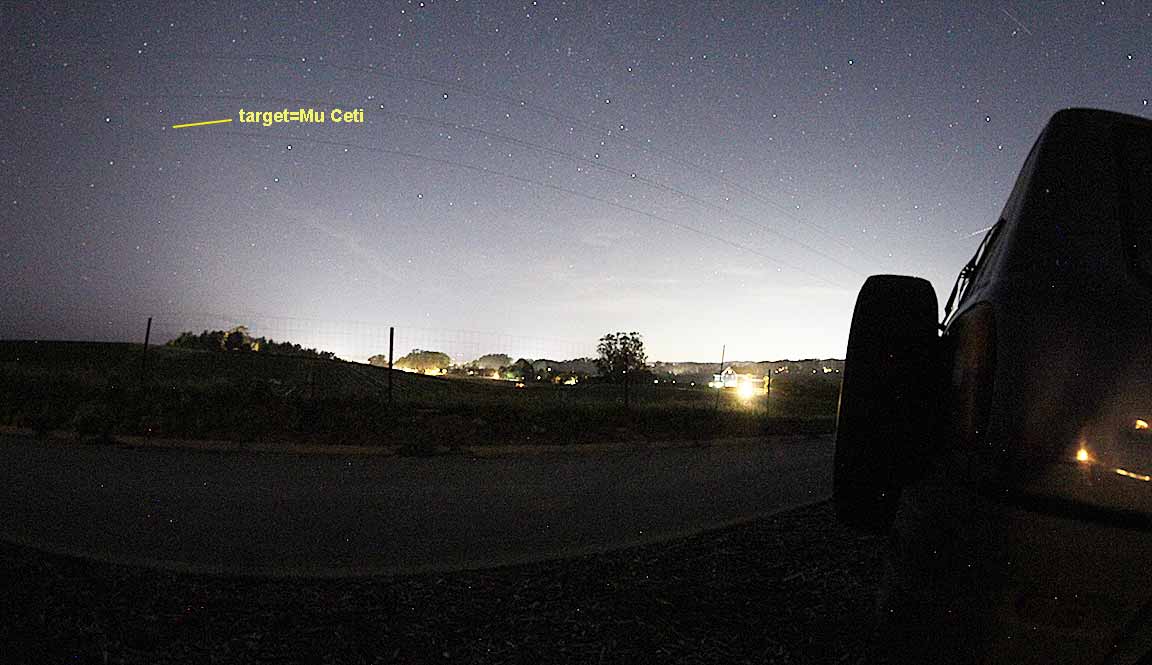
At my site |
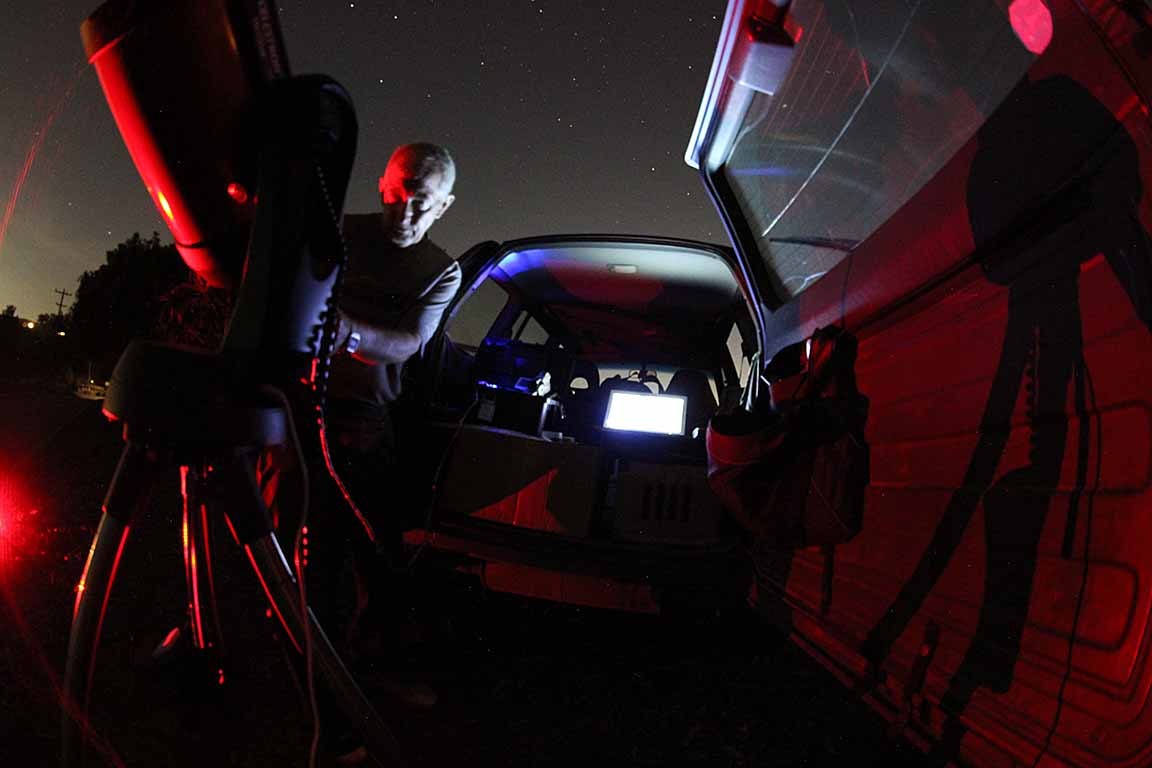 |
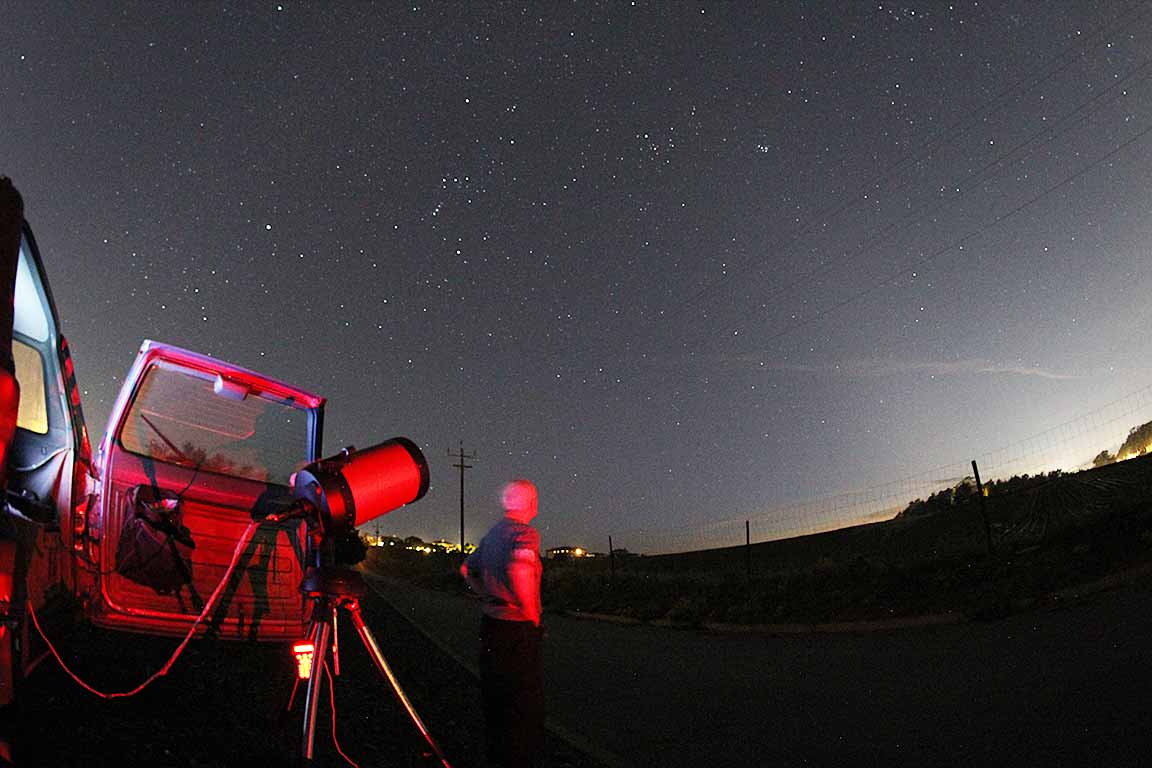
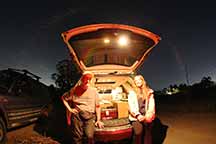
Quite unusual to have a naked eye target star, here in a fisheye lens image after the event. |
Me and Jordan, at her site less than 1/2 km north of my site |
 |
 |
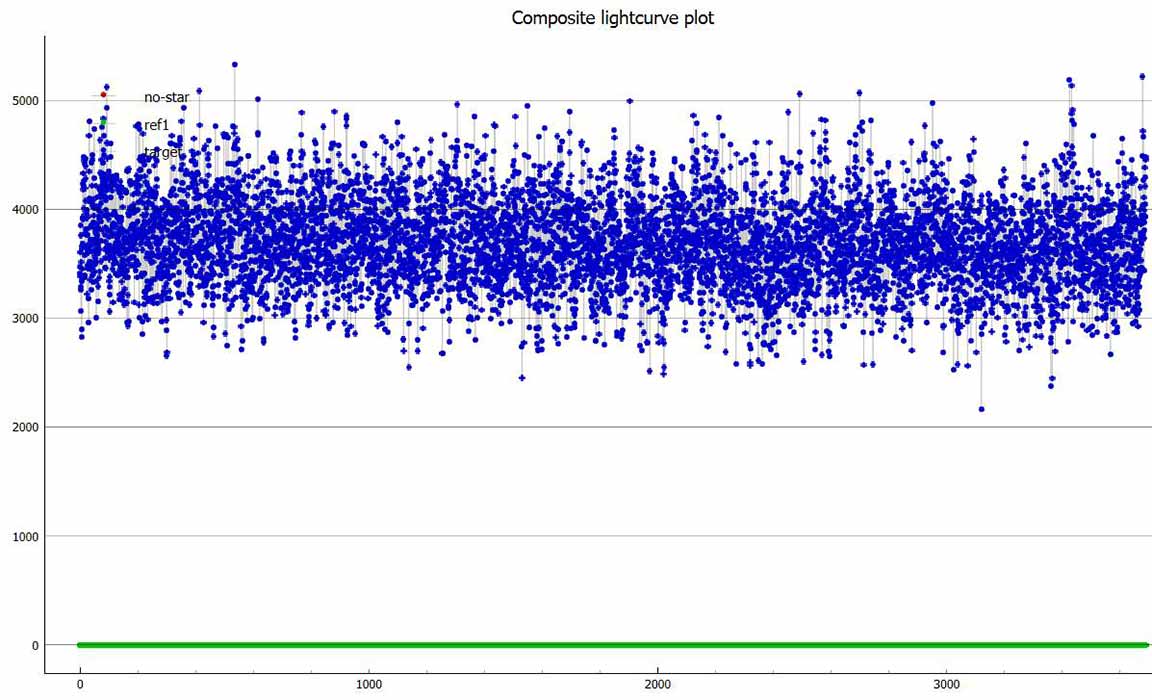
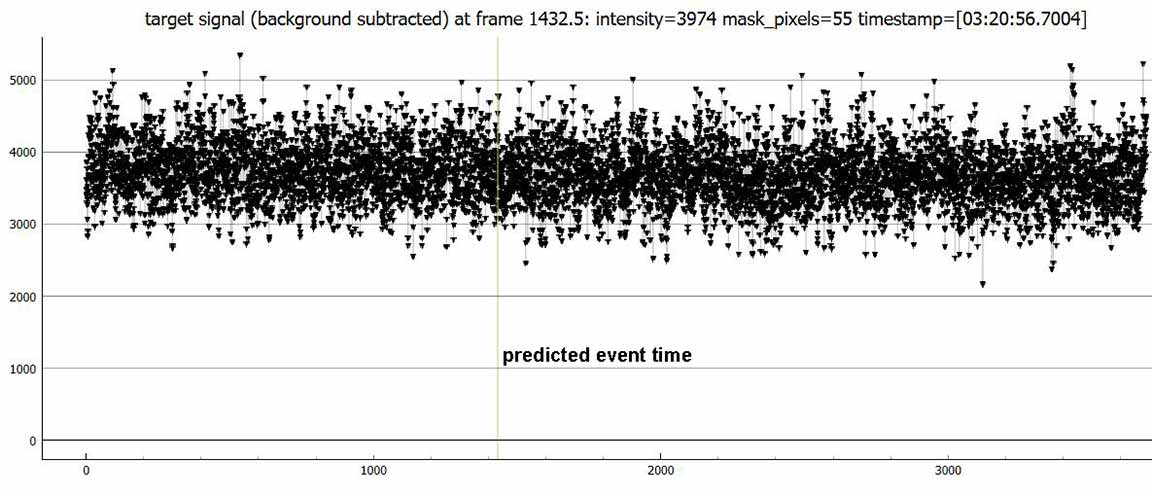
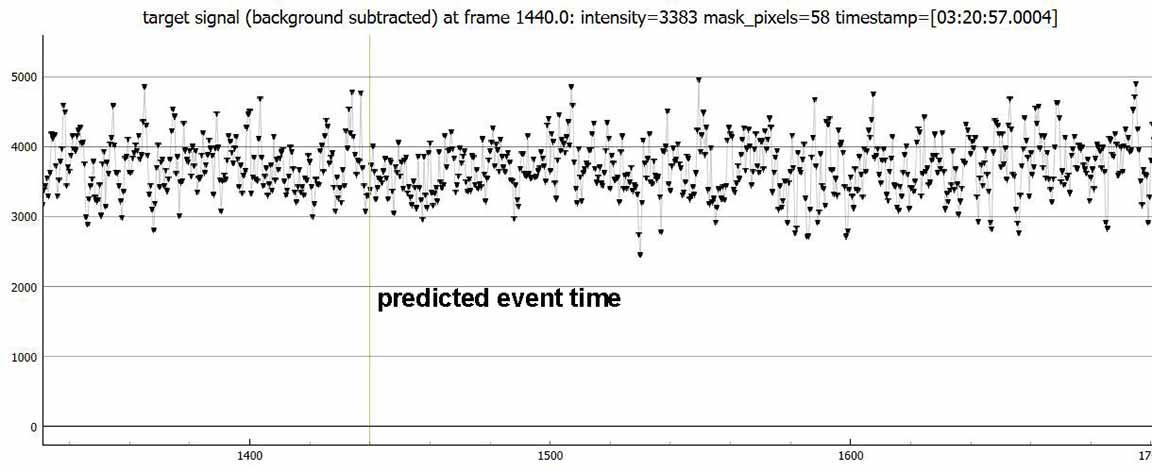
My light curve. I was happy to see that there were no saturated pixels and the light curve does not show topped clipping which would be characteristic of saturation. Wary that the light curve should only drop to mag=7.8 which is still quite bright (but only 1/30th of full light), but clearly there is no event. Excellent data. I used Gain=30, and slight defocusing, at 1x, and reduced in field mode.
 |
 |
 |
 |
Observed from Heather Point Ln off San Andreas Rd. Got a recording on Lenovo computer. Gain=41, defocused some, gain left at 41, setting = EI. No event obvious. I've turned in a "miss" report for her. In the extremely unlikely event that a reduction of her data shows a hit (I don't see how that is possible, since Kirk further north a bit also had a miss and at better dynamic range resolution), then I'll revise and resubmit. Jordan is still learning PyMovie at this time. This was her first attempt at recording an occultation on her own using the OccBox I made for her and the loaned 8SE scope from Cabrillo College. A successfully recorded event. Given the troubled learning curves that I, and Karl, had, this is good. There's a million things that can and do go wrong. A tough event in the sense that avoiding saturation was going to be very difficult for a 4th magnitude star with no comparison stars. Setting = EI was mis-interpretted as "1x" as it was the next setting below 2x. But the Watec menu is not intuitive in this regard, so an easy mistake to make.
long= 121 51 08.35
Lat= 36 55 39.29
elev 37m
Observed a miss at Natural Bridges State Beach.
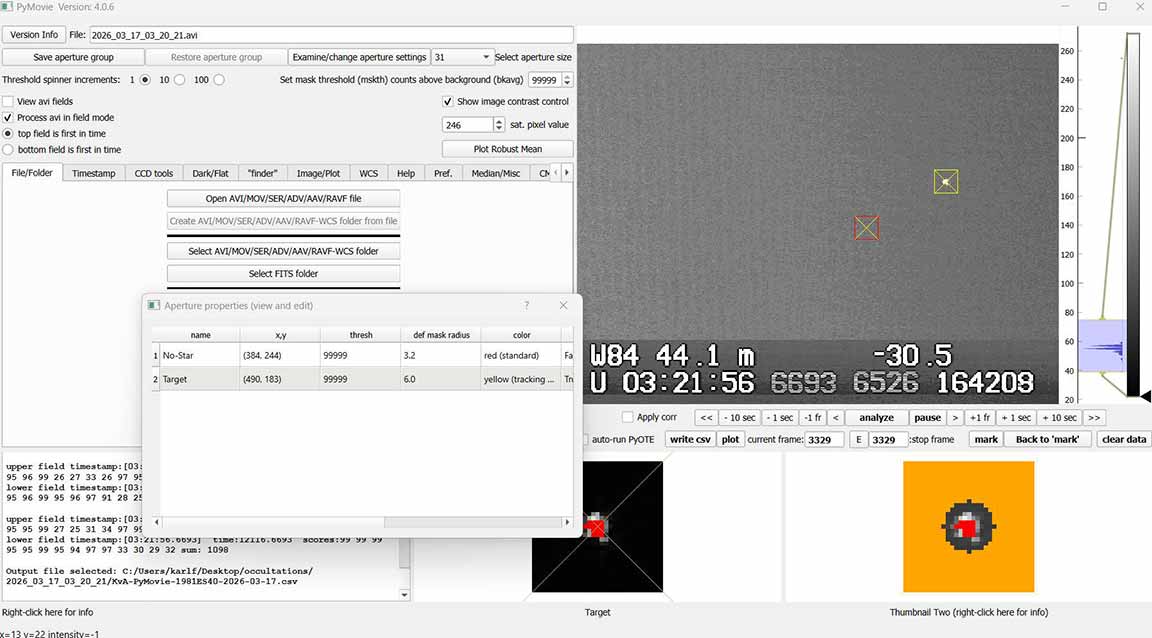
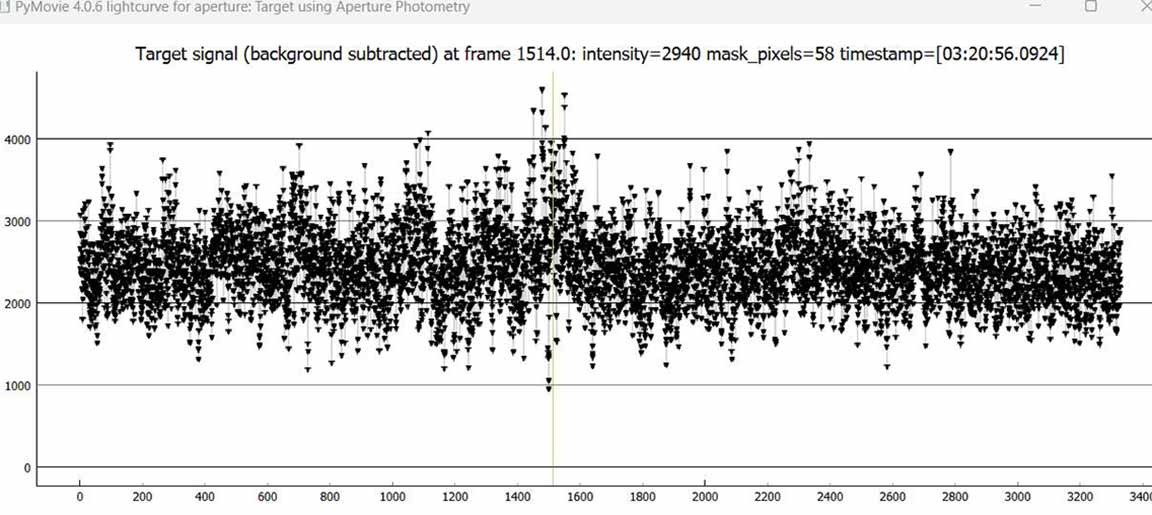
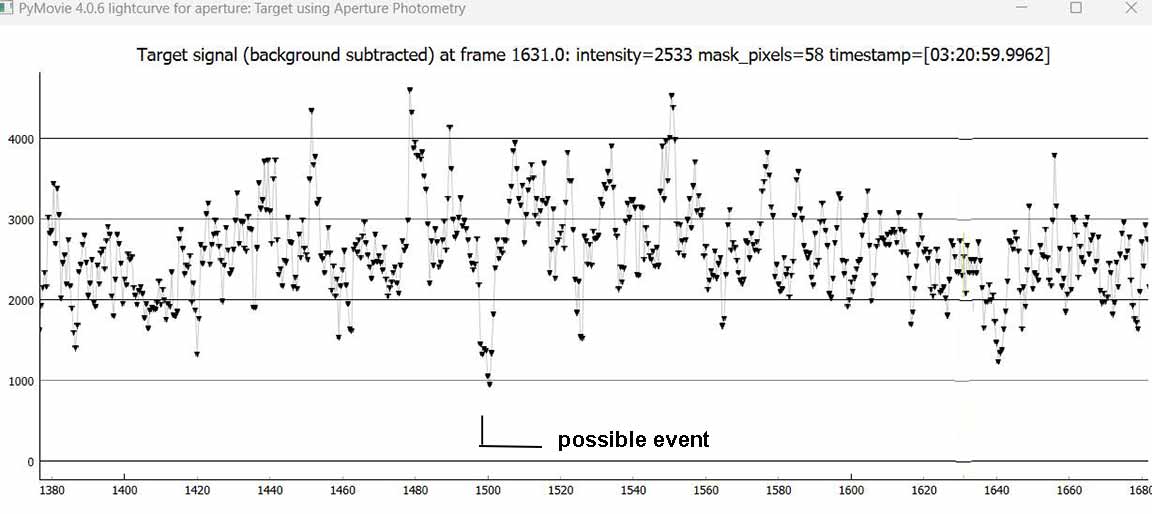
(79111) 1981 ES40 from Blue Ball Park, 1X, Gain=12, clear, still, dark (comparatively) moderate seeing . No blink detected, but bit of unusual flickering at event time. Processing: Target was very saturated. No reference star in field.
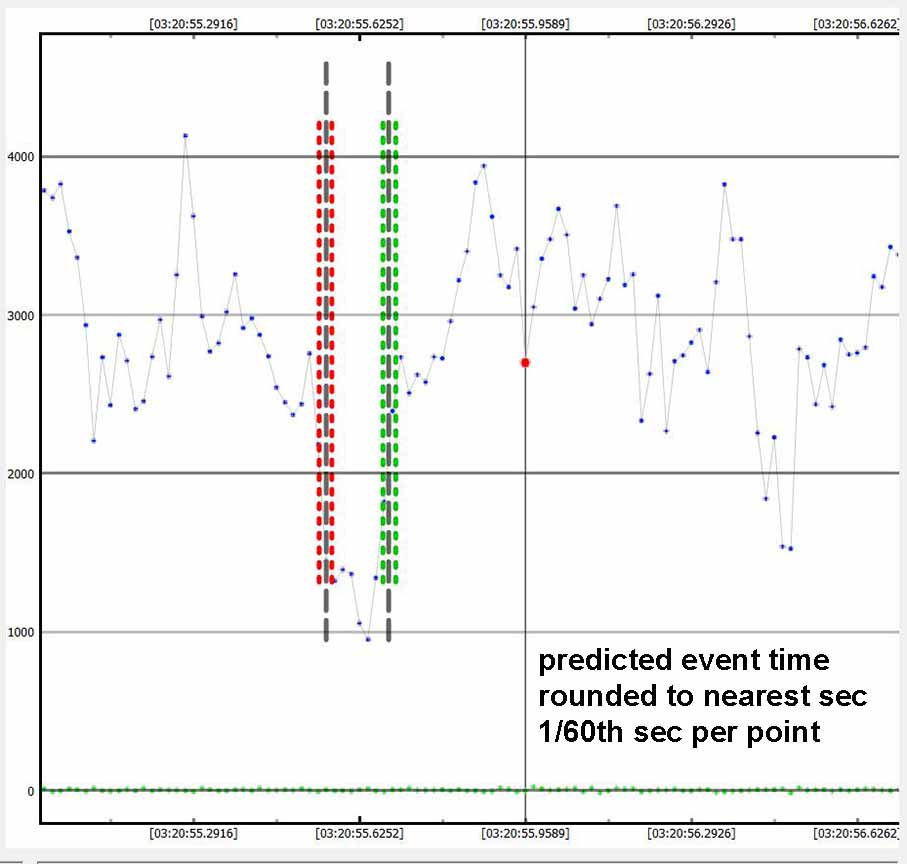
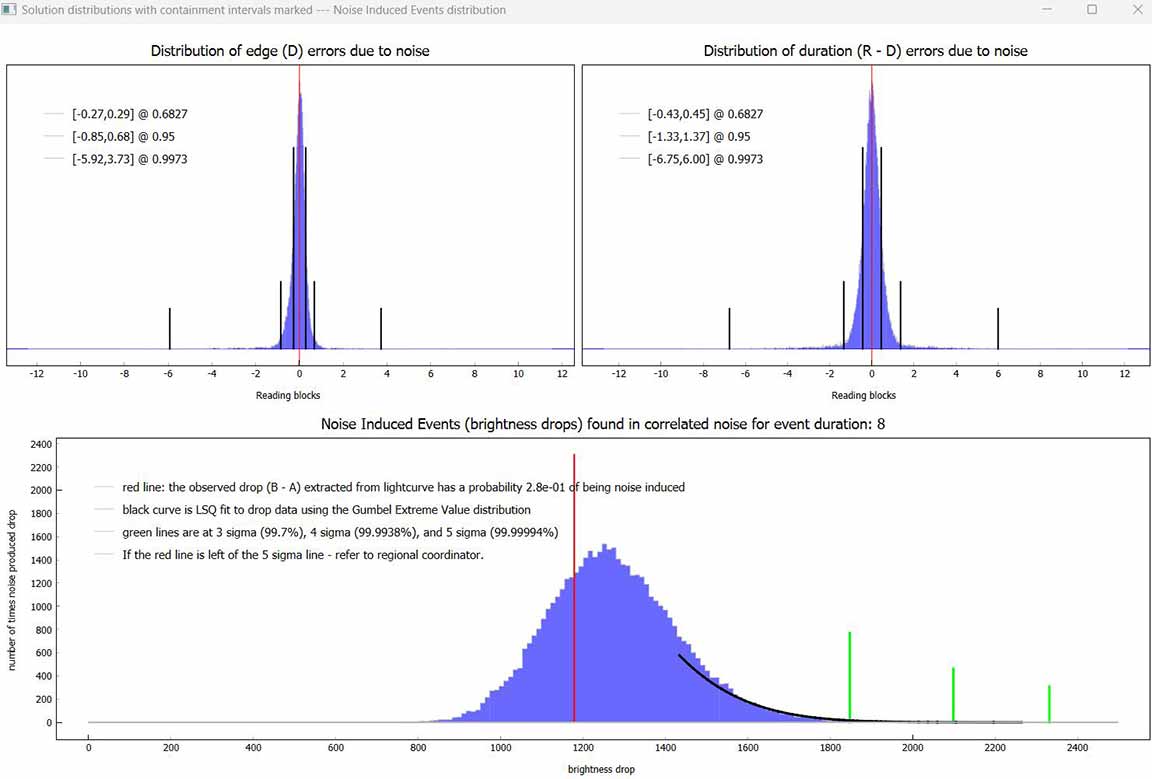
RN: I've examined Karl's recording. No clear reason why his data shows stronger point to point scatter in the seconds before and after the event time, but it does make interpretation of his recording more difficult. If there were no saturation of target pixels, then an occultation should have taken the star magnitude down from 4.0 down to 7.7, or 1/30th of the unocculted magnitude. But there was a lot of saturated pixels, even at Gain=12. Karl did have a drop to half brightness or 0.71 mag drop at the expected time, but immersed in noisy pixels. Still, the profile of the possible event does suggest it is real, since there are 6 consecutive points all close to the same level at 0.71 mag drop. Within 1/2s of the predicted time. However there is another shorter sequence of 4 points near the same level just 1 sec later, judged less significant by PyOTE and not flagged. DNR was 2.78, which is significant. The other argument in favor of it's reality is that I was on the centerline and had a miss, as did Jordan Brown. And Kirk Bender was inside the northern limit by a small amount and also had a miss. Clearly the path shifted by at least 1 path width. Karl was just north of the 1-sigma line. The histogram of the NIE tests doesn't give this event significance standing on its ow with no Bayesian consideration, however. The fact it is at the predicted time and is 50/50 likely at an event-positive location are not factored into PyOTE.
 |
 |
 |
 |
 |